
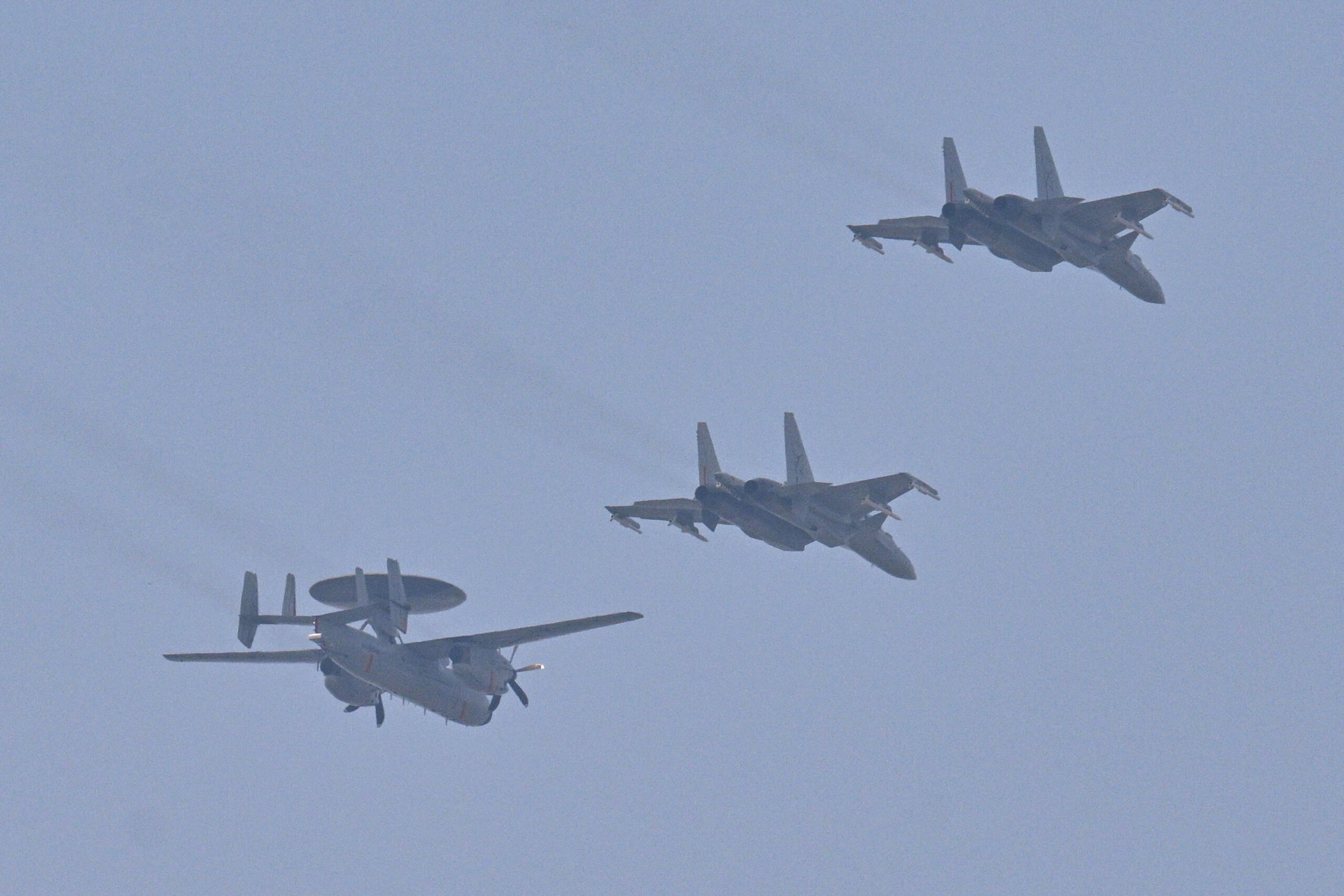
In recent days, Chinese state media Xinhua News Agency revealed the embarrassing situation of the People’s Liberation Army Rocket Force in order to promote the “outstanding Communist Party members” within the military. Subsequently, CCTV of the Chinese Communist Party also disclosed the awkwardness surrounding the carrier-based aircraft KJ-600 and J-15 of the Chinese Navy to promote Yang Yong, a military test pilot recently awarded the first-class merit.
On July 31, in anticipation of the August 1st Chinese Army Day propaganda, Xinhua News Agency announced that Yang Yong of the 91548 unit of the Chinese army was awarded the National Defense Science and Technology first-class merit. However, the brief announcement did not explain why Yang Yong was able to receive this rare first-class military merit.
On July 30, CCTV released a program titled “Achieving Victory,” which mentioned that Yang Yong, a carrier-based aircraft test pilot on the Liaoning carrier, faced challenging situations and risks in his test flights.
On July 31, a post on a mainland Chinese online Q&A platform asked about the background of Yang Yong’s receiving the first-class merit in defense science and technology.
The post detailed Yang Yong’s trials and tribulations in test flights of carrier-based aircraft, highlighting the lack of reference experience, life-threatening moments, and the loss of two comrades during carrier-based aircraft test flights.
In response to the post, netizens discussed the high fatality rate of carrier-based test pilots and the challenges faced by novice personnel within the Chinese military’s early stages in comparison to the more advanced training levels of the US military.
The KJ-600 carrier-based early warning aircraft of the Chinese Communist Party made its first appearance in Beijing’s military parade less than a year ago. Despite claims of successful landings on the Fujian carrier, it quickly returned to Shanghai after a ceremony in Hainan in November 2025. The delayed public training exercises of the Fujian carrier reveal the reality behind the development of carrier-based aircraft within the Chinese Communist Party.
The Chinese military, aware of its technological lag, continues to prioritize hasty advancements and satellite launches, disregarding the lives of its personnel. Many Chinese citizens do not believe the Party’s propaganda and have exposed the harsh realities online, unveiling the truth behind the military’s endeavors.
In a short video released by CCTV on July 31, titled “Fujian Ship Launches KJ-600! Details of the Test Flight Revealed,” provided insights into the risks and challenges faced by pilot Yang Yong. The mission’s description highlighted the courage and risks undertaken to gather valuable data in perilous conditions.
The video emphasized the blank uncertainties faced by carrier-based aircraft test pilots, underscoring the dangers and uncertainties encountered during their missions.
The videos delved into the experiences of Yang Yong in operating the J-15 aircraft from the Liaoning or Shandong carrier, showcasing the challenges faced during takeoff and landing operations, shedding light on the unreliability of the J-15.
The reports by Xinhua and the People’s Liberation Army newspaper emphasized the importance of modernizing the defense and army, a priority set forth by President Xi Jinping during a recent collective study session of the Political Bureau.
The Chinese military’s rush to modernize reflects political ambitions and corrupt practices within the system, magnifying the rhetoric of “high quality” as an empty phrase.
Less than a year ago, reports in certain mainland Chinese news outlets tried to boost the image of the KJ-600 early warning aircraft, implying a superiority over US counterparts. However, the contradictory narratives in Chinese media, including claims of surpassing US capabilities, reveal the ongoing confusion and misinformation within the Chinese military campaigns.
Reports on the successful launch of the KJ-600 from the Fujian carrier highlighted the pilot’s experiences and the split-second decisions made during takeoff. The high-risk nature of operating the KJ-600 was underscored, portraying it as a perilous early warning aircraft.
Acknowledging the limitations of the older models used on the Liaoning and Shandong carriers, the reliance on the J-15 for aerial defenses was revealed to be inadequate, portraying the carriers as underperforming assets within the Chinese fleet.
The development history of Chinese early warning aircraft, including the challenges faced in acquiring advanced technology and reliable platforms, exposes the lagging progress in China’s radar and surveillance capabilities.
The recent disclosure of pilot Yang Yong’s life-threatening experiences in the KJ-600 marks another embarrassing moment in the development of Chinese early warning aircraft. Yang Yong’s meritorious award, achieved at immense personal risk, could be seen as a mockery of the Chinese military’s endeavors.