
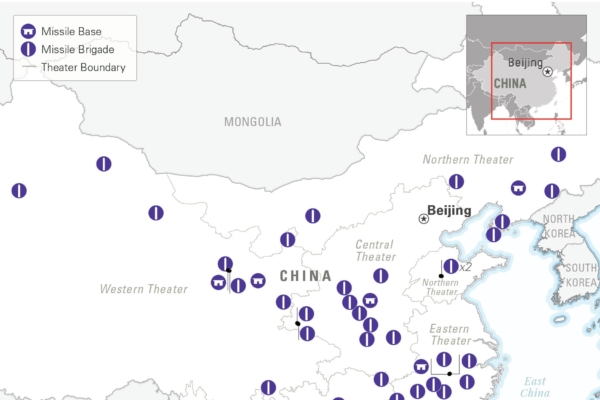
On Friday, May 29, Reuters reported with satellite images that the Chinese Communist Party (CCP) has been expanding missile launch wells and other infrastructure on a large scale in the northwest desert, including launch platforms, bunkers, and communication nodes.
The satellite images reviewed by Reuters show at least three massive military complex facilities taking shape in a remote desert area in China. Near the nuclear missile wells, there are large launch sites, bunkers, and communication node compounds forming an octagonal network structure. These missile wells may be storing the CCP military’s longest-range missiles.
The report indicates that there are over 80 launch platforms and three octagonal facilities in the Chinese desert, possibly used for moving missile launch vehicle fleets and anti-aircraft units.
The newly discovered military infrastructure in the desert is centered around two octagonal facilities built in the eastern part of Xinjiang over the past six years. These two facilities are located southwest of the Hami nuclear missile well, about 140 kilometers and 230 kilometers apart, respectively.
The satellite images reveal that these octagonal complexes include accommodation areas and large parking lots for military vehicles, surrounded by armored bunkers and reinforced weapon storage areas. There are also airports and railway hubs connecting these facilities to the Hami missile wells.
The images also show that in April and May, there was a large military vehicle exercise near the northern octagonal area. Additionally, recent images show large tents, and some analysts believe there are suspected missile launch points hidden in the desert, some equipped with anti-aircraft missile systems.
Three security experts who analyzed the images for Reuters pointed out that some of the facilities shown in the images could be used for deploying mobile anti-aircraft missiles, electronic warfare nodes, or intercontinental ballistic missile launch systems on larger platforms.
Alexander Neill, a researcher at the Pacific Forum think tank in Hawaii, stated that based on satellite images, the large-scale construction of these facilities by the CCP has covered thousands of square kilometers of desert beyond the missile wells.
He believes that Beijing is significantly enhancing and diversifying its strategic nuclear deterrence capabilities.
Although the CCP has the capability to launch nuclear weapons from submarines and aircraft, the missile wells in the deserts of Xinjiang and Gansu remain the core of its nuclear forces.
It is worth noting that these octagonal complexes are strategically located at the core of the road and pipeline networks deep in the desert. These channels connect to concrete launch platforms dispersed between rocks and dry riverbeds.
The scale of the military facilities the CCP is constructing in the desert has astonished seasoned professionals. Hans Kristensen, director of the Nuclear Information Project at the Federation of American Scientists, told Reuters, “I have never seen anything like it – this is an extraordinary engineering feat.”
He stated that while it is difficult to determine how these facilities will be used, considering their vast scale, “almost any possibility cannot be ruled out.” The lines connecting each launch platform may include fiber optic cables for communication.
Kristensen’s analysis indicates that the CCP’s defense scale around the missile wells is significantly different from that of other nuclear powers. For example, the United States and Russia typically rely on a large number of missile wells, relatively hidden locations, and sturdy structures for deterrence, rather than deploying missile defense systems extensively.
Near the northern octagonal facility, analysts also found construction of a facility possibly used for space or microwave communication, featuring satellite antennas and two large towers.
Zhao Tong, an expert on nuclear policy at the Carnegie Endowment for International Peace, stated, “Overall, these octagonal structures and the distinctive towers are likely related to command, control, and communication systems (C3) and may also be used to maintain and store the CCP’s nuclear forces in the Hami intercontinental missile wells.”
Furthermore, south of the Lop Nur nuclear test site, there is a third smaller octagonal facility that appears to be used as a target range. The images show the surrounding ground is full of craters, damaged buildings, and targets believed to be Western fighter jet models.
Some Western senior diplomats and analysts believe that in the event of a conflict over Taiwan, the CCP may use nuclear deterrence to intimidate or limit foreign intervention.
The Chinese Ministry of National Defense did not respond to inquiries about the disclosed nuclear plans and their progress based on related satellite images. The Pentagon stated that they would not comment on intelligence-related matters.