
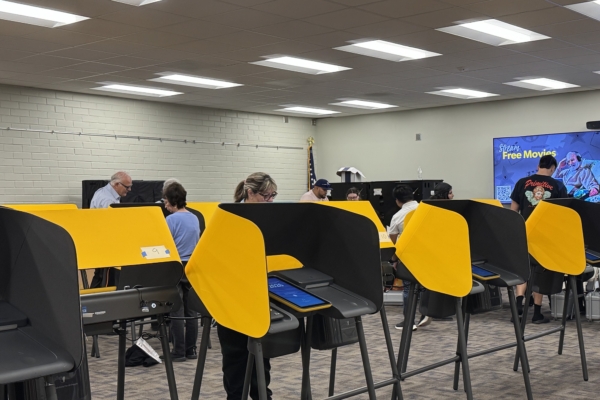
In a recent development in the United States political landscape, the issue of allowing non-citizens to vote has become a highly sensitive topic, particularly in the context of the upcoming elections. This week on Wednesday, the Los Angeles City Council advanced a motion requesting the residents of Los Angeles to vote in November on whether non-citizens should be allowed to vote in local elections, including municipal and school district elections.
The news quickly sparked strong backlash, with even the world’s richest man, Musk, posting on social media platform X, stating, “They are introducing voters to win elections.”
The motion was introduced by Councilman Hugo Soto-Martínez from the 13th District of Los Angeles and was passed with a vote of 10 to 5 during the council meeting on Wednesday.
Soto-Martínez, who took office as a council member in Los Angeles in 2022 and is currently seeking reelection, emphasized the importance of the proposal, highlighting the diverse immigrant communities in Los Angeles, totaling over 1.35 million residents, and their integral connection to the city’s history, identity, culture, and achievements. He argued that expanding voting rights to marginalized groups historically strengthened democratic participation, combated institutional inequities, and drove positive changes.
The motion specifically mentions that if approved by the voters, Deferred Action for Childhood Arrivals (DACA) recipients, legal permanent residents, Temporary Protected Status (TPS) holders, among others, would be allowed to vote, emphasizing the principles of fairness and representation.
Soto-Martínez questioned why temporary workers in Los Angeles should have more say than parents who have lived in the city for decades, whose children attended public schools.
Given Los Angeles’s status as California’s largest city, any changes to its electoral system carry significant weight. The timing of the motion is notably sensitive, as controversies surrounding the city’s mayoral primary election results persist, the Department of Justice has recently announced an investigation into election fraud in California, and allegations have surfaced against a long-time signature gatherer in Los Angeles for paying homeless individuals to register as voters using false addresses.
Despite opposition from five council members, the motion was passed with a decisive majority by the city council.
Critics argue that allowing non-citizens to vote undermines the integrity of the American electoral system, suggesting that citizenship is a prerequisite for faithfully adhering to the rules and responsibilities of being an American citizen in order to exercise voting rights.
Ira Mehlman from the Federation for American Immigration Reform (FAIR) expressed concerns that allowing non-citizens to vote undermines the fundamental concept of citizenship and the meaning of being a member of American society, highlighting that the privilege of voting in elections is an inherent right reserved only for American citizens.
According to estimates from the Center for Migration Studies, California is home to approximately 80,000 TPS holders, mainly from countries like Venezuela, Haiti, Afghanistan, and Ukraine, with over 30,000 residing in the Los Angeles-Long Beach-Anaheim metropolitan area.
Criticism and debates over the issue have flooded social media platforms, with some residents expressing strong opposition to the proposal. Concerns have been raised regarding the potential for foreign influence and manipulation in local elections, leading to negative impacts on the country and its electoral processes.
While the Mayor of Los Angeles, Karen Bass, has yet to comment on the voting rights proposal, her opponent in the reelection campaign, Nithya Raman, voted in favor of the motion.