
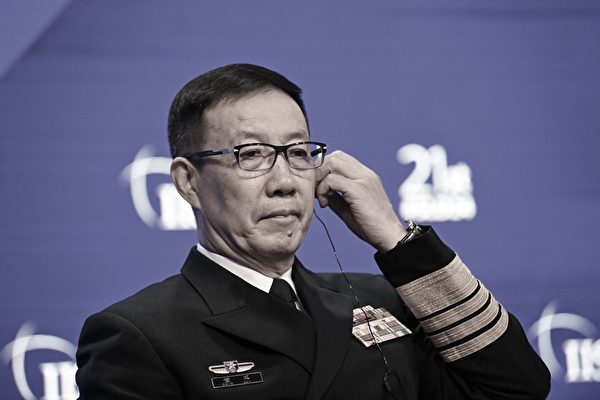
Amidst the power struggle within the Chinese Communist Party (CCP), the attention on Minister of National Defense Dong Jun continues to grow. Dong’s absence from the Shangri-La Dialogue held in Singapore at the end of last month has sparked speculation. However, he has been actively involved in recent foreign visits, including accompanying Xi Jinping and his wife’s visit to North Korea. Analysts believe that this may indicate the resurgence of the influence of the “wife’s clique” within the military following the downfall of Vice Chairman of the Military Commission Zhang Youxia.
On June 8th and 9th, Dong Jun made a high-profile visit to North Korea with Xi Jinping and Peng Liyuan, participating in various meetings.
Independent commentator Cai Shunkun posted on X Platform, stating that this at least shows that Dong Jun has not been marginalized as rumored by outsiders by Xi Jinping.
On June 1st, Dong Jun visited South Africa. In March and April this year, he also visited Vietnam, Russia, Kyrgyzstan, and attended the meeting of the SCO Defense Ministers.
Dong Jun, a member of the 20th Central Committee of the CCP, was appointed as the new Minister of National Defense on December 29, 2023, after the downfall of Li Shangfu. It was suggested that his promotion was related to his connection with Xi Jinping’s wife, Peng Liyuan, as both are natives of Shandong.
Many opinions suggest that Dong Jun’s promotion from Navy Commander to Minister of National Defense was recommended by the former Director of the Political Work Department of the Central Military Commission, Miao Hua. Dong Jun was a former subordinate of Miao Hua when he served as the Political Commissar of the Navy. Miao Hua, a close confidant of Xi Jinping, was expelled from the party and the military in October of last year.
The Financial Times reported on November 27, 2024, that the CCP authorities had launched an investigation into Dong Jun. However, during the press conference of the CCP’s Ministry of National Defense the next day, spokesman Wu Qian proactively announced that Miao Hua was “suspended for investigation,” denying the allegations of Dong Jun being investigated.
Since assuming the position of Minister of National Defense, Dong Jun has not been promoted to the Central Military Commission or the State Council, making him the lowest-ranking Minister of National Defense since the establishment of the CCP. During the 20th Fourth Plenary Session in October last year, the Central Military Commission only appointed Zhang Shenmin as Vice Chairman, while Dong Jun did not enter the Military Commission. However, amidst the internal turmoil within the CCP military in the past three years, many active senior generals have been ousted, while Dong Jun remains a survivor so far.
China expert Li Lin analyzes that there are approximately four reasons why Dong Jun has not faced any consequences so far:
First, his close relationship with Peng Liyuan may genuinely exist, offering him protection; Second, he may have cooperated with investigations to ensure his survival by, for example, providing information about Miao Hua; Third, due to the strategic and diplomatic needs of the authorities, in the face of deteriorating geopolitics, Xi Jinping needs someone responsible for military diplomacy; and lastly, Xi Jinping’s aggressive cleansing may have prompted the delayed handling of Dong Jun’s issues, as the leadership is focusing on overcoming the vacuum left by the downfall of Zhang Youxia and He Waidong, unable to ensure Dong Jun’s safety for now.
Li Lin’s latest analysis suggests that Dong Jun’s high-profile appearances may indicate that following Zhang Youxia’s downfall, Peng Liyuan has regained control behind the scenes, leading to the resurgence of the “wife’s clique” within the military, potentially causing further unrest among military ranks.
Legal scholar Yuan Hongbing, residing in Australia, revealed to “Seeing China” on February 23 that Xi Jinping has long been operating a “husband-wife shop” within the military. Peng Liyuan holds significant authority as a full-time member of the Central Military Commission’s Cadre Selection Committee. Previously, the promotion of senior military officials in the CCP military largely sought her input, causing dissatisfaction among military generals.
The influential figure within the military, Zhang Youxia, was seen as an obstacle to Peng Liyuan’s control over military power.
Yuan Hongbing disclosed that amidst the downfall of He Waidong, Miao Hua, and others, Zhang Youxia openly criticized the serious mistakes in appointing senior military officials during an expanded Military Commission meeting, demanding a more democratic appointment process and criticizing the operation of the “husband-wife shop.” Zhang Youxia and Liu Zhenli jointly submitted a list of over 70 names of generals, claiming to represent the “will of the military” from over 100,000 military officers. This move was seen as a direct challenge to Xi Jinping’s ultimate authority in military appointments.
Independent commentator Du Zheng previously analyzed in “Shang Bao” that a serious internal conflict erupted between Zhang Youxia, another Vice Chairman of the Military Commission, He Waidong, and Miao Hua. He Waidong and Miao Hua were believed to be closely associated with Peng Liyuan, serving as her agents in manipulating military personnel affairs.
Du Zheng stated that Xi Jinping later relied on the help of Zhang Shenmin, the Secretary of the Military Discipline Commission who betrayed Zhang Youxia, to suddenly take down Zhang Youxia and his ally, Liu Zhenli.
Du Zheng recently predicted in the Taiwanese media “Shang Bao” that under Peng Liyuan’s resurgence in interference in military personnel affairs in Xi Jinping’s administration, Dong Jun of the “wife’s clique” may be considered for another Vice Chairman position within the Military Commission, or at least be appointed as a member of the Military Commission. However, after three years of turmoil, it remains uncertain whether the Central Military Commission can reach its full capacity in the near future, pending the selection and approval of new personnel in the military hierarchy.