
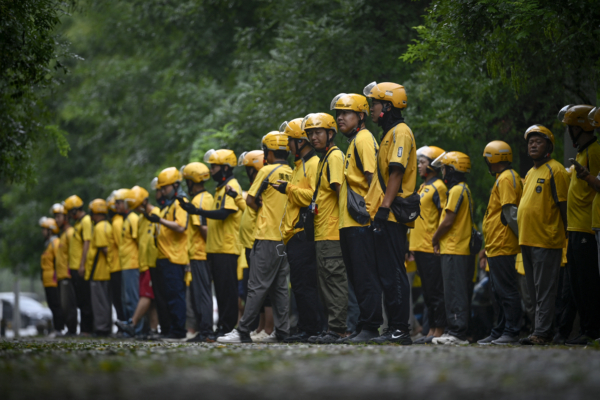
With the economic downturn continuing, the employment situation in China is worsening. The latest data shows that the number of “flexible employees” is expected to reach 320 million this year, drawing widespread attention and remaining a hot topic.
Recently, the China New Employment Forms Research Center released the “2025 China Blue-Collar Employment Research Report,” which indicates that the size of China’s blue-collar workforce is expected to reach about 427 million by 2025. Among them, the number of domestic service workers is expected to increase by 4% to reach 46.8 million, and the number of food delivery workers is expected to increase by 6% to reach 15.9 million. The report, based on 28,450 valid samples, covers various groups such as food delivery workers, domestic service workers, truck drivers, online streamers, couriers, manufacturing workers, construction workers, cleaners, and security personnel.
The report also reveals that the number of flexible employees in China is expected to increase from 280 million in 2025 to 320 million in 2026. Considering the total employment population in China at the end of 2025 was 725 million, this means that over 44% of people are in a flexible employment status.
Since the release of this report, it has continued to generate interest. On June 9th, the topic labeled “China’s flexible employment reaches 320 million” trended on Weibo, with netizens from different backgrounds expressing their frustrations.
Some have commented, “There are mainly two aspects in my observation: those over 40 and those outside the system are especially unemployed. I participated in a headhunting training before, and they said half of my friends in the circle are not working. Some are voluntarily out of work while others are involuntarily. This includes those affected by the retreat of foreign companies, industry cycles, economic downturns affecting budgets; to be honest, the impact of AI is currently not high.”
Another aspect is the recent university graduates, who find it extremely difficult to secure employment if they do not enter factories or the formal system. Whether they studied abroad or graduated domestically, it is challenging to find office jobs.”
A financial blogger and Weibo influencer, “Quantitative Analysis Official,” shared, “Let me offer my observation. I am around 35 years old, and from my observation of classmates and friends of the same age, around 1/3 have already withdrawn from the regular labor market, perhaps becoming stay-at-home parents, helping with family matters, choosing not to work or traveling everywhere. Even with my decent educational background, people around me are still in such situations.”
Some netizens mocked the officials for their ability to create new terms, saying, “Who came up with ‘flexible employment’? Quite distinctive.” And, “It’s just a word game.” Or, “Quite good at creating new terms.” Furthermore, they joked, “‘Flexible employment’ = unemployment. So familiar, right?” While some criticized, “Saying ‘unemployment’ as ‘flexible employment’ doesn’t change anything. Let’s not make everyone laugh; can’t we face the reality that many can’t do it now?”
Others pointed out, “The so-called ‘flexible employment’ means being unemployed, as those with stable job income would not choose the uncertainties of ‘flexible employment’.” And, “In reality, 44% is unemployed.” Also, “Some of the unemployed may not be able to transition to ‘flexible employment.’ If 44% are unemployed, this unemployment rate could lead to chaos.”
Some netizens urged the authorities to take action, saying, “Based on the total population, over 40% are in flexible employment. This proportion is too high! So either provide policy support for flexible employment or quickly develop private enterprises to offer more jobs and reduce the proportion of flexible employment.”
According to the official stance of the Chinese National Bureau of Statistics, flexible employees are defined as individuals who engage in labor for at least 1 hour per week to earn labor compensation or operating income. Flexible employees are an important part of the “urban employed population” for combined calculation purposes.
According to official annual reports, the number of flexible employees was around 120 million in 2015. After the outbreak of the pandemic in 2020, the number rapidly increased to 200 million, reaching 240 million in 2024.