
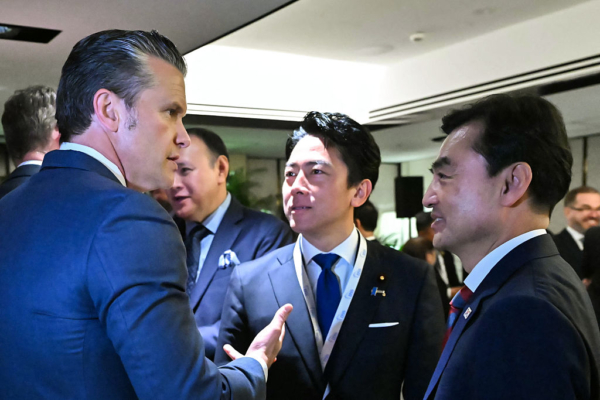
Japan’s efforts to strengthen its defense capabilities, despite facing criticism from the Chinese Communist Party, have received support from the United States. During a meeting in Singapore on Saturday (May 30), Japanese Defense Minister Taro Kono and U.S. Defense Secretary Hagerty reached multiple agreements, including temporary deployment of U.S. missile capabilities in Japan and accelerating joint missile development and production.
The two defense ministers held a meeting during the Shangri-La Dialogue security conference in Singapore. They emphasized the need to expedite joint missile research and development between the two countries as well as advancing missile defense data sharing.
Kono briefed Hagerty on the various measures taken by the Japanese government to enhance its defense capabilities, which was well received by Hagerty. Kono stressed the importance of further strengthening the deterrence and response capabilities of the Japan-U.S. alliance.
According to a statement released by the Pentagon, the two defense ministers reiterated the crucial role played by the U.S.-Japan alliance in maintaining peace in the Indo-Pacific region. They discussed Japan’s strategic document review situation and the efforts made by Japan to rapidly enhance its defense capabilities and increase defense spending.
The two defense ministers also discussed upcoming bilateral activities, which are part of the comprehensive efforts to enhance combat training and exercises in Japan. They agreed to temporarily deploy U.S. land-based missile capabilities to Japanese Self-Defense Force bases, and strengthen flexible aerial dispersal access and drills, while committing to advancing deployments in the Southwest Islands of Japan.
Furthermore, they reiterated the importance of continuing concrete and practical trilateral cooperation with Australia, and praised the establishment of an air defense and missile defense data-sharing framework among the three countries.
Hagerty and Kono also discussed the importance of increasing missile production to meet critical air defense needs.
The Japanese Ministry of Defense also issued a similar statement. Hagerty informed Kono that the U.S. supports Japan’s efforts to enhance its defense capabilities, increase regional deterrence, and further maintain regional peace and stability. The two also held extensive discussions on regional affairs, including issues related to China.
Regarding Japan’s strengthening of defense capabilities, the stance of the United States is starkly different from that of the Chinese Communist Party. China has consistently opposed these efforts and accused Japan of “new militarism” and “remilitarization.” The Japanese government, however, refuted these claims, stating that its policy remains “fully defense-oriented.” Instead, it pointed out that China’s military actions in the region have “aroused serious concerns in the international community.”