
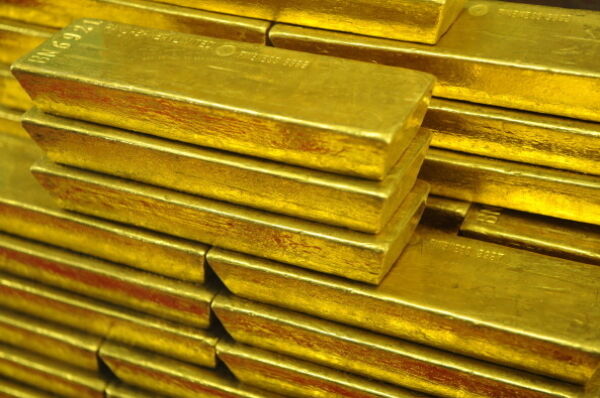
In recent days, international gold prices have continued to plummet significantly. On June 8th, the international gold price fell below $4300 per ounce. Despite the fact that prices of various brands of gold jewelry in China have dropped by around 400 yuan per gram from the peak earlier this year, a decrease of 23%, the anticipated buying frenzy in the market has not materialized, with most jewelry stores still seeing low foot traffic. Analysts believe that consumers are generally concerned about the possibility of further price declines in gold, preferring to wait and see rather than rushing to make purchases.
As gold prices rapidly decline, market adjustments are also deepening. Since June 4th, international gold prices have entered a new round of decline. On June 8th, the international gold price dropped below $4300 per ounce. As of June 8th, the domestic spot price of 99.99% pure gold was 944.5 yuan per gram, representing a cumulative decline of 7.45% since early May.
In terms of gold jewelry prices in mainland China, prices per gram have dropped by about 400 yuan from their peak earlier this year, a decline of about 23%. Mainstream brands of solid gold jewelry have seen prices fall to the range of 1315-1323 yuan per gram. Looking at the price trends, whether it’s international gold prices or domestic retail gold jewelry prices, they have both essentially returned to the levels of December 2025.
A report from “Henan Business Daily” on June 8th stated that as international gold prices fell below $4400 per ounce on June 5th, domestic brand gold jewelry prices also followed suit. This sharp decline has wiped out all the gains made earlier this year, bringing both international gold prices and domestic gold jewelry prices back to the levels of December 2025.
With the new round of gold price declines that started on June 5th, by 5 p.m. on June 6th, customers crowded in front of various counters at Zhengzhou Jindu Yindu Jewelry Plaza to take advantage of the low prices. Some people came in with their entire families, making bulk purchases.
Sisi, a staff member at Liu Hui Jewelry, noted that there has been a noticeable increase in customers visiting the store in recent days. However, there has been a significant change in buying patterns: “There are far more people buying jewelry than buying gold bars, and most of them are purchasing products with large weights, such as large gold bracelets or three-gold and five-gold items.”
While the gold counters are bustling with activity, the other end of the precious metals market appears unusually quiet. Shop assistants have mentioned, “Silver bars have broken everyone’s hearts; they are basically being left untouched.”
Alongside the differentiation in the retail sector, there has been a simultaneous adjustment in the capital markets. On June 8th, as international gold prices fell below $4300 per ounce, with further declines in gold prices, the domestic gold sector encountered indiscriminate selling. By the market close, mainland A-share stocks such as Sichuan Gold and Shanjin International fell by 8% and 7% respectively; Hong Kong stock gold retail companies led the decline, with Datang Gold falling by over 10% and Zijin Gold International by 8.7%. Lao Pu Gold fell 5.4% to 473 Hong Kong dollars, more than halving from its 52-week high of 1108 Hong Kong dollars; Chow Sang Sang fell by 4.4% and Tse Sui Luen by 5.7%.
As of June 8th, domestic gold jewelry prices have dropped by about 400 yuan per gram from their peak earlier this year, but consumers are apprehensive that the downward trend may continue. The market is showing a pattern of “the more it falls, the fewer people buy” on both the consumer and investment sides.
In a report by “First Financial Daily” on June 8th, at the retail end, brands such as Chow Sang Sang, Lao Mei Huangjin, and Lao Fengxiang have significantly lowered their gold jewelry prices, which are currently priced at around 1300 yuan per gram, representing a 23% decline compared to the peak earlier this year. However, the stores have not seen the expected buying frenzy; instead, foot traffic remains scarce.
The topic of “gold jewelry prices falling by 400 yuan, but no one is buying” has been trending on Weibo recently, sparking widespread discussion.
Many netizens commented that even though gold jewelry prices have dropped by 400 yuan, it’s not like gold prices have fallen to 400 yuan, so they continue to wait. “Currently priced at around 1300 yuan per gram, it’s still expensive.”
Some voices have mentioned, “Buy high, don’t buy low; the more it falls, the more people wait to bottom out.”
A Weibo user named “Lao Niu Huixian Guang” stated that despite the decline in gold prices, the counters are not as lively as imagined, indicating a change in consumer attitudes. People no longer just look at the price per gram of gold when buying; they also consider labor costs, liquidity, depreciation, and cyclical positions. Gold still holds attraction, but after reaching high levels, rationality is more valuable than impulsiveness.
Another Weibo member, “Jing Gang Exclusive,” pointed out that as gold prices continue to fall, everyone is tightening their wallets and waiting. Many people now monitor gold prices every day, hoping it will drop to 500 yuan per gram before making a purchase. The Shuibei market in Shenzhen is notably quiet, with sales on the previous day of two kilograms of gold now just attracting onlookers; there are very few actual buyers. The market conditions are so poor that some businesses are even considering exiting the market altogether.