
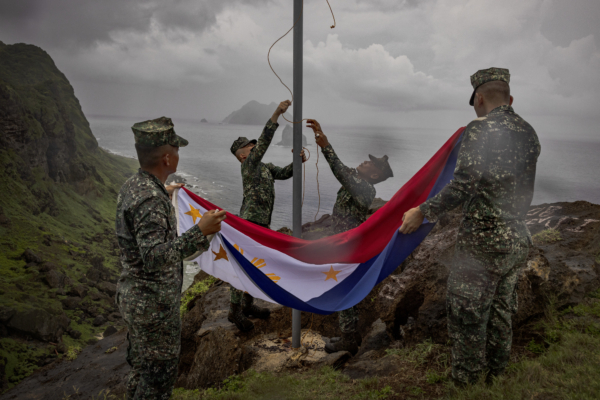
The Philippine military, the Japan Maritime Self-Defense Force, and the US military conducted joint exercises in the Bashi Channel for the first time starting on February 23. This exercise marked the first time Japan deployed its Self-Defense Force aircraft in the area. China expressed dissatisfaction with the exercise on Friday, February 27.
In a statement, the Philippine military mentioned that the military aircraft of the US, Japan, and the Philippines conducted reconnaissance exercises over the northernmost Philippine island of Batanes, aiming to demonstrate the seamless coordinated combat capabilities of the three parties in complex maritime environments.
According to Agence France-Presse (AFP), the joint exercise, known as the Multilateral Maritime Cooperation Activities (MMCA), expanded its scope beyond the South China Sea for the first time. Previously, the Philippines and China have had multiple conflicts in the South China Sea due to territorial disputes, with particularly intense clashes on Scarborough Shoal.
The four-day joint military exercise involving the US, Japan, and the Philippines concluded on Thursday, February 26. The exercise included live firing drills conducted by the Philippine Navy missile frigate BRP Antonio Luna. The distance between the Philippines and Taiwan, which practices self-governance, is about 100 kilometers (60 miles).
The Philippine military stated that “the aerial operations took place over Philippine territory and territorial waters north of Luzon Island,” adding that the naval vessels of the three countries remained in the waters west of Batanes Island. The statement also mentioned that the operational area extended to “the northern tip of Luzon Island, particularly Mavulis Island,” the northernmost point of the Philippines, where a small contingent of the Philippine Navy and Marine Corps is stationed.
Colonel Xerxes Trinidad, Public Affairs Chief of the Armed Forces of the Philippines, told AFP that this was the “first time” the MMCA operation was conducted in that specific operational area.
On February 27, a spokesperson for the Southern Theater Command of the People’s Liberation Army (PLA) claimed that the Philippines’ efforts to engage in “joint patrols” with foreign countries were actions that undermine regional peace and stability. He also alleged that the PLA Navy organized “routine patrols” in the South China Sea from February 23 to 26.
Due to China’s persistent inclination towards using force against Taiwan and conducting multiple encirclement exercises in recent years to coerce the island nation, Japan’s Prime Minister hinted in November last year that Japan might intervene militarily if Taiwan is attacked, a statement that stirred discontent from China.
Subsequently, China imposed export restrictions, warned its citizens against traveling to Japan, and accused Japan of reviving militarism.
On February 24, Japanese Defense Minister Taro Kono announced that Tokyo plans to deploy a medium-range surface-to-air missile system in Okinawa Prefecture near Taiwan by March 2031. The day before, on February 23, invoking national security reasons, China imposed export control measures on 20 Japanese companies and entities.