
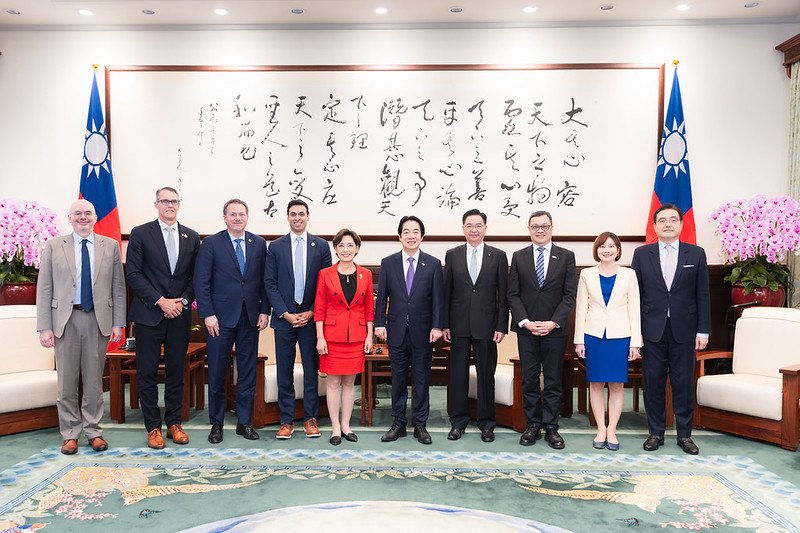
In recent news from August 1, 2026 – President Tsai Ing-wen of the Republic of China met with Young Kim, Chair of the Asia-Pacific Subcommittee of the United States House Committee on Foreign Affairs, on July 31. During the meeting, President Tsai expressed his hope for Taiwan and the United States to collaborate in building a secure and reliable non-red supply chain, while jointly developing the unmanned aerial vehicle industry. Young Kim mentioned that, based on the ongoing conflicts in Ukraine and Iran, Taiwan requires extensive procurement and manufacturing of drones.
The visit by the members of the United States House Committee on Foreign Affairs Asia-Pacific Subcommittee, including Young Kim, Suhas Subramanyam, Michael Cloud, and Randy Feenstra, signifies the strong relationship between Taiwan and the United States. President Tsai stated that it was a pleasure to reunite with Chair Young Kim, highlighting the consistent support of the U.S. Congress for Taiwan. He expressed sincere gratitude on behalf of all Taiwanese for the unwavering backing from the American lawmakers.
As the United States commemorates its 250th anniversary and Taiwan celebrates the 30th year of direct presidential elections, President Tsai emphasized the significance of safeguarding democratic values. He acknowledged the bipartisan support from the U.S. Congress towards Taiwan and expressed gratitude towards Young Kim for her continuous efforts in advancing pro-Taiwan legislation, fostering deeper Taiwan-U.S. partnership and enhancing collaboration opportunities.
Amid increasing military pressure from the Chinese Communist Party, President Tsai reiterated Taiwan’s firm stance on upholding peace and stability in the Taiwan Strait. Emphasizing the importance of national defense, he affirmed Taiwan’s commitment to bolstering defense budget, enhancing societal resilience, and intensifying cooperation with democratic allies to deter aggression and confront threats effectively.
President Tsai highlighted the crucial role of unmanned aerial vehicles in modern defense, recognizing the global demand for secure and reliable supply sources. Leveraging Taiwan’s strengths in semiconductor, information communication technology, and precision manufacturing, he identified the emerging opportunities in the development of the drone industry.
In addition to proposing a special budget for unmanned aerial vehicles procurement, the government is actively promoting drone production based on defense requirements. Taiwan’s achievement in aligning with international standards and safeguarding critical technologies through rigorous cybersecurity evaluations demonstrates its readiness to collaborate with the U.S. in creating a secure non-red supply chain and advancing drone industry development to meet defense and international market demands swiftly.
President Tsai extended appreciation for the long-term support from the U.S. Congress and government across various aspects such as democratic values, regional security, and technological cooperation. He attributed Taiwan’s progress to the consistent backing from the American legislative and executive branches. Concluding his remarks, he welcomed Young Kim and all visiting delegates once again, underscoring the commitment to deepen Taiwan-U.S. cooperation for peace, stability, and prosperity in the Indo-Pacific region.
During her address, Chair Young Kim expressed gratitude to President Tsai for the warm reception and emphasized the bipartisan nature of the congressional visit, representing states like California, Virginia, Iowa, and Texas with strong economic, trade, and cultural ties with Taiwan. She underscored the paramount importance of Taiwan’s security and freedoms in the Indo-Pacific region and to the United States in countering the threats posed by the Chinese Communist Party.
Asserting the necessity of joint efforts to confront these challenges, Young Kim stressed the significance of Taiwan’s concrete actions in enabling greater U.S. support. She acknowledged Taiwan’s achievements in seeking peace through strength and commended the commitment to elevate defense spending to 5% of GDP, including the recent approval of the $25 billion “Defense Special Bill.”
Young Kim commended Taiwan’s initiative in proposing the “Defense Autonomous Unmanned Vehicle Procurement Special Act.” Given the urgency highlighted by recent conflicts in Ukraine and Iran, she urged swift enactment of comprehensive legislation for unmanned aerial vehicles to meet Taiwan’s procurement and manufacturing needs.
Furthermore, Young Kim emphasized that the unmanned aerial vehicles legislation should mark the beginning rather than the end of Taiwan’s defense efforts. Every new defense measure, including enhancing reserve force capabilities, will strengthen the resolve of free people globally to resist the Communist Party of China’s malevolent intentions.
Acknowledging the increased pace of U.S. arms sales to Taiwan and efforts to facilitate Taiwan’s participation in international organizations, support diplomatic allies, formulate economic crisis strategies, and promote bilateral tourism exchanges, she highlighted the continuous support from the U.S. Congress for Taiwan. She concluded by expressing gratitude for the hospitality of the Taiwan government and anticipated further discussions and exchanges in the future.