
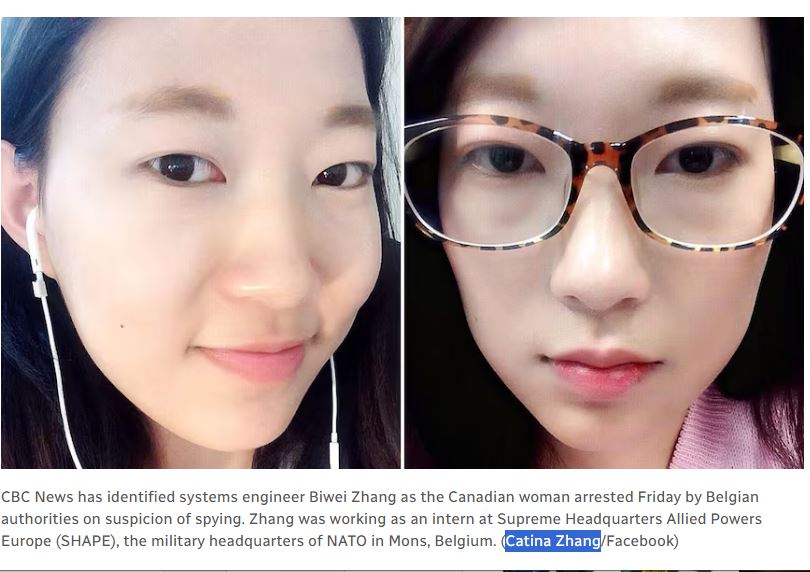
According to a CBC investigation, a Canadian Chinese woman named Claire Z., who is suspected of engaging in espionage activities during her internship at the NATO military headquarters, is likely Biwei Zhang. She is a systems engineer with an economics background and is believed to have worked for multiple Canadian government agencies before her internship at the NATO military headquarters in Belgium.
Last Saturday, Belgian authorities announced the arrest of this woman interning at the Supreme Headquarters Allied Powers Europe (SHAPE) of NATO, on suspicion of engaging in espionage activities for a third country, with no bail before trial. According to a report by the Canadian Broadcasting Corporation (CBC), the investigation revealed that the woman is Biwei Zhang, a systems engineer with an economics background, whose online resume shows she had worked for the Canadian Space Agency and Statistics Canada.
Biwei Zhang’s publicly available personal and professional information matches the information provided by Belgian prosecutors. The prosecutor described the suspect as a “Canadian citizen of Chinese descent” who interned at the Supreme Headquarters Allied Powers Europe (SHAPE) in Mons, Belgium.
During the criminal investigation, the identity of the defendant will not be disclosed by the Belgian court. CBC used open-source investigation techniques to compare the Belgian authorities’ description with Biwei Zhang’s identity information on LinkedIn, Facebook, and Threads profiles, as well as her graduate thesis and a federal court case.
In July 2025, Biwei Zhang posted in two different Facebook groups that she was looking for rental accommodations in Mons to begin her internship. In 2023, she was also looking for housing in Geneva as she was about to intern at the World Trade Organization. These dates align with the work experiences listed on her LinkedIn profile.
These details also correspond to information previously reported by Reuters. A security source told Reuters that Claire Z. worked in the IT department at NATO SHAPE. This aligns with Biwei Zhang’s background in computer science and systems engineering; she obtained her master’s degree in the field at the University of Ottawa in 2022.
The source mentioned Claire Z. is “not a student” and is in her “thirties”. This information is consistent with Biwei Zhang’s professional background; her Facebook username is “biwei.zhang.93”, indicating she may have been born in 1993, making her 32 or 33 years old.
Belgian officials stated that Claire Z.’s pre-trial detention will last at least one month, with ongoing investigations. Therefore, her identity details will not be disclosed during this period.
This case has raised concerns about the effectiveness of Canada’s security clearance procedures, prompting the Federal Public Safety Minister Gary Anandasangaree to commit to investigating whether the individual has worked for any Canadian institutions.
“We need to thoroughly investigate this matter to ensure such incidents do not reoccur,” Anandasangaree said.
Biwei Zhang’s LinkedIn profile shows she held various positions in Canadian federal institutions, including working as a data scientist at the National Research Council (NRC) for 6 months in 2017, an economist at Statistics Canada from April 2018 to October 2022, and a systems engineer at the Canadian Space Agency (CSA) from May 2022.
Other experiences listed by Biwei Zhang include serving as a policy analyst in economic research and statistics at the European Space Agency (ESA) and the World Trade Organization (WTO) and working at the Standards Council of Canada (SCC) in the “mirror committees” (MCs), whose main responsibility is to integrate diverse Canadian opinions to form the official Canadian stance and represent Canada in international standard-setting work.
Biwei Zhang had sought a judicial review of a decision by the Public Service Commission of Canada, which found her guilty of fraud when applying for a position at the Canada Border Services Agency (CBSA) for using two different names and email addresses in her application and failing to clarify whether she submitted multiple applications. In April 2014, a federal judge dismissed her request for judicial review.
Dan Stanton, a former intelligence officer at the Canadian Security Intelligence Service (CSIS), told CBC that he had no direct knowledge of the case but understands why NATO would be concerned about potential intelligence leaks.
Stanton currently serves as the National Security Program Director at the Professional Development Institute at the University of Ottawa. He mentioned that for organizations like NATO, intern positions are a “prime entry point”.
“The most significant secrets in espionage are often obtained not by stealing documents or accessing databases, but through conversations and eavesdropping,” he said.
Regarding NATO’s arrest operation, Stanton stated that it is good news, indicating that “our processes are effective”.