
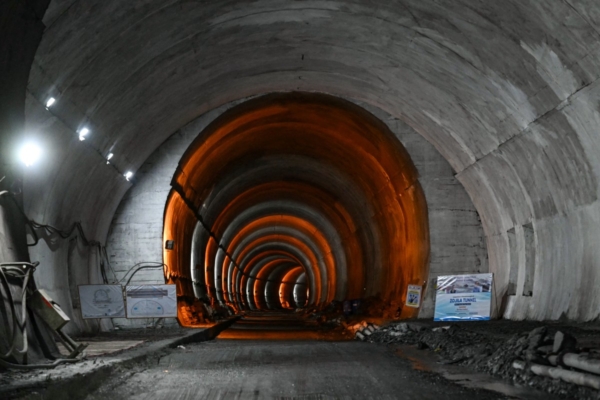
India recently completed a major strategic project in the Himalayas. On Tuesday, June 9th, the final section of rock was drilled through to connect the strategic Zojila Tunnel. This milestone progress signifies that in the future, the Indian military can access the Ladakh front-line region bordering China seamlessly and at all times.
In 2020, there was a bloody clash between Chinese and Indian troops along the Line of Actual Control (LAC) in the Galwan Valley in eastern Ladakh. Although relations between the two countries have somewhat improved since then, the 3,500-kilometer border remains the root of tension between them.
Given Ladakh’s strategic position with China to the east and Pakistan to the west, the significance of the Zojila Tunnel is immense for India’s security. Once operational, the tunnel will greatly enhance the mobility of Indian forces in the region and improve equipment transport efficiency. According to “India Today,” travel time between Jammu and Kashmir and Ladakh is expected to be reduced from around three and a half hours to just 20 minutes upon the tunnel’s completion.
As a core part of India’s large-scale infrastructure development plan, the Zojila Tunnel will be integrated with the local road and rail networks. This integration will allow for uninterrupted movement of trade goods, troops, and supplies from India’s hot lowland plains to the snowy border areas throughout the year.
India’s Minister of Road Transport and Highways, Nitin Gadkari, emphasized during the tunnel’s breakthrough ceremony on Tuesday, that “this is not just a tunnel but a lifeline.” The tunnel aims to significantly improve traffic between Srinagar (the main city in the Indian-controlled Kashmir) and Leh (the core city of Ladakh). Currently, the road between these two cities is frequently blocked by heavy snowfall during winter, often exceeding truck heights.
The 13.15-kilometer long tunnel passes beneath the 3,528-meter high Zojila Pass. Since construction began in 2020, over 3,000 workers have been involved in the excavation. With the successful final blast, India’s longest and the world’s highest-altitude two-lane bidirectional highway tunnel has been officially connected, solving the historical challenge of isolation due to heavy snow between the two regions during severe winter.
However, as reported by “News18,” including approach roads, bridges, and related facilities, the total length of the entire project is about 31 kilometers. This includes the Nilgrar tunnel group consisting of two twin-tube tunnels (457.35 meters and 1,953.63 meters in length respectively), serving as critical access corridors leading to the main tunnel. Additionally, the project includes 2.35 kilometers of cut-and-cover structures, a 450-meter snow protection shed, and three large bridges totaling 460 meters in length.
The tunnel’s ventilation and safety systems also demonstrate extremely high technical complexity. Since the tunnel does not have dedicated escape adits, engineers have constructed three large vertical shafts inside the mountain for ventilation and emergency purposes. The shaft on the west side penetrates the mountain to a depth of 474.3 meters, making it India’s longest vertical shaft currently in operation.
Project engineer Manmohan Singh told AFP that over the past few years, the team worked tirelessly day and night in extreme adverse weather conditions to excavate the tunnel, achieving successful breakthrough without any accidents.
The tunnel is one of four major tunnel networks planned by India, including the 6.5-kilometer Sonamarg Tunnel, with the entire network set to be fully operational by 2028. Additionally, India has invested $3.9 billion in constructing a railway line connecting the lowland plains to the Indian-controlled Kashmir, which includes the world’s highest Chenab Rail Bridge.
The railway spans 272 kilometers starting from the Northern Army Command Headquarters in Udhampur, passing through Srinagar, and was inaugurated by Indian Prime Minister Narendra Modi in June 2025.
Since gaining independence from British rule in 1947, the Kashmir region with a majority Muslim population has long been subject to a divided control between India and Pakistan, with both claiming full sovereignty over the area.