
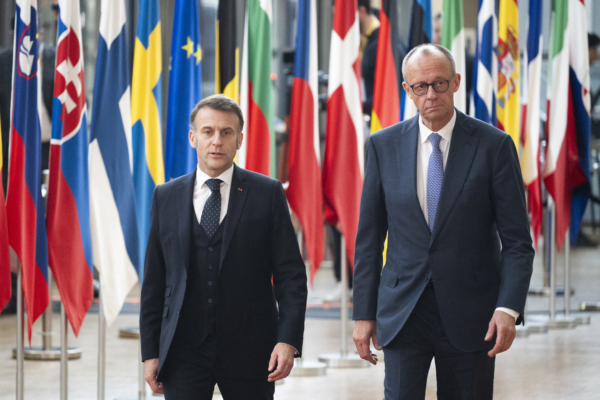
Germany is teaming up with France to push the European Union to establish stronger trade defense tools in response to the sharp increase in low-priced imports from China that are impacting European industries. This marks a growing consensus between the two major economies in the EU on the issue of trade with China, preparing to take a tougher stance to protect European industries and jobs.
According to reports from the Financial Times, diplomatic sources have indicated that besides France and Germany, countries like Poland, the Netherlands, and Belgium have also expressed support for this new initiative.
French President Emmanuel Macron proposed last month that the EU should establish a tool similar to the US “Section 301” that would allow the European Commission to implement tariffs or import quotas more quickly in the face of “unfair trade practices”.
On Thursday, as EU leaders convened in Brussels for a summit, they were set to discuss this proposal.
A senior EU diplomat stated: “While we still support free trade and the World Trade Organization in principle, we are no longer naive.”
He further explained to the Financial Times that China’s five-year plan is seen as an attack on the market, with its overcapacity and subsidy policies leading to a large influx of low-priced products, posing risks to 50% of EU industries and businesses; in some member countries, this proportion even reaches 70%.
This shift in policy is referred to by economists as “China Shock 2.0”. Due to weak internal consumption and overproduction in China, after the US implemented tariff protections, a large number of subsidized products are flowing into the European market.
Data shows that the EU had a trade deficit with China of up to €360 billion (about $417 billion) last year.
Macron has openly warned that the surge in Chinese exports is “suffocating most of Europe’s industries” and admitted that Europe has been “slow to react”.
Germany has been cautious about implementing tough trade defense measures due to concerns about retaliation from China, but with economic growth stagnating and key export industries like automotive and chemicals facing pressure from Chinese competition, Berlin’s stance is starting to shift.
German officials have indicated that as long as the new tools are not targeted at specific individuals, Germany is “open” to them.
The current focus of discussion is whether the EU’s existing trade defense tools are insufficient to address the surge in Chinese exports and overcapacity issues.
Existing EU safeguard measures typically apply globally, potentially causing collateral damage to allies like Switzerland, the UK, India, and Japan; while the current “anti-coercion tools,” although more targeted, are considered to be more difficult to implement.
The new proposed tools aim to more precisely target specific industries or sources of risk. On one hand, the EU is considering establishing new trade defense tools to impose tariffs or quotas on industries such as chemicals and green technology; on the other hand, the European Commission has put forth a concept of “diversified tools,” requiring companies to source inputs from multiple suppliers to reduce reliance on China in areas such as rare earths and car batteries.
In March this year, Belgian Prime Minister Bart De Wever emphasized in a letter to the President of the European Commission Ursula von der Leyen that urgent action must be taken against China’s “systemic threat,” even if it may provoke retaliation.
De Wever wrote at the time: “We have reached a point of no return, and in order to protect our industries, economy, and citizens in the long term, we must make difficult choices regarding China in the short term.”
While there are still differing opinions within Europe, such as Spain’s concern about losing Chinese investments and some member states worrying about possible retaliatory measures from Beijing, most member states have a shared understanding of the seriousness of the issue.
Maros Sefcovic, the EU official responsible for trade affairs, stated: “Our trade relationship with China has reached a stage where it needs to be reset. This is not a confrontation but a rebalancing.”
As the summit unfolds, EU leaders are expected to provide guidance on the European Commission’s next steps. While dialogue channels are still kept open, the EU appears ready to utilize new trade tools to defend its economic security when necessary.