
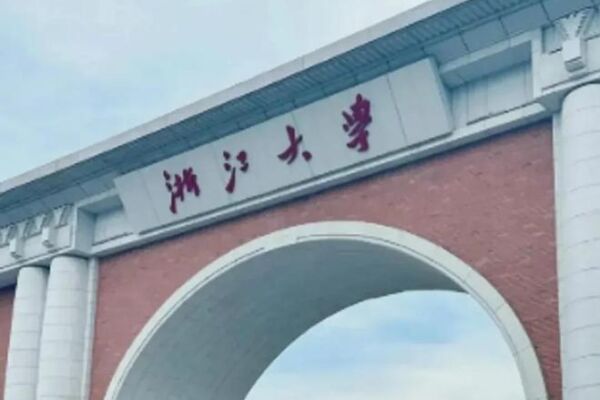
Zhejiang University’s School of Economics recently announced adjustments to the subject specialties for master’s degree enrollment for the year 2027. The announcement did not include academic master’s programs such as theoretical economics in the list of enrollment specialties. The news sparked discussions, with short video accounts spreading titles like “Zhejiang University Cancels Academic Master’s Programs” and “Eight Schools, including the School of Economics, Make Official Announcements,” focusing on concerns about the compression of academic master’s programs, the expansion of professional degree programs, and the trend of universities prioritizing practical aspects over academic research.
On June 15, Zhejiang University’s School of Economics released a notice regarding the adjustments to the subject specialties for master’s degree enrollment in 2027. The notice revealed that the enrollment specialties for master’s degree students in the year 2027 include finance, taxation, international business, and digital economics, with all degrees categorized as professional degrees. The notice also mentioned that if new national policies for graduate enrollment are introduced, the university will adjust accordingly, with the final enrollment prospectus and list of specialties published on Zhejiang University’s graduate enrollment website being the authoritative source.
On mainland Chinese short video platforms, related videos with titles like “Zhejiang University Cancels Academic Master’s Programs” and “Colleges Can’t Make Money from Academic Master’s Programs” were circulated, with some comments questioning the financial viability of academic master’s programs and distinguishing between applied and theoretical master’s programs.
Some netizens expressed concern that focusing solely on employment-oriented training for master’s students would further marginalize theoretical research and foundational disciplines. This reflects a shift in Chinese universities towards emphasizing practical skills and short-term outcomes in response to a deteriorating economic environment.
Economist Xue Xin, speaking on condition of anonymity, explained in an interview with Epoch Times that the changes in master’s enrollment at Zhejiang University’s School of Economics indicate that the Chinese Communist Party (CCP) system does not genuinely value economic theoretical research. Xue Xin highlighted that true theoretical economics delves into issues related to institutions, property rights, finance, markets, and power distribution. He mentioned that the CCP has historically been anti-academic and, due to various economic challenges currently facing China, might be avoiding theoretical economic discussions that could challenge the legitimacy of the CCP’s economic system.
Zhejiang University’s School of Economics had already shown signs of shrinking academic master’s enrollment. A document issued on June 18, 2025, indicated that applied economics would no longer admit master’s students, with enrollment plans incorporating considerations for enrolling master’s students in theoretical economics, while continuing to admit students in finance, taxation, international business, and digital economics.
Public information reveals that professional degrees typically emphasize practical skills and career orientation, whereas academic master’s programs focus more on theoretical training and research skills. The specialties retained by Zhejiang University’s School of Economics – finance, taxation, international business, and digital economics – are more closely linked to market positions, industry policies, and practical sectors. The field of theoretical economics encompasses political economy, Western economics, economic history, and environmental economics, with research focusing on macroeconomic structures and economic systems.
Ms. Xu, a Chinese higher education researcher using a pseudonym, stated that contemporary universities prioritize employment rates, funding, projects, and social evaluations. Professional degree programs have shorter cycles, higher fees, industry connections, and appear to offer more immediate results. On the other hand, academic master’s programs, especially in theoretical economics, have longer training periods, indirect employment outcomes, and do not yield immediate performance indicators for the university. This aligns with the interests of some overly ambitious leaders who prioritize short-term gains.
Ms. Xu noted that in recent years, mainland Chinese universities have expanded professional degree programs in graduate education, linking master’s training to employment, industry, projects, and local demands. While the CCP’s educational system emphasizes “serving national strategies” and “facilitating economic and social development,” in practice, the space for theoretical research is being squeezed by administrative indicators and political security narratives. Some universities have also started to cease enrollment or reduce academic master’s programs. This trend suggests that CCP-led universities are not nurturing individuals based on the real issues of the Chinese economy but rather focusing on employment quotas, financial revenue, and political security.