
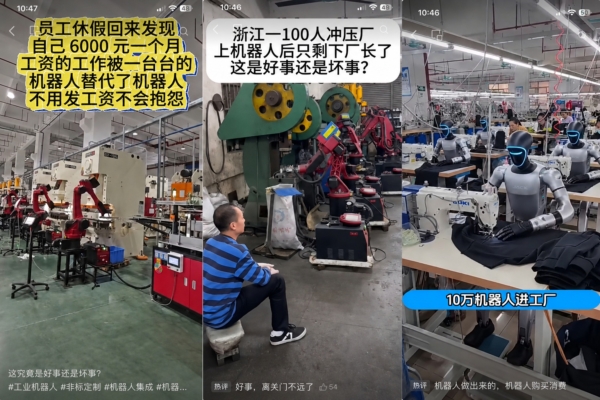
In recent times, factories in Jiangsu and Zhejiang provinces have been intensively testing and deploying humanoid robots. Videos on social media show robots entering fields such as clothing, automotive, and logistics, starting to replace some of the existing human labor. Interviewees believe that robots should be doing tasks that humans cannot accomplish, rather than rendering humans unable to survive. The Chinese Communist Party pushing for robot replacement in times of employment difficulty places industry achievements before the livelihoods of the grassroots population.
During the first half of this year, scenes of robots working in workshops have emerged in factories in Jiangsu, Zhejiang, and other areas. Multiple videos uploaded by netizens depict a clothing workshop using a large number of humanoid robots to operate sewing machines. Some netizens cynically commented, “The clothes made by robots will be consumed by robots.” Another netizen mentioned that a stamping factory in Zhejiang introduced 100 robots, commenting, “Once robots are in place, only the factory manager is left in the workshop. Is this a good or a bad thing?”
Some business owners have expressed that mainland factories hiring workers for a monthly salary of 4,500 to 5,000 yuan, when legally obligated to contribute to various insurances and funds, end up with actual monthly expenditures often reaching around 6,000 yuan, with the additional costs accounting for approximately 30% of labor costs.
Mr. Wu, an enterprise owner engaged in clothing processing in Jiaxing, Zhejiang, told reporters that labor costs are too high, leading many companies to switch to using robots: “In factories around Zhejiang, hiring a worker costs between 4,500 to 5,000 yuan per month, plus contributing 1,500 to 1,700 yuan for insurances and funds. When you calculate it, a robot costs tens of thousands of yuan, doesn’t require contributions to insurances and funds, and won’t lead to conflicts. Why wouldn’t I choose that?”
According to a report from Qianjiang Evening News, in Guangzhou, China, humanoid robots from Beijing Xingdong Era turn the packages on the conveyor belt ensuring the shipping labels face upward before sorting them into corresponding compartments. The report also mentioned that Jack Technology has finalized orders for 2,000 humanoid robots, and BYD plans to deploy over 20,000 self-developed humanoid robots in factories by 2026. A batch of humanoid robots in Jiakr Intelligent Factory has already begun pre-job testing.
Mr. Wang, a manager of a machinery parts factory in Wenzhou, stated that the introduction of robots into factories, while appearing as industrial upgrading, actually reflects the joint endeavor of enterprises and local governments to promote “dehumanization.” He explained, “Many bosses nowadays are not unable to find workers, but find employing people too expensive. Besides wages, there are pensions, medical insurance, unemployment insurance, and work-related injury insurance. Even though robots are slower, they won’t demand social security, take sick leave, or seek rights protection.”
Mr. Wang mentioned that he is also considering introducing robots: “I am preparing to update equipment and shift to robot operations.” He expressed his indignation, saying, “The Chinese Communist Party, aware of the employment difficulties, still encourages robot substitution through policies, subsidies, and demonstration projects, regarding the livelihood of the working class as the cost of industrial upgrading. Hangzhou is promoting robots everywhere, and robot manufacturers are receiving government support.”
Qianjiang Evening News quoted the CEO of AiTu Intelligent Sewing Technology Co., Ltd., Mr. Zhang Hanwen, stating that in recent years during his research visits to clothing factories, many bosses’ first question is whether there is automated technology that can replace human labor. The report indicated that AiTu humanoid robots are currently only capable of performing simple tasks such as loading and unloading, with an efficiency of about 20-30% of human labor and still requiring additional time to catch up to human productivity. However, companies are still planning to formally introduce humanoid robots this year and deploy them into factories by the end of the year.
Mr. Liao, with 30 years of experience in the manufacturing industry, mentioned that many companies are struggling and are forced to alter their production methods. He explained, “Many factories have relocated to Southeast Asian countries due to high production costs in China, resulting in shrinking profits. The total cost of an employee per year, including salaries, insurances, accommodations, and management expenses, is substantial, and now with a 40% decrease in orders. The government is desperate to promote robots, talking about technological independence, but, essentially driving both enterprises and workers to the brink.”
The Chinese Ministry of Industry and Information Technology issued the “Guiding Opinions on Innovative Development of Humanoid Robots” in 2023, aiming for the accelerated realization of scaled development in the humanoid robot industry by 2027, with related products deeply integrated into the real economy. In recent years, Zhejiang, Jiangsu, Shanghai, Guangdong, and other regions have successively introduced policies to support the robot industry, aiding their entry into factories through subsidies, demonstration lines, application scenarios, and order support.
Mr. Liao voiced that the Chinese Communist Party packages robots as “new productive forces,” but what the grassroots see is a reduction in job opportunities, while entrepreneurs are faced with the rapid shift of industrial chains. The government’s simultaneous promises of employment stability and promotion of robot substitution blatantly contradict each other.