
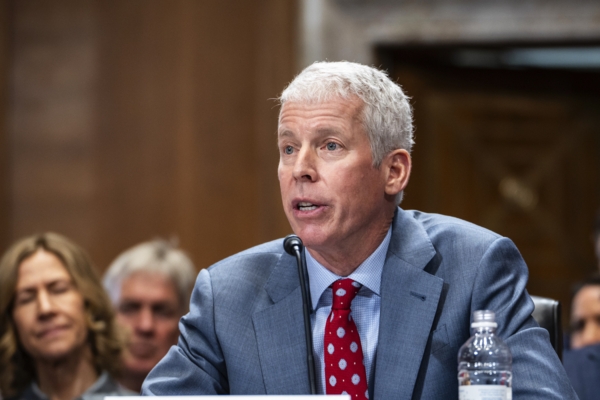
The U.S. Energy Secretary, Chris Wright, stated on Tuesday (June 9) that despite Washington and Tehran not reaching an agreement to end the war, ship traffic and crude oil exports in the Strait of Hormuz are significantly rebounding.
At the 10th Annual Global Energy Forum hosted by the Atlantic Council, Wright mentioned that energy exports in the Strait of Hormuz have increased and are expected to continue expanding.
When asked about the comparison with previous weeks, Wright commented, “I would say the traffic is clearly increasing.”
He further noted that the increase in exports is a fair assessment and that exports are expected to continue to rise in the future.
Influenced by these optimistic remarks, Brent crude oil futures prices dropped by 3.2% to $91.34 per barrel on Tuesday. Since the outbreak of the Iran conflict in February this year, the critical waterway responsible for transporting about 20% of global energy had been temporarily disrupted, leading to significant fluctuations in global energy prices.
Despite positive signals from U.S. officials, actual shipping data indicates that full recovery still has a long way to go. According to PortWatch data from the International Monetary Fund (IMF) as of last Sunday, the average daily ship traffic in the strait was only 5 vessels, a significant contrast from over 100 vessels per day before the war.
Wright admitted that due to changes in shipping routes and supply chains being redirected, it will take time to return to normal once the strait reopens.
He stated, “I believe it will take several more months to restore normal energy and critical supplies flow.”
It is reported that currently, some ships pass through the strait under the cover of darkness by turning off their transponders for safety.
Wright pointed out that oil prices did not soar as expected during the war, mainly attributed to global inventory adjustments, especially with China consuming strategic reserves.
He mentioned that China reduced its daily crude oil imports by about 4 million barrels in May and instead used its massive stockpile. Furthermore, the temporary suspension of the Jones Act by the U.S. to increase transportation flexibility effectively mitigated price pressures.
In terms of alternative supplies, Venezuela’s production capacity has significantly improved as a highlight. Wright revealed that since the situation in the country has improved, its crude oil exports have tripled.
Wright stated that with the increase in oil exports, he sees more Venezuelan oil flowing to the U.S. because “Venezuelan crude oil is very suitable for U.S. refineries.”
Looking ahead, Wright emphasized the critical importance of energy stability for the artificial intelligence (AI) industry. With the surge in power demand for data centers, he believes that natural gas is currently the most reliable energy source to provide 24-hour stable power.
He pointed out that the U.S. Department of Energy is committed to ensuring that the energy system does not hinder AI development and advocates for the production of all economically beneficial forms of energy to maintain the resilience of the global energy system.