
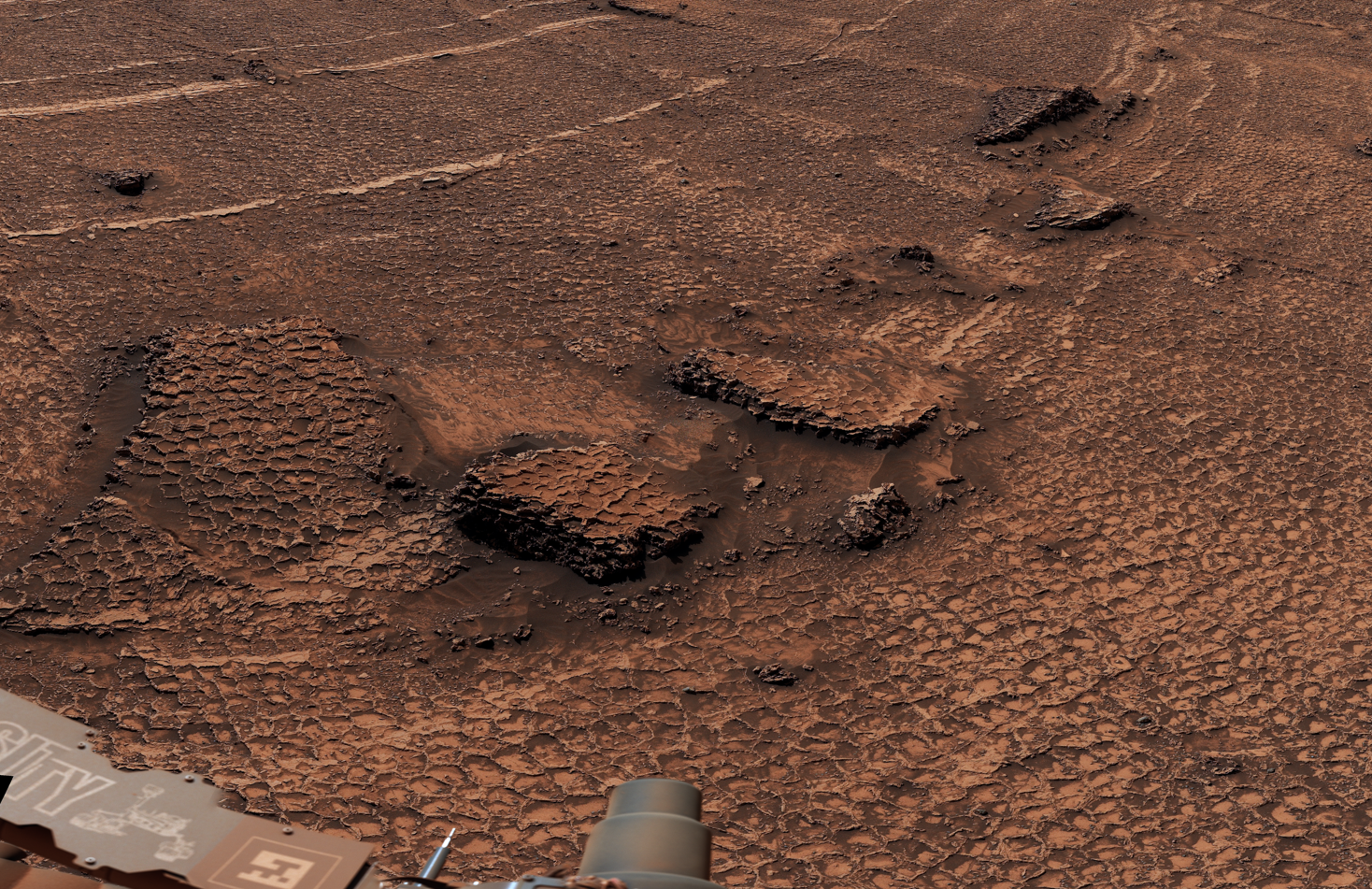
Recently, NASA’s Curiosity rover has transmitted its latest findings from Mars. The rover captured unprecedented honeycomb-shaped geometric patterns in the valley of Mount Sharp. These dense interlocking geometric patterns not only showcase the unique landscape of the Martian surface but also provide crucial clues for scientists to explore the hydrological and geological evolution of the Red Planet billions of years ago.
Throughout its nearly 15-year Mars exploration career, Curiosity has faced challenging climbs. Since 2014, it has been slowly ascending to the central Gale crater, reaching up to 5 kilometers high on Mount Sharp. While the foothills of Mount Sharp are now dry and cold, researchers believe that billions of years ago, this area might have had a network of flowing water that likely fed into surrounding lakes.
In the recent photos sent back by Curiosity, NASA mission experts were not surprised by the discovery of the honeycomb-like patterns scattered across the ground, as these patterns typically indicate long-gone water and mud. However, scientists have never seen such densely packed polygons at a single location before.
The 360-degree panoramic image taken by Curiosity’s Mastcam on June 19 and 20, 2026, in a valley called “Valle Grande,” consisted of 340 individual pictures stitched together and transmitted back to Earth. The image captured the ground covered with geometric patterns ranging from about 5 to 10 centimeters in diameter.
These polygonal textures can form under various conditions such as surface desiccation (like mud cracks), cycles of intense temperature variations, compaction after burial, or sediment shrinkage due to water loss and mineral alteration, squeezing water out from the sediment to leave behind this unique arrangement.
“We have seen many fascinating landscapes through the eyes of Curiosity, but this polygonal ocean is truly breathtaking,” said NASA project scientist Ashwin Vasavada in a statement. “We are carefully measuring their shapes and chemical composition, hoping the data contains clues about how these features were formed.”
These polygonal fractures also surround and encapsulate another impressive geological feature. On June 11, Curiosity captured a roughly 6-meter-high peak covered with sand, nicknamed “Miraflores.” Although Miraflores now tapers upwards into a pointed peak, the slow erosion process that shaped it into its current form used to make this peak much wider—similar erosion processes also created the valley that Curiosity is currently exploring.
Curiosity was built by NASA’s Jet Propulsion Laboratory (JPL) located in Pasadena, California, and is responsible for mission operations, operated by the California Institute of Technology (Caltech). The mission falls under NASA’s Mars Exploration Program overseen by the NASA Science Mission Directorate in Washington. Additionally, the Mastcam carried by the rover was constructed and operated by the Malin Space Science Systems company (MSSS) in San Diego.