
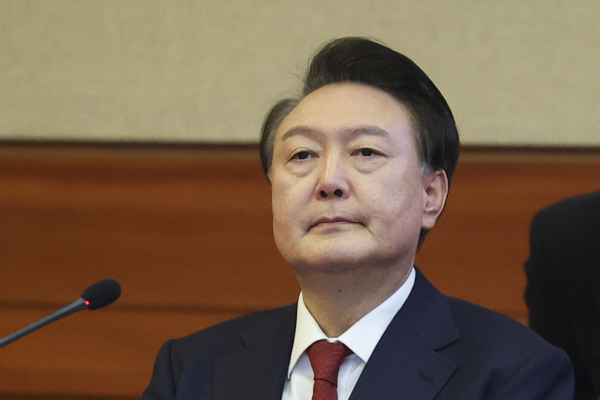
On Friday, the Seoul Central District Court sentenced former South Korean President Yoon Suk-yeol to 30 years in prison. The court found that he ordered the dispatch of drones to invade North Korea in order to escalate cross-border tensions and create a basis for declaring martial law.
This sentence aligns with the sentencing recommendation from the special prosecutor, as the court determined that Yoon Suk-yeol committed crimes of aiding the enemy and abusing his authority.
Looking back at the background of the case, in October 2024, Pyongyang authorities publicly accused South Korea of sending drones into North Korean airspace and disseminating political leaflets. Initially, the then Minister of Defense Kim Yong-hyun vehemently denied the accusations, but the South Korean Ministry of Defense later changed its stance, stating that it could neither confirm nor deny the accusations.
The court pointed out that Yoon Suk-yeol planned the drone incursion into Pyongyang in October 2024 with the aim of escalating tensions between the two Koreas, thereby creating a pretext for the declaration of martial law on December 3.
In addition to Yoon Suk-yeol, several high-ranking military officials were also severely sentenced in this case.
Kim Yong-hyun was sentenced to 30 years in prison, a higher term than the 25 years requested by the special prosecutor; former Defense Security Command commander Yeo In-hyung was sentenced to 15 years in prison; while former drone combat commander Kim Yong-dae was sentenced to 3 years in prison, with a 5-year probation.
In the sentencing document, the Seoul Central District Court detailed the motives of the defendants’ crimes.
The court stated: “In order to create conditions for martial law, the defendant decided to provoke North Korea using ‘psychological warfare’ military means to induce their countermeasures, thereby inciting armed provocations such as localized conflicts or creating national security crisis situations due to intensified military tensions.”
The judges in court harshly criticized this action as a “betrayal” of the nation’s expectations because the citizens expect the president and the defense minister to only use military force for legitimate purposes, not for personal motives.
Furthermore, the court ruled that this action exposed South Korea’s military assets to North Korea, strengthening their military defense and preparedness, which resulted in substantial harm to South Korea’s national security interests.
In response to the sentencing, Yoon Suk-yeol’s legal team expressed deep regret and stated that they would appeal.
The defense lawyers argued that dispatching drones was a legitimate military defense measure against North Korea’s past acts of dropping “garbage balloons” into South Korean territory. They emphasized that Yoon Suk-yeol neither ordered nor approved the action beforehand, criticizing the prosecution’s accusations as “speculative and fabricated lies.”
Currently, Yoon Suk-yeol remains in detention and is facing multiple trials related to the declaration of martial law.
Prior to this, in February 2026, he was sentenced to life imprisonment in the first trial for crimes of internal turmoil, and that case is also in the process of appeal.