
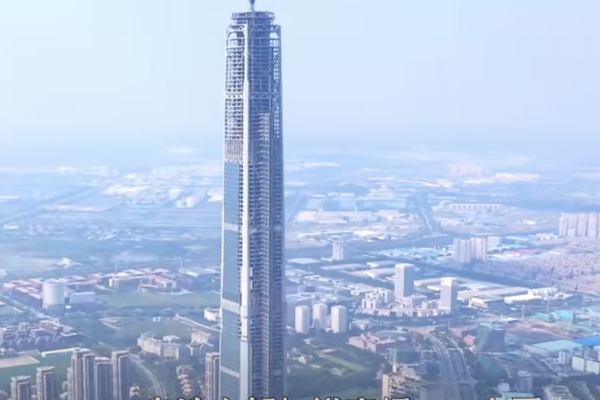
For many years, skyscrapers have been regarded by local governments in mainland China as “urban business cards” and symbols of economic power. Building the “tallest building” not only attracts media attention, but also boosts surrounding property prices, promotes land sales, and attracts investment. However, in recent days, Chinese state media have rarely used terms such as “hot potato,” “urban scars,” and “half-baked projects” to criticize the phenomenon of abandoned super-tall buildings in many places. The issues pointed out by the state media this time are just the tip of the iceberg.
The Beijing Daily and Ban Yue Tan recently published articles criticizing the chaotic situation of “tallest buildings” in many parts of China. Reports indicate that in recent times, some places have been keen on initiating high-profile and iconic projects, rushing to construct “the tallest building in the region” in hopes of shaping the city’s image and enhancing development.
However, many billion-yuan investments in skyscrapers in various places have encountered difficulties such as construction halts and long-term abandonment in recent years. These “half-baked projects” hanging in the air have not become urban business cards as intended but have instead become a “hot potato” for local governments.
Among them, state media mentioned that a recent “tallest building” project in a coastal city in the east, which had been left unfinished, has been taken over by a new owner and is reportedly set to be transformed into a livable community. The project was originally planned to build the “tallest building in China” at 700 meters high, but it has remained abandoned for years due to a broken funding chain by the developer.
It is widely believed that this project refers to the Shum Yip Upperhills International Center in Longgang, Shenzhen.
In May 2026, China Resources Land acquired the project for 7.045 billion yuan, completely canceling the original plan for a 700-meter skyscraper landmark and transforming it into a mixed residential and commercial community.
Nine years ago, Shum Yip won the land for a record 23.943 billion yuan and claimed to invest 50 billion yuan to build the “tallest building in China.” However, as the real estate market cooled and the debt crisis of real estate developers broke out, the project ultimately went from a “land king myth” to an abandoned project, going through auctions, government acquisition, and finally being taken over by a state-owned enterprise at a low price.
This is not an isolated case. The report also mentioned a landmark building in a national-level new area in the western region, which was designed to be over 500 meters tall with an investment of 10 billion yuan, but after reaching 280 meters in construction, it has been stalled for more than two years. Observers believe this may reflect projects like the Chengdu Greenland Shufeng 468 that have also faced interruptions in recent years.
Furthermore, Ban Yue Tan also mentioned a northern city that once planned to build the “tallest building in the north” at 597 meters high but due to inadequate pre-risk assessment, a broken funding chain, and debt disputes, the project has been suspended for 10 years.
It is widely believed that this clearly points to the Tianjin 117 Tower.
The Tianjin 117 Tower with a total height of 597 meters is the first in structural height and the third in total height among skyscrapers in China. The project was once considered an important landmark in the Binhai New Area of Tianjin, but due to the bursting real estate bubble and the financial crisis of the developer, the project has been suspended for an extended period, becoming one of the most representative cases of abandoned super tall buildings in China.
At the peak of the real estate market, the “tallest building” was once a symbol of local investment promotion and land finance prosperity. However, today, these once highly anticipated skyscrapers are gradually becoming massive relics of China’s real estate bubble and local financial difficulties.
Meanwhile, the problem of abandoned “tallest buildings” in these regions is also gradually becoming a significant hidden risk in local finance and debt.
In fact, the problem of abandoned and stalled super-tall buildings is not unique to individual cities.
A circulated chart of “unfinished skyscrapers over 450 meters” shows that there are dozens of unfinished, stalled, or abandoned super-tall projects across China, spread in cities like Shenzhen, Shanghai, Guangzhou, Chengdu, Nanjing, Wuhan, Tianjin, Shenyang, Dalian, Fuzhou, Xi’an, and many others.
Many of these projects were once seen by local governments as important symbols for urban upgrading and investment promotion, even using slogans like “China’s tallest building,” “Central China’s tallest building,” “Northern China’s tallest building.”
However, with the continuous stagnation of the real estate market, the debt crisis among real estate developers, and the worsening of local finances, many super-tall projects have successively faced halts, abandonment, height reduction, or even forced changes in their plans.
From the chart, it is evident that many skyscrapers are either “under construction,” “abandoned,” or “essentially abandoned.” Some projects, even if not officially declared abandoned, remain in a state of “slow construction” or “only foundation left” due to insufficient market demand, high vacancy rates in commercial spaces, difficulty in financing, etc.
Observers believe that these skyscrapers, once symbols of local ambition and real estate prosperity, have now become significant reflections of China’s bursting real estate bubble, declining land finance, and local debt crises.
As for why such chaos has occurred? The report points out that over the past two decades, many Chinese cities have heavily relied on real estate and land sales to drive economic growth, with super-tall landmarks seen as important tools for local governments to attract investments, boost property prices, and enhance the city’s image.
Many local officials believed in the “landmark economy,” thinking that by building the “tallest building,” they could stimulate land values, attract investments, raise GDP, and improve the city’s rankings. During the peak of the real estate market, the “tall building competition” became a unique competition among local governments for achievements.
However, in many places lacking industrial support, population base, and actual market demand, super-tall projects have been pushed forward. Some cities have seen an oversupply of commercial office spaces, high vacancy rates, yet they continue to initiate new skyscraper projects.
The Beijing Daily pointed out that some local governments previously excessively pursued “tallest building” and “urban landmark” projects but overlooked the local industrial foundation, population scale, and market demand. Some cities, even with insufficient population and commercial demand, still forcefully initiated super-tall projects, leading to a large number of vacant offices, rents insufficient to cover operating costs, and even the phenomenon of “the taller the building, the greater the losses.”
Furthermore, super-tall building investments are massive, with long construction cycles heavily reliant on funding chains. Once the real estate market cools down or the financing environment worsens, projects are very likely to come to a halt.
The report cited a cadre from a development zone in the west who mentioned that skyscraper construction often requires a significant amount of manpower, resources, and funds, along with high maintenance costs in the later period, putting immense pressure on local finances and developers. When market demand weakens or economic fluctuations occur, super-tall projects are prone to “difficult childbirth” or “abandonment.”
Mainland internet users believe that while the apparent cause of these problems is the breaking of real estate developer’s funding chains, the deeper reasons lie in the long-term reliance of local governments on land finances, blind pursuit of “prestigious” landmark projects, inadequate supervision, and serious lack of pre-risk assessment.
Many local governments, during investment attraction and approval processes, lack effective oversight of developers’ actual financial capabilities, subsequent market demand, and financing risks. Some projects are prematurely launched before issues like policies, airspace, and funding are clarified, ultimately leaving behind massive abandoned projects and debt black holes.