
Amid China’s economic downturn, more and more people who once were “on the verge of the middle class” are realizing that they are only “pseudo middle class” built on high leverage, high-paying industries, and era bonuses. Recently, on mainland China’s social media, the topic of “pseudo middle class” has sparked resonance due to the characteristics of high debt and low risk resistance of this group.
###
As China’s economy continues to languish and industries like the internet and finance face ongoing layoffs, an increasing number of individuals with high education, corporate jobs, real estate, and a decent lifestyle are starting to reassess their real situations. The phenomenon of “looking like the middle class but having almost no risk resistance” is resonating with many.
###
Recently, an online trend on Chinese short video platforms involves templates like “When you are born in a middle-class family,” sparking discussions on the differences between “true middle class” and “pseudo middle class.”
In these discussions, “resilience to risks” is considered the dividing line between the true middle class and the pseudo middle class.
Many netizens believe that true middle class status is not just about owning a house, a car, and a high income, but also the ability to maintain family life without a drastic decline even if unemployed for six months to a year. On the other hand, many seemingly well-off families are fundamentally living paycheck to paycheck and relying on loans to sustain their lifestyle; once the income stream stops, they quickly run into difficulties.
###
A member with 249,000 followers on Weibo stated, “Many people with a monthly income of thirty to fifty thousand, driving luxury cars like BMW, Mercedes, Audi, living in upgraded large houses, may look like the middle class, but as soon as the salary stops for three months, mortgage, car loan, and children’s tuition immediately suffocate the whole family.”
He believes that these people are more like “bearers of the middle-class lifestyle” rather than genuinely belonging to the middle class.
###
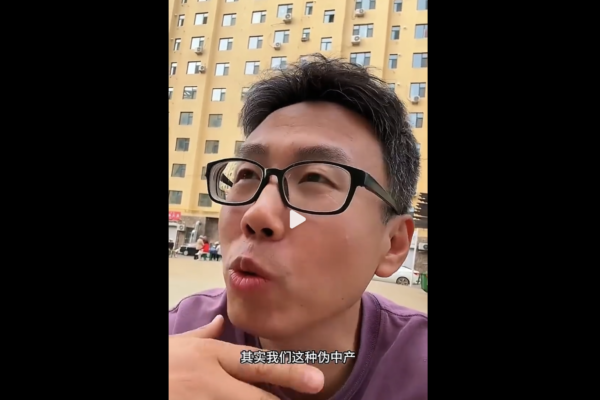
This sentiment has escalated recently due to a narrative from the popular Beijing blogger “Lao Ge Takes You Soaring,” who shared his reflection on the “pseudo middle class.”
He narrated his experience as a graduate from a prestigious university with three years of entrepreneurial experience and six years at Baidu after a failed venture. He thought he had “made it” in life but was swiftly hit by the chain reaction of unemployment, divorce, selling the house, and returning to his hometown after being laid off.
“In a blink of an eye, I transformed into a middle-aged uncle who is unemployed, divorced, and rolling back to his hometown, feeling like my life had been a big dream.” He mentioned that over the years, he had been reflecting on why someone with decent education and a respectable job ended up in such a position.
He stated that he finally realized that the problem lay in one pseudo phrase—pseudo middle class, pseudo strength.
He recalled the time when he and his ex-wife (a woman with high education, good looks, and high income) worked in Beijing with a combined monthly income of over 16,000 yuan, just enough to cover the mortgage. So, they borrowed over 800,000 yuan from friends, pooled over 2 million yuan for the down payment, and purchased a 5 million yuan house in Beijing.
“After the purchase, we were particularly proud, and when someone mentioned ‘you have a house in Beijing,’ we felt like we had made it to the middle class.” He admitted that at that time, he subconsciously overlooked the huge loan behind, feeling like his assets were already worth several million.
It wasn’t until he was laid off and used the hundreds of thousands of compensation to pay off the mortgage only to see that there was no surplus, that he truly realized the problem.
“We pseudo middle class individuals cannot withstand any risks.” He mentioned that if either spouse loses their job or an elderly family member needs costly medical care or faces an accident, the whole family immediately plunges back to the starting line. Mortgage and household expenses are suffocating.
He believed that many individuals from ordinary backgrounds who moved to big cities for education are prone to overestimating their status due to a decent job. “For others, being middle class may be the result of generations of accumulation with support from parents and ancestors, while for kids like us from small towns, we often have only ourselves.”
He admitted that he later discovered that merely buying a house with a loan didn’t equate to being middle class. “When you are on the verge of the middle class, you might mistakenly think you have already reached it.”
“Going through all this made me realize that I couldn’t really stand firm in Beijing. Just because I bought a ‘old rundown’ house with a loan, I am not necessarily middle class; it’s just my mistaken belief.”
He attributed the breakdown of his marriage to this “pseudo strength.”
“I thought I could cruise smoothly at a big company (Baidu) back then, and this pseudo strength also blinded my wife into thinking that I could continue like that.” Now looking back, he thought that perhaps marrying an ordinary girl to live a steady life would have made the marriage last longer.
“It’s too late now. Sometimes we overestimate our abilities. Instead of striving hard to reach a ladder that wasn’t meant for us, it’s essential to realize the risks you shall bear once you reach it.”
The aforementioned video has been widely shared on social media, striking a deep chord among the audience.
A netizen under the name “Horn of Rohan” commented, “Makes a lot of sense. Without buying a house, the six-year income from a large corporation plus compensation from layoff estimated at 3 million. With 3 million in hand, things would be much easier.”
Some internet users mentioned that in recent years, there has been a surge in job crises, with pseudo middle class individuals over 35 being hit the hardest: internet and finance professionals relying on high salaries find it challenging to land similar positions after being laid off, resulting in salary drops exceeding 30% (e.g., from 1.16 million to 700,000 yuan for an employee at a financial firm). Added to compulsory expenditures like education and healthcare, they quickly fall back to the bottom layer.
Others opined that consumerism accelerates a return to poverty: pseudo luxurious experiences like visiting art exhibitions for photo ops, expensive fruit-picking adventures, a 68 yuan coffee paired with an English book for an Instagram photo are essentially superficial, vanity-driven expenditures detached from real economic strength.
Financial blogger “Anxious Cola Cake” also weighed in on “Lao Ge Takes You Soaring” experience, acknowledging that it struck a chord with him. What puzzled him the most was the phrase, “With tens of thousands thrown into the mortgage, not even a splash can be afforded.”
He believed that many people think buying a house in Beijing propels them to the middle class, but in reality, “most people possess not a house but a mortgage—a debt.”
“After buying the house, your future life is often locked in. Carrying a long-term mortgage, people are hesitant to quit a job, start a business, or even ‘dare to fall ill or take a break’.”
He emphasized that the surrounding environment constantly reinforces this “success narrative.”
“People around you applaud how successful you are for buying a house and a car. Gradually, you don’t even realize you’ve fallen into the trap.”
He bluntly stated that many so-called “middle class” individuals haven’t truly grasped their lives, with “the house belonging to the bank, and the salary belonging to the company. Many things may seem to belong to you, but you could lose them at any moment. Once you lose your job or industry collapses, you’d find yourself with almost nothing.”
He mentioned that in recent years, as several industries experience a clear downturn, more people have begun reconsidering what constitutes true security.
He also shared an encounter with a young food delivery person who had no house, car, or debt and made around 200 yuan per day, yet seemed content.
“He said he was happy making 200 yuan a day. It made me suddenly realize that many people misunderstanding success. The real crucial aspect might not be how much you earn but rather ‘your ability to withstand risks.'”
“Some people earn a lot but carry a decade-long mortgage, while others with moderate incomes have no debt pressure. Who is freer is hard to determine.”
He described carrying a long-term mortgage as “sometimes akin to being in jail.” “For those with debts, every day they wake up thinking about how much they need to repay; those debt-free think about how much they can earn that day. It’s entirely two different states.”