
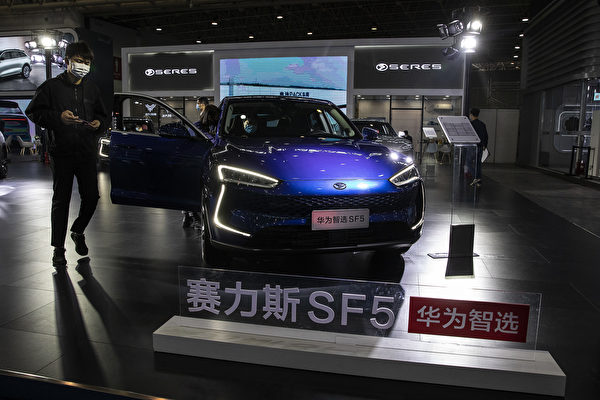
On June 11th, Sailes Port stocks opened low and continued to fall, breaking through a market value of over 100 billion Hong Kong dollars during trading, a decrease of over 50% from its initial public offering in November last year. Analysts believe this is not just a regular pullback, but a thorough reevaluation by the market of the valuation logic behind the “Huawei-dependent” new force.
By midday, Sailes (09927.HK) closed at 56.05 Hong Kong dollars per share, down 4.68%, reaching a total market value of 97.638 billion Hong Kong dollars, officially dropping below 100 billion Hong Kong dollars. Towards the end of trading, the decline narrowed to 3.061%, closing at 57.0 Hong Kong dollars per share.
On November 5, 2025, Sailes made its debut on the Hong Kong Stock Exchange, becoming China’s first luxury new energy vehicle company to achieve dual listings in both the A-share and H-share markets. On the first day of trading, Sailes opened at 128.9 Hong Kong dollars per share and closed at 131.5 Hong Kong dollars per share. Today, its Hong Kong stock market value has accumulated a decline of 56.65%.
On June 11th, topics related to “Sailes Hong Kong stock price” and “Sailes Hong Kong stock market value breaking through 100 billion” trended on Weibo.
Financial blogger and Weibo influencer “Xiao Liu Zhongcheng” posted, “On June 11th, Sailes stocks opened low and continued to fall, breaking through a market value of over 100 billion Hong Kong dollars, a decrease of over 50% from its IPO in November last year. This is not just a regular pullback, but a thorough reevaluation by the market of the valuation logic behind the ‘Huawei-dependent’ new force.”
The blogger analyzed that Sailes was once the “lucky one” in the capital market. With deep ties to Huawei and hot-selling models, the company soared from a marginal car company to a hundred-billion-dollar giant, with a peak A-share market value exceeding 300 billion. At that time, the market valued it as a technology growth stock, with the core logic being “exclusive cooperation with Huawei + smart driving barrier.”
However, the story quickly reversed. Huawei’s car Business Unit opened up cooperation, with Chery, BAIC, and JAC entering the scene successively, turning “exclusive privilege” into “shared.” Sailes’ scarcity premium instantly collapsed. More crucially, the company experienced stagnant revenue growth with a meager increase of only 0.18% in net profit in 2025, with significant profits being swallowed by Huawei channel fees and component procurement fees, resulting in a per-vehicle profit sharing of over 130,000 yuan.
Capital markets are the most realistic: when the logic of “high growth + high barrier” disappears, what remains is the valuation level of traditional automotive companies. Institutions in the Hong Kong stock market were the first to vote with their feet, leading to a listing day breaking, followed by a 7-month halving, essentially reflecting a valuation correction from being a “Huawei concept stock” to a “manufacturing company.”
In the blogger’s conclusion, a warning was given, “The lesson of Sailes is a caution for all enterprises tied to a single giant: without autonomous technology and profits, even the most dazzling stories cannot support long-term stock prices.”
New knowledge blogger and Weibo influencer “Wang Zhihui Toli” commented, “The reason for Sailes’ significant drop is that all the money was being earned by Huawei. Shareholders feel like they are being taken advantage of, and then they all rush to exit. The sales volume of cars is not an issue, and the gross profit margin is also high, but looking at the net profit margin, it’s so low, not even compared to BYD (referring to Build Your Dreams). Shareholders just can’t take it. If you can’t make money and there’s no return for the shareholders, what’s the use of just having GMV (Gross Merchandise Value)?”
On April 30th, Sailes disclosed its first-quarter 2026 report, showing total operating income of 25.746 billion yuan, a year-on-year increase of 34.46%; a net profit attributable to the parent company of 754 million yuan, a year-on-year increase of 0.89%; non-net profit of 103 million yuan, a staggering 73.87% year-on-year drop; and a net cash flow generated by operating activities of -20.95 billion yuan, compared to -7.63 billion yuan in the same period last year.
Public records show that Sailes is the first cooperative vehicle manufacturer under Huawei’s Intelligent Selection Car model. Under the model, Huawei participates in various aspects of the automobile’s product design, product experience, product marketing, product distribution, retail marketing, etc.