
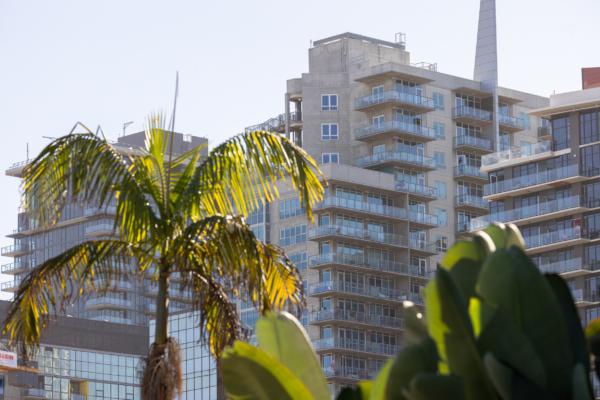
Residents of San Diego will decide in a special municipal election on June 2 whether to approve the proposed Empty Homes Tax. If the bill passes, it will take effect on January 1, 2027.
The San Diego City Council voted in March to include the Empty Homes Tax, officially known as Measure A, on the ballot for June 2. The tax aims to encourage long-term rental or sale of properties to increase housing supply and raise funds for city services, with the revenue going into the city’s General Fund.
According to a memo from the city prosecutor in March, for non-primary residence properties left vacant for more than 182 days in a year, an initial tax of $8,000 will be levied in the first year, increasing to $10,000 annually thereafter. If such properties are owned by corporations, an additional $4,000 will be charged in the first year, with an extra $5,000 per year subsequently.
The Empty Homes Tax will be levied separately from property taxes and other homeowner expenses.
However, owner-occupied homes, properties leased for long-term residence, and vacant properties meeting certain exemption criteria, such as those of military service members, properties affected by natural disasters, or properties inherited after the owner’s death, will not fall under the tax.
Shane Harris, CEO and founder of S Harris Communications and a public advocate, has been actively opposing this proposal. He has urged the city government to explore alternative solutions to address fiscal challenges.
Harris recently expressed his concerns in an interview on EpochTV’s “California Insider,” stating, “Essentially, this tax is packaged as targeting the wealthy, but in reality, ordinary families who have worked hard to purchase second homes or apartments over the years are now affected. This is essentially an attack on property ownership.”
Harris cited a personal acquaintance who could be impacted by the legislation. The woman owns a residence in Nevada and an apartment in San Diego. Her husband recently passed away, and she still needs to travel to Nevada for medical treatment.
He believes the Empty Homes Tax might force her to sell her primary residence or apartment due to the high burden of the tax.
According to the city prosecutor’s memo, approximately 5,140 residential properties in San Diego could be subject to the Empty Homes Tax. If the bill passes, all revenue collected will go into the city’s General Fund.
Harris pointed out that this fund is not dedicated to housing and can be used for any purpose by the city government, and the income generated may not be enough to cover budget gaps. He added that there is currently insufficient data supporting this tax proposal.
In addition to increasing the financial burden on owners of non-primary residences, Harris also believes that the tax will intrude on people’s privacy. He questioned, “How will the city government confirm if you are living in your own home? And how will they enforce it?”
Moreover, Harris stated, “The city may likely spend most of the revenue on enforcement,” which he views as “misuse of taxpayers’ money.”
He also indicated that the proposal would discourage people from investing in non-primary residences.
Harris, who identifies as a Democrat, argued that the tax is actually aimed at addressing multimillion-dollar deficits by increasing costs for homeowners, many of whom fall into the middle-income bracket.
“This is not a funding issue; it’s a spending issue,” Harris remarked. He pointed out that there are many city departments and projects that “haven’t delivered results,” suggesting that cutting expenses from these areas could redirect funds to areas that truly matter to the public, such as police, fire services, and infrastructure.
San Diego Mayor Todd Gloria unveiled a $6.4 billion budget for the 2027 fiscal year on April 15, highlighting a $118 million structural deficit the city faces. The budget indicates forthcoming austerity measures in various areas in 2027, including reducing city staffing levels, shortening library and recreation center hours, cutting capital investments, art and culture allocations, and adjusting personnel recruitment.
Harris believes the San Diego City government has not done enough in reducing expenditures. He proposed discontinuing the DEI (Diversity, Equity, and Inclusion) initiative launched in recent years.
“The government needs to recognize that basic needs are the most important, everything else is extra,” Harris insisted. “Families in California need to do what ordinary families do every day—sit around the dining table and discuss where to cut expenditures to sustain the household budget.”
San Diego is not the only city considering an Empty Homes Tax. Similar tax proposals have been raised in San Francisco, Berkeley, New York City, and Honolulu.
In 2022, San Francisco introduced Proposition M, attempting to levy taxes ranging from $2,500 to $20,000 on vacant apartments and other residential units, depending on property size and duration of vacancy.
The proposition was included on the ballot and passed by voters on November 8, 2022. However, the San Francisco Superior Court ruled the tax unconstitutional in November 2024, prohibiting the city government from implementing or managing the tax revenue.
The court documents stated that Proposition M violated the Takings Clause of the Fifth Amendment of the U.S. Constitution, which requires compensation to property owners when government action appropriates private property. The court also deemed that the proposition violated the property owners’ “fundamental freedoms related to home residency arrangements” and the privacy rights under the California Constitution.
Furthermore, the court ruled that Proposition M violated the Ellis Act. As part of California’s government code, the act prohibits public entities from coercing landlords to rent out their residential units.
Berkeley voters also approved an Empty Homes Tax, known as Proposition M, in November 2022, aimed at curbing non-owner-occupied and speculative real estate investments. According to guidance from the Berkeley Rent Board, vacant residential units meeting the criteria will be taxed $3,000 to $6,000 in the first year and $6,000 to $12,000 annually thereafter, depending on the type of residence.
The tax currently faces legal challenges. The Berkeley Property Owners Association issued a statement in November 2025, indicating they were participating in legal proceedings concerning the tax. The organization noted that the court ruling on the San Francisco Empty Homes Tax could significantly impact Berkeley’s related litigation.
Harris suggested that if San Diego adopts an Empty Homes Tax, it could also face legal challenges. “People are struggling… I want to leave more money in people’s pockets,” he stated. “People don’t want to pay higher sales taxes or higher property taxes.”