
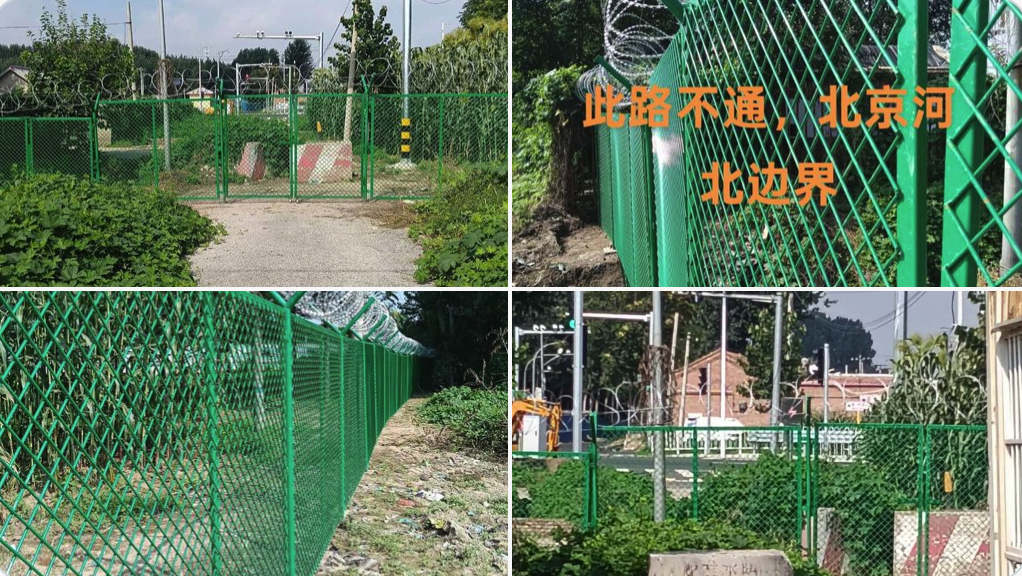
Recent days have seen the appearance of razor wire fences, surveillance cameras, and roadblocks near the border between Beijing and Hebei. Two originally connected villages have been separated by fences, with some intersections blocked by cement blocks and trucks. Netizens have dubbed this administrative boundary as the “borderline” and criticized the CCP for treating ordinary citizens as potential threats, turning Beijing into a “big prison.”
Videos and images shared by netizens show a green fence erected between Baoshang Village in Anping Town, Xianghe County, Langfang City, Hebei Province, and Xiaotun Village in Gaocun Town, Tongzhou District, Beijing. The top of the fence is installed with razor wire, and surveillance cameras are placed along the line. Some village roads are blocked by iron gates, cement blocks, and vehicles. The videos show individuals pointing to the other side of the fence and questioning who ordered the closure of the area. These related scenes have spread on the internet.
A resident of Yanjiao, Hebei named Ms. Liu told Epoch Times that she recently saw a green fence erected between Baoshang Village and Xiaotun Village, blocking passage. She said, “Some razor wire is equipped with blades, and even motorcyclists entering the Beijing area have their documents checked. These razor wire fences and cement blocks are blocking the paths of the people around Beijing, making it inconvenient for them to shop. Many people who commute between the two areas or visit relatives are now finding it extremely difficult to travel. The government is not considering how to make things easier for the common people but instead focusing all its energy on preventing and restricting them, which is very disheartening.”
Ms. Liu further mentioned that there are many petitioners living in the area, and such wire fences have cut off their passage to Beijing, making it impossible for residents of the two villages to move back and forth.
Local residents indicated that temporary quarantine panels previously placed between the two areas have now been replaced by fixed fences with razor wire. Taiwan’s CTV News reported on July 25 that similar facilities have appeared at various border areas between Beijing and Hebei, with some village entrances sealed off by cement blocks and trucks.
The related images have drawn criticism from netizens. User “looklook” commented, “When a regime does too many bad things, it becomes fearful of everything, treating its own people as the biggest enemy.”
Netizen Lyra M. questioned, “Why does Beijing need to set up fences and razor wire along its border areas? Provide an objective answer, without the need to justify the authorities. An authoritarian regime cannot be trusted with cutting-edge technology, as it will not use it for the benefit of others but rather for monitoring and safeguarding their own authoritarian rule.”
Dissident in Beijing, Mr. Li, mentioned that access to Tiananmen Square now requires advance reservations, and even entering Beijing requires passing through multiple checkpoints. He stated, “Previously, we said Tiananmen Square was a prison, and now we can say that Beijing itself has become a prison. I heard there are also sentry posts in places like Haidian, Changping, and the urban-rural fringe of Beijing. Such a setup used to be seen only at the borderlines, and now it’s being applied at administrative boundaries. This shows that their fear has reached an extreme level, considering ordinary grassroots people as imaginary enemies. Turning the city into a walled-off ‘big prison’ exposes the inherent stability maintenance mindset of the CCP.”
The CCP has long been wary of petitioners, human rights advocates, and rights lawyers. During sensitive political events such as the CCP’s National People’s Congress, Beijing authorities set up temporary checkpoints at urban-rural junctions to inspect passing individuals.
A Beijing human rights activist, Mr. Chen, mentioned the recent heightened state of alert by the authorities, stating that it “might be related to the CCP’s ‘August 1 Army Day.’ In any case, ‘Two Sessions,’ ‘June 4th,’ ‘July 1st,’ ‘August 1st,’ ‘October 1st’ are all sensitive dates for them, requiring the deployment of sentry posts and community grid personnel to severely control society.”
The control between Beijing and Hebei goes beyond just fences. Another online video shows a person riding a motorcycle from Xianghe County in Hebei into Beijing but being stopped at the border. The inspection personnel checked the driver’s ID, driving license, vehicle documents, and asked relevant questions before allowing the individual to proceed.
This footage, along with the razor wire fence in Baoshang Village, demonstrates Beijing’s control methods on the outskirts: official roads have inspection stations, village paths are fenced off, and people and vehicles entering Beijing must undergo document checks. Over the past twenty years, Beijing’s outskirts have seen continuous reinforcement of inspection, blockade, and surveillance measures.
Mr. Chen mentioned that while the Beijing authorities promote collaborative development between Tongzhou District and the “North Three Counties” of Hebei, with Xianghe County being one of the “North Three Counties,” the official document emphasizes transportation connectivity, industrial collaboration, and public service alignment, yet Baoshang Village and Xiaotun Village are separated by razor wire fences.