
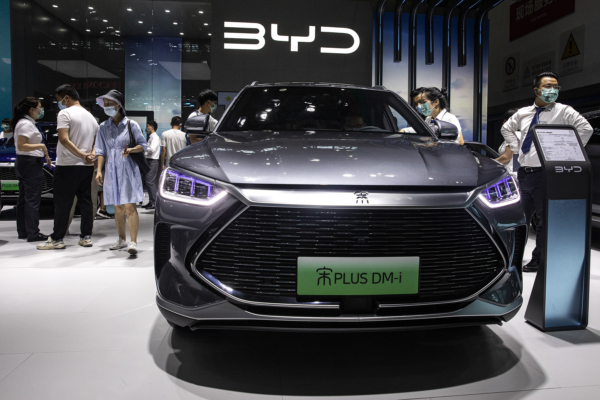
BYD has faced setbacks in its planned investment in Turkey, leading the local government to temporarily suspend the company’s import tax exemption. The Turkish authorities have warned BYD that if they fail to invest $1 billion as planned in establishing a production base in Turkey by 2024, the government will reclaim the related incentives.
According to Nikkei Asia, an official from the Turkish Ministry of Industry and Technology stated, “Since there has been no progress for some time, we have suspended the incentives originally enjoyed by the company since the beginning of 2026.” “The investment agreement, related conditions, obligations, and guarantees with the company remain valid. If the investment is not completed, the enterprise must repay the incentives received according to the law and their commitments.”
The cancellation of BYD’s import tax exemption by the Turkish government has severely impacted its sales in Turkey. In May, BYD sold only 152 vehicles in Turkey, significantly lower than the 3,866 vehicles sold in January. Throughout 2025, BYD sold a total of 45,537 vehicles in Turkey, including 25,858 plug-in hybrid electric vehicles (PHEVs) and 19,679 battery electric vehicles (BEVs).
On July 8, 2024, the Turkish Investment and Economy Office announced BYD’s investment plan in Turkey. The signing ceremony took place at the Dolmabahçe Presidential Working Office in Istanbul, presided over by Turkish President Recep Tayyip Erdoğan and attended by Turkish Minister of Industry and Technology Mehmet Fatih Kacır and Investment Office Director A. Burak Dağlıoğlu.
As per the agreement, BYD is set to build an electric and plug-in hybrid car production base with an annual capacity of 150,000 vehicles in Manisa, Turkey, along with a sustainable mobility research and development center. The factory aims to create up to 5,000 direct job opportunities and is planned to commence production by the end of 2026. If realized, BYD will become the first new foreign car brand to commit to establishing a production facility in Turkey since 1997.
In exchange, the Turkish government provided BYD with an import tax exemption and waived the requirement for its distributors to establish 20 service points nationwide. However, despite over two years passing, construction has not yet begun on the Manisa factory.
Coincidentally, shortly after the July 2024 announcement, the Chinese Ministry of Commerce convened a meeting with car companies to discuss overseas investment risks. Turkey was identified as one of the high-risk investment destinations, along with India and Russia. While no official documents have been publicly disclosed, news sources like Reuters cited insiders saying car companies must “notify the relevant ministry and the Ankara embassy before investing in Turkey.”
On June 9, BYD held its 2026 shareholders’ meeting at its headquarters in Shenzhen. During an interview with Reuters, BYD Executive Vice President Stella Li publicly acknowledged that the Turkey factory project is currently in a “suspended” state. She also mentioned that the top priority currently is the Hungary factory, with the secondary priority being to find a second production base in Europe. Li did not provide a timeline for the resumption of the Turkey factory project.
Li also serves as the President of BYD Americas and has been instrumental in driving BYD’s expansion in overseas markets like Europe, Latin America, and Australia, making her one of the key figures in BYD’s internationalization efforts.
Notably, BYD’s reputation for overseas factory construction has been tarnished. In December 2024, the Brazilian government discovered 160 Chinese workers living in “slave-like” conditions at BYD’s factory site in Bahia state, Northeast Brazil. These workers were found to be working excessively long hours, sometimes required to work seven days consecutively, and living in “extremely poor” conditions.
These workers were hired in China and brought to Brazil, where over 100 of them had their passports confiscated and were prohibited from leaving without permission. The employer was a company called Jinjiang Construction Brazil, the main construction contractor for the BYD factory.