
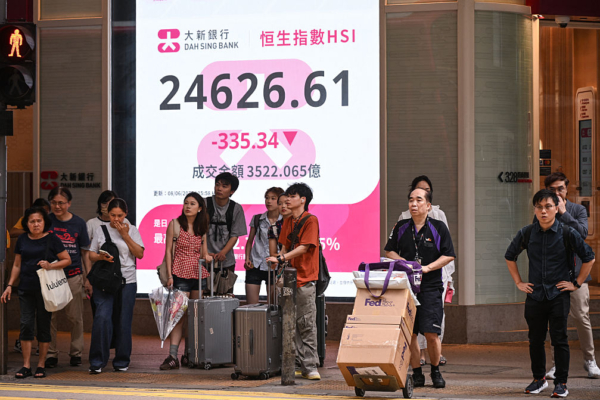
In recent days, the Hong Kong stock market has been on a downward trend. On June 11th (Thursday), the Hang Seng Index fell below 24,000 points intraday and recorded a seventh consecutive decline. The Hang Seng Index also experienced a “death cross” for the first time since July 2023. Experts interviewed indicated that this technical signal reflects deteriorating market confidence, with investors growing more concerned about the Chinese economy and corporate profit prospects.
The term “death cross” typically refers to when the short-term moving average falls below the long-term moving average, seen by technical analysts as a signal of weakening market trends.
On June 11th, the Hang Seng Index dropped below 24,000 points in the morning, breaking through the low point from March and continuing the trend of “falling with no rise” compared to A-shares and overseas markets in recent months.
Tech stocks also faced pressure. Due to the decline in heavyweight stocks like Alibaba, the Hang Seng Tech Index dropped below 4,600 points intraday, hitting a new low in over 8 months.
Reports from June 11th stated that the Hang Seng Index closed at 24,249.29 points, down by 158.67 points or 0.65%; while the Hang Seng Tech Index closed at 4,655.74 points, down by 69.05 points or 1.46%.
According to the investment research platform “Gelonghui,” both the Hang Seng Index and the Hang Seng China Enterprises Index recorded seven consecutive declines on that day, setting new recent lows. Weighted tech stocks continued to decline, with Alibaba falling over 5%, Baidu and JD.com dropping around 3%, Xiaomi and Tencent down approximately 1.8%, and Meituan falling over 1%.
A report from Hong Kong’s “Sing Tao Daily” on June 11th mentioned that prior to trading on that day, the Hang Seng Index had experienced a continuous decline for 6 trading days, totaling a drop of 1,631 points or 6.3%, marking the longest losing streak since October 2025. With another decline on that day, the losing streak extended to 7 trading days. Concurrently, the Hang Seng Index witnessed a “death cross” for the first time since July 2023.
During an interview with Epoch Times, US-based economist David Huang stated that the “death cross” itself is not the cause of market downturns, but rather a technical outcome following sustained declines, indicating a shift to a short-term weakening trend.
Huang remarked that what truly deserves attention is not just the technical chart itself, but rather the indication of declining market confidence, with a large amount of capital tending to exit for a wait-and-see approach. Historically, the appearance of a “death cross” does not necessarily mean an immediate market crash, but often signifies the potential for a prolonged period of weakness in the market.
He believed that this technical signal reflects investors’ dwindling confidence in China’s economic recovery. The lack of significant rebounds in the China property market, consumption, and private investment has led investors to doubt whether Chinese corporate profitability can improve.
Simultaneously, there is a decreasing risk appetite for investing in the Chinese market. Huang explained that in times of uncertain economic outlook, funds often shift from the stock market to safe-haven assets such as cash, bonds, and gold.
He also pointed out that global capital is reassessing the risks faced by China and Hong Kong markets, including factors such as US-China relations, geopolitical issues, global supply chain restructuring, and China’s slowing economic growth. These factors can influence investors’ judgments on the Hong Kong and mainland Chinese markets.
Regarding the “death cross” that occurred in June, Chinese capital market veteran Xu Zhen stated to Epoch Times that it easily reminds people of the market trends following the same signal in July 2023. He mentioned that back then, the Hang Seng Index dropped by about 23% in the subsequent six months.
Xu Zhen explained that the decline in 2023 was not caused by technical indicators but primarily due to the full-blown crisis in China’s property market, emerging deflationary pressures, and reduced attractiveness of Chinese assets due to high maintained interest rates in the US. These fundamental factors led to continuous outflows of foreign funds from Hong Kong stocks, with funds shifting towards US Treasury bonds and AI-related stocks.
When asked about the possibility of a repeat of the 2023 trend in 2026, Xu Zhen believed that there are still similar issues present, including the unresolved crisis in the Chinese property market, continued weak domestic demand, and more pronounced overcapacity issues.
Looking at the fund flows, Xu Zhen expressed that foreign capital remains skeptical about the Chinese economy, making it difficult to establish a long-term trend of inflow into Hong Kong stocks; Southbound funds may provide a support role during significant declines in Hong Kong stocks, but the subsequent performance will depend on whether mainland funds continue to buy into Hong Kong stocks.
Reports from “First Financial” mentioned that escalating geopolitics in the Middle East, along with rising inflation figures, have raised expectations of global central bank rate hikes, further dragging down the performance of Hong Kong stocks.
Huang emphasized that international geopolitical risks, US interest rates, and the US dollar’s trends will all impact the risk appetite of global funds. If the fundamental aspects of the Chinese economy do not show clear improvement, a deteriorating external environment may amplify the downward pressure on Hong Kong stocks.
In terms of future prospects, Huang believes it is crucial to monitor whether the Hang Seng can hold around 24,200 points and the continuous inflow of Southbound funds. Additionally, data on Chinese consumer spending, exports, and property, Chinese company profit performance, and trends in US interest rates and the US dollar will all influence the future direction of Hong Kong stocks.