
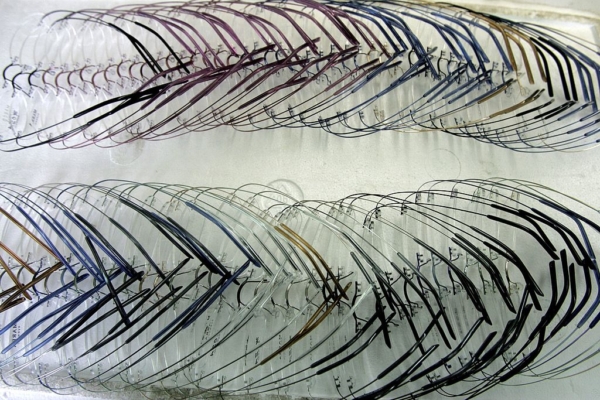
Recently, the eyeglass market in Danyang, Jiangsu Province, has been exposed to irregularities in the high-priced sale of lenses. A pair of “nearsightedness control lenses” priced at 3280 yuan have a wholesale acquisition cost of only about 126 yuan; some ordinary lenses and unbranded lenses, after packaging, can also be sold at significantly higher prices.
Jiangsu’s Danyang is one of the important eyeglass production bases in mainland China, where a large number of lens and frame manufacturers and wholesalers are concentrated. A survey by mainland media shows that the prices of some lenses significantly increase after entering retail stores from wholesale markets.
Reportedly, some lenses targeting teenagers for “nearsightedness control” are priced higher at retail, but the original prices are not high. A pair of nearsightedness control lenses with a store price of 3280 yuan has a wholesale acquisition cost of about 126 yuan. After entering retail stores from the wholesale end, the prices are inflated more than twenty times. Even if sold at a discount, at around 328 yuan, there is still profit margin for the businesses.
Similar high markups are not limited to nearsightedness control lenses. Investigations show that a common 1.61 refractive index lens with a purchase price of about 15 yuan can be priced at 799 yuan in retail stores. Another pair of eyeglasses with a purchase price of about 50 yuan, wholesalers suggest a retail price ranging from 388 yuan to 588 yuan, with a profit margin exceeding ninety percent.
Some wholesalers also sell so-called “white-label lenses.” These lenses have no clear branding, packaging, factory name, address, or quality inspection report. After businesses purchase them, they can rebrand or repackage them and then sell them in retail stores.
Investigations show that some “white-label lenses,” when repackaged, can increase in price from 200 yuan to 900 yuan. Some businesses claim that the main difference between white-label and branded packaging is in the packaging itself, with minimal differences in the actual cost of the lenses.
At the retail end, similar lenses vary greatly in price due to differences in packaging, names, and marketing. Some low-priced lenses, when packaged as “blue light protection,” “anti-fatigue,” “nearsightedness control,” etc., see significant price increases. For ordinary consumers, it is difficult to determine the true source, brand, and cost of the lenses when getting fitted for eyeglasses.
Teenage nearsightedness control is a popular concept in the mainland eyeglass market. Media reports in mainland China state that some businesses exploit parents’ concerns about their children’s deteriorating vision to sell high-priced control lenses, using persuasive language such as “without correction, the degree of myopia will increase rapidly” and “it may develop into high myopia in the future.”
In addition to overpricing, the processes of eye examination and follow-up checks are also said to have transparency issues. Some parents have reported that their children underwent multiple follow-up checks within a year, with the first three check-ups being told that the myopia was “under control,” until the fourth check-up revealed an increase in myopia from over 200 degrees to 400 degrees.
Related reports also quote industry insiders as saying that some stores may initially measure the eye degree higher during the initial check-ups, then create an illusion of “effective control” using the results of follow-up checks. Consumers are presented with professional jargon and expensive packages, but verifying whether the lenses are genuine, meet the advertised efficacy, and if the eye examination data are accurate, is not easy.
The report also mentions that some well-known nearsightedness control lenses are being counterfeited. Some low-priced “functional lenses” on certain online platforms may not be authentic brand products, making it difficult to verify their control effects, source, and quality for consumers.