
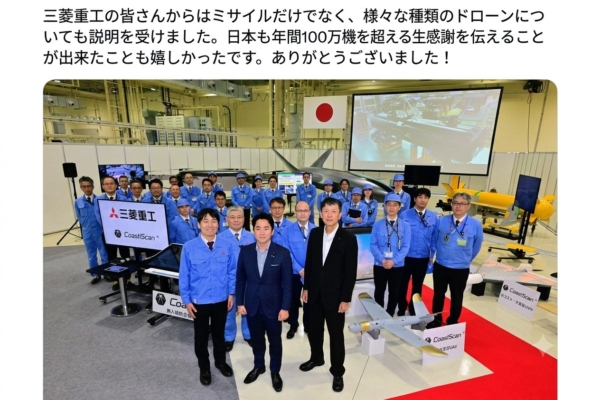
Japanese Defense Minister Shinjiro Koizumi recently posted on X platform to introduce his inspection of Mitsubishi Heavy Industries’ drone production capacity. Now, he has posted again to publicly announce the bidding for a “drone interception” procurement project, emphasizing that “speed” is the top priority of the defense ministry’s current policy.
Minister Koizumi personally sought military equipment proposals from the public through social media, a rare move that has attracted attention. What’s intriguing is that the post explicitly starts with “Welcome to repost (hoping to expand),” a departure from Japan’s usual discreet and closed defense procurement process. Within just 7 days of its release, the post attracted around 18,000 reposts and over 2.45 million views.
The link attached to Koizumi’s post from the Defense Equipment Bureau shows that the “Drone Interception Early Procurement Plan” has the main specifications of requiring unmanned aerial vehicles to fly below 5,500 meters, at a speed of about 463 kilometers per hour, and weighing under 600 kilograms. It specifically indicates that the equipment will be used to counter long-range suicide drones such as the Iranian-made “Shahed” or the Israeli-made “HARPY.”
The procurement plan is set to kick off intensively in the summer of 2026. If the sample tests meet the standards, the production contract could be signed as early as late August, with a target delivery date in September. The entire procurement process is expected to be swift within 3 months, implementing the core national defense policy highlighted by Koizumi, which is speed.
Notably, Koizumi revealed during his visit to Mitsubishi Heavy Industries in May that Japan’s annual drone production target could reach 1 million units. However, his inspection photos on X platform unexpectedly exposed attack drones and various speculated low-cost, small-scale aircraft that Mitsubishi Heavy Industries had not previously disclosed.
According to Nikkei News, Eisaku Ito, the president of Mitsubishi Heavy Industries, mentioned regarding the Defense Ministry’s emergency bidding, “The development of this interception drone took only about three months.” He also disclosed that the company has successfully developed a prototype of “interception drones” capable of shooting down enemy aircraft and is now actively proposing to the Defense Ministry for the procurement project.
In the current conflicts like the Russia-Ukraine war and the Middle East turmoil, low-cost, mass-produced drones have given rise to a “new form of warfare.” The core of modern defense competition no longer solely relies on large equipment like fighter jets but revolves around the ability to mass-produce small drones in a faster and more cost-effective manner, directly influencing battlefield outcomes based on technological prowess and production capacity.
Nikkei further reports that the Japanese defense drone market was previously led by startups like ACSL and Terra Drone. With major defense contractors like Mitsubishi Heavy Industries now officially participating, it not only brings system integration and production technologies for large equipment but also provides ample operational resources to assist startups in scaling up production, facilitating joint operations with traditional fighter jets and warships.
With the Japanese government expected to revise the “Three Security Legislation Documents” by the end of 2026, Mitsubishi Heavy Industries’ rapid actions alongside the Defense Ministry align with Japan’s national strategy to establish a domestic unmanned aerial vehicle production base for security and defense.