
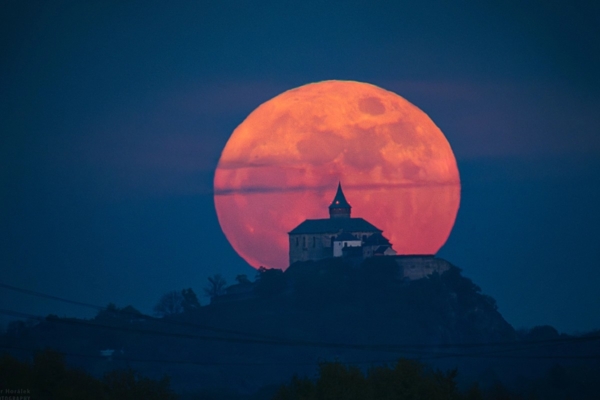
Most astrophotographers would be content with a decaying barn as a foreground when photographing the Milky Way, but Petr Horálek prefers a majestic 15th-century castle standing on a steep mountain peak as a backdrop, capturing a red full moon rising behind it.
For centuries, a volcanic rock formation in East Bohemia, Czech Republic has been home to a formidable Gothic fortress overlooking the lowlands of the Elbe River. Abandoned long ago, the Kunětice Castle was left to decay before being restored and transformed into a vibrant museum today.
On a clear evening in early May near the village of Osičky, about four miles from the castle, Horálek meticulously set up his camera with near mathematical precision. His goal was to capture the moment when the full moon was rising, aligning perfectly with the castle’s walls and towers in its path, resembling a giant amber gem slowly ascending.
Calculating several data points in his mind during this shoot, the 39-year-old Horálek, a tech worker and educator with a passion for astronomy since age 11, shared that accurately aligning the moon’s trajectory with the castle foreground “is not as difficult as it seems”, but requires a simple scientific approach.
“You just need to know the azimuth of the moon relative to the castle,” he said, referring to the compass angle measured in degrees from true north used to precisely position celestial bodies. Horálek used applications like Planit Pro or PhotoPills to help determine the moon’s position.
The key, however, lies not in tracking the moon but in magnifying it. For this project, Horálek employed an optical effect called “lens compression” to make the moon appear vastly larger while “shrinking” the castle’s walls and towers. By setting up several miles away between his tripod and the castle, he made the structures in the frame smaller while the distant moon appeared unchanged in size. He then used a 1,400mm super telephoto lens to capture the castle back in its rightful place in the frame, with the moon proportionally magnified.
Yet, this intricate shoot across vast distances at night came with risks. While waiting, winds shook his camera, and clouds could obstruct the horizon at any moment. As daytime warmth dissipated, evening chill quickly set in – a sharp temperature contrast that could lead to atmospheric refraction distorting the scene. Additionally, with high magnification lenses, the moon moves at a rapid pace, giving him only a few seconds to capture that precise alignment.
He pressed the shutter.
The resulting shot far exceeded his expectations. “It’s always very satisfying when everything comes together smoothly,” he said. “But many times, the shoot gets disrupted by low clouds near the horizon.” Sometimes, darkness envelops the castle too late.
Yet, this unpredictable environment is part of its charm. “Each time these phenomena look completely different, unique and unreproducible,” he added. Anomalies in the atmosphere are part of this allure.
Horálek resides in Seč and teaches astronomy at Silesian University in Opava. His journey with astronomy began in 1997 when his grandmother first showed him the Big Dipper. It was not until 2010, after a trip to the Cook Islands to chase a total solar eclipse, that his true photography journey began. This experience led him to invest in his gear, igniting a passion for photography that has never left him. He is now a writer and speaker dedicated to sparking public interest in astronomy.
“For the average observer, the night sky often seems boring, unchanging, and distant,” the astrophotographer said. “Many people feel they shouldn’t spend time gazing at it. But their perception is wrong – so much is happening in the sky, and a brief moment of interest and observation can open a door to a completely different world.”
Horálek initially photographed the Kunětice Castle during the Covid-19 pandemic. “Everything was restricted at the time, and in reality, this became the only way to escape the frustrations,” he said.
During the lockdown, he stood alone in the dark fields, growing fascinated with the historical significance held within the castle walls.
“The castle was originally built in the 14th century, rising to prominence under the powerful Pernštejn family, who transformed it into a Gothic fortress incorporating Renaissance elements,” he said. “Throughout centuries, it suffered damage from wars and long abandonment, eventually turning into ruins until recent restoration efforts.”
Horálek noted that the castle’s greatest appeal lies in its “extraordinary grandeur”. He pointed out that observing it from a distance allows for stunning compositions with the full moon, shooting stars, and occasionally appearing comets.
For Horálek, framing the moon with this historical architecture is a way to connect humanity with the vast universe. Reflecting on his work, he said, “When placing humanity in the vast emptiness of the universe, we are incredibly tiny and fragile beings.” He emphasized, “We should cherish this rare opportunity to thrive on this fragile Earth.”
For the English version of the report, please refer to the English edition of Epoch Times:
Czech Photographer Captures ‘Unrepeatable’ Red Full Moon Behind 15th-Century Castle