
China accounted for about 70% of global shipbuilding orders last year, but the advantages previously gained through low-cost labor and massive production capacity are now facing challenges due to factors such as aging population, changing youth employment attitudes, and skills talent gap.
Recently, an article titled “Where Will the Next Generation of Workers Come From When Global Orders Account for 70%” published on the WeChat public account “Science and Industry Power” revealed that researchers from Shanghai Jiao Tong University found after surveying 15 shipyards, almost all management teams shared the same worry: highly skilled workers are aging and nearing retirement, while young people are unwilling to take over.
Data shows that the average age of frontline workers in Chinese shipyards has reached 41 years old, with less than a quarter of people under 35 years old.
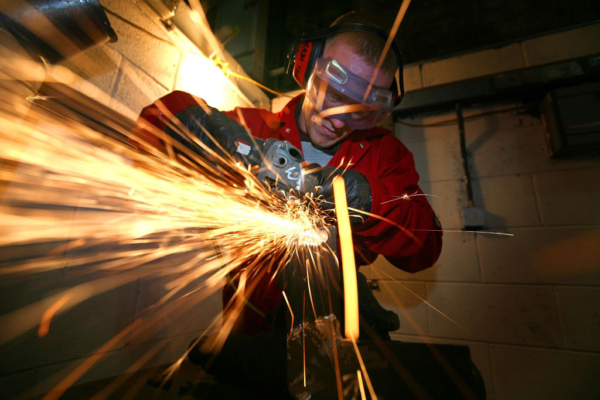
The shipbuilding industry has long faced issues of harsh working environments. In the summer, temperatures inside the ship hulls can exceed 50 degrees Celsius, and welders and assemblers often have to work for long hours in confined spaces.
Having worked in the industry for nearly 50 years, Zhang Yifei mentioned that although wages have indeed increased in recent years, fundamentally, it’s still “hard-earned money.”
He recalled that during the peak of summer, climbing from the stuffy hull to the deck would make the 38-degree Celsius outside temperature feel quite cool.
Apart from the labor shortage, an even greater problem is the lack of individuals willing to stay in the industry long-term.
Research indicates that many young workers currently view shipyards as short-term job placements rather than lifelong careers. Some workers shift to other industries after working for a few months or years, leading to the breakdown of the apprentice system.
Some seasoned technicians note that in the past, workers would actively think of solutions to problems, whereas nowadays, many just wait for instructions from their superiors.
The article also exposed a hidden truth in the shipbuilding industry: a prevalent practice in Chinese shipyards is to adopt a model of “in-house workers plus outsourcing workers.” The ratio of formal employees to outsourced workers in many shipyards has reached 1:9, meaning 9 out of 10 workers are labor contractors. This system helped cost control during periods of order fluctuations but brought about new challenges.
Due to the high turnover rate among outsourced workers, some shipyards experience an annual personnel turnover rate of 30%, leading to a lack of motivation for companies to cultivate technical talent, and workers lacking long-term career prospects.
The result is a vicious cycle: companies are unwilling to invest in training, workers are unwilling to stay, and the transmission of skills is on the verge of being lost.
Professor Liu Yuzhao from Shanghai University’s sociology department believes that the issue extends beyond the shipbuilding industry and reflects a breakdown in the entire system of cultivating skilled workers in China.
With the expansion of universities in China and the marginalization of vocational education, many technical schools have closed down, and vocational education is increasingly seen as an option for those who can’t enter universities. Influenced by societal norms, the number of young people willing to choose technical education continues to decline.
Faced with this “worker shortage mountain,” many shipyards are pinning their hopes on intelligent manufacturing where “robots replace humans.” However, the industry generally agrees that even with ongoing technological advancements in the next decade, robots can only replace about 30-40% of the workforce. This is because shipbuilding is different from automobile manufacturing, as each ship is almost a customized product, requiring workers’ on-site judgment and experience for many processes.
For instance, in the welding process, there are various irregular weld seams between different sections, and currently, robots still struggle to completely replace experienced welders.
Therefore, how to digitize the experience of the retiring generation of technicians before they leave and transform it into artificial intelligence training data is seen as a crucial issue for the next decade.
The article suggests that if the working environment is not improved, occupational attractiveness is not enhanced, and intelligent transformation is not completed in the future, even if controlling 70% of global orders, the industry may face the dilemma of “having orders but lacking workers.” Behind the celebration of achieving record-high orders, an industry crisis is quietly approaching: Who will build ships in the future?