
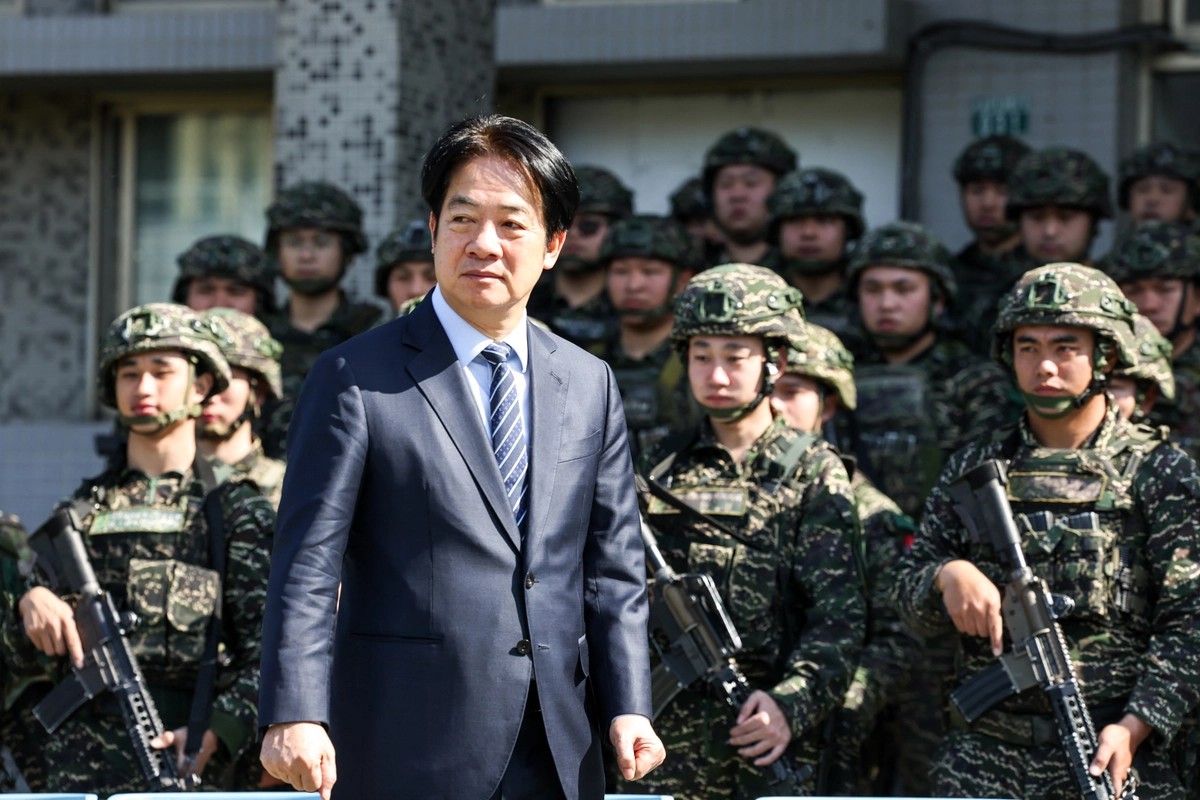
Taiwan is expanding its collective defense strategy by increasing military spending, investing in drone warfare, and strengthening security cooperation with the United States, Japan, and other democratic partners to counter the aggression of the Chinese Communist Party.
President of Taiwan, Lai Ching-te, stated on July 17 at the National Chung-Shan Institute of Science and Technology in Taoyuan, Taiwan, that Taiwan must respond to the international call to share collective defense responsibilities and urged the Legislative Yuan to allocate funds for new drone projects. It is widely known that the Chinese regime has never renounced its aim to unify Taiwan by force.
President Lai emphasized that the pressure from China on Taiwan is increasing, highlighting that drones have become the most crucial assets in modern warfare, citing examples from the Ukraine-Russia conflict and the US-Iran standoff.
Taiwan’s drone industry is gaining commercial recognition as well. Last month, Saudi Arabia invested a record-breaking $47.2 million in Taiwan drones, signaling that Taiwan-produced drones are seen as capable combat systems by foreign buyers, not just local prototypes.
Therefore, Taiwan can fully utilize its advanced drone technology to bolster its national defense.
Unlike NATO, Taipei does not have a formal collective defense treaty. The concept of “collective defense” mentioned by Lai refers to informal divisions of labor with Washington, Tokyo, and other democratic partners, while Taiwan also plays a more active role in defending its homeland.
In this model, Taiwan needs to increase military spending and defense capabilities instead of solely relying on external protection. In return, Taiwan hopes to continue receiving weapons sales, diplomatic support, and technology sharing from the United States.
An example of this was seen in December 2025 when the US State Department approved eight arms sales to Taiwan with a total value of $11.1 billion. Lai believes that drones are one of the most cost-effective ways for Taiwan to fulfill its defense responsibilities.
This argument traces back to Taiwan’s “porcupine” strategy, formally named the “Overall Defense Concept” (ODC), proposed by Admiral Lee Hsi-min during his term as the Chief of the General Staff from 2017 to 2019. Lee advocated for the deployment of numerous small, mobile, and low-cost weapon systems that can survive after initial strikes, rather than a few expensive and vulnerable platforms. Subsequently, US and Taiwanese officials extended this logic to drone swarms, referring to it as a “hellscape.”
This concept has evolved over time. Taiwan’s Ministry of National Defense noted in its 2021 four-year defense review that asymmetric combat capabilities are complementary, not replacements, for conventional forces. Under the current government, the strategy has been adjusted based on Admiral Lee’s initial concept, incorporating drones, artificial intelligence (AI) systems, and the T-Dome air defense network, while retaining conventional military platforms.
In a position statement submitted to the US Senate Armed Services Committee in April, Admiral Samuel Paparo of the US Indo-Pacific Command (INDOPACOM) stated that the command “will continue to provide security assistance to enable Taiwan to build credible, resilient, asymmetric, dispersed, and cost-effective self-defense capabilities.” Taiwan has committed to strengthening its reserve forces and funding procurement projects for both the US and Taiwan.
The Indo-Pacific Defense FORUM described this strategy as integrating “missile and drone capabilities” with mobile coastal defenses.
President Lai has set Taiwan’s defense spending at 3.3% of GDP for 2026, aiming to reach 5% by 2030. He stated in his National Day speech in October 2025 that the increased budget would be used for constructing the multi-layered T-Dome air defense system, AI integration, and self-reliance in defense industry.
He also favors joint production of weapons with US companies rather than direct purchases. This includes agreements with Anduril, a US defense technology company headquartered in California, for joint production of the Barracuda-500 cruise missile and underwater drones.
President Lai aligns Taiwan’s defense posture with statements from the Group of Seven (G7) and other organizations, directly quoting these statements in his June 25 speech on collective defense and burden-sharing.
Taiwan has also expanded this concept to enhance societal resilience. Through the American Institute in Taiwan’s global cooperation and training framework, international seminars on civil defense, resource stockpiling, and infrastructure protection have been jointly organized, attracting participants from over 130 countries and regions.
Japan has also shifted its stance. In November last year, Japanese Prime Minister Sanae Takaichi stated in parliament that a Chinese blockade or invasion of Taiwan would pose a “threat to survival.” This language invoked Japan’s collective self-defense and further closely linked Japan’s security interests with Taiwan’s security interests.
Japan’s Ministry of Defense plans to deploy an electronic warfare unit to Yonaguni Island, located 68 miles from Taiwan, in 2026. Medium-range air defense missiles are expected to be deployed on the island by 2031.
After the G7 issued a joint statement in November 2025 opposing changes to the status quo by force, Taiwan’s Ministry of Foreign Affairs welcomed the statement. The statement was made at a meeting in Niagara, Canada, where G7 foreign ministers and the EU’s High Representative for Foreign Affairs and Security Policy gathered. It reaffirmed opposition to unilateral changes to the status quo in the Taiwan Strait by force or coercion, encouraged peaceful cross-strait dialogue, and supported Taiwan’s participation in international organizations.
Taiwan’s Ministry of Foreign Affairs stated its “warm welcome and appreciation” for the statement, seeing it as evidence of international consensus in maintaining the status quo.
According to President Lai’s collective defense concept, the goal is to increase the political, economic, and military costs for China of any blockade or invasion, aiming to deter such actions. Taiwan seeks to achieve this goal through strengthening its defense, cooperating with the US and Japan, and seeking broader support from the G7. This defense strategy emphasizes burden-sharing and cooperation rather than reliance on external protection.