
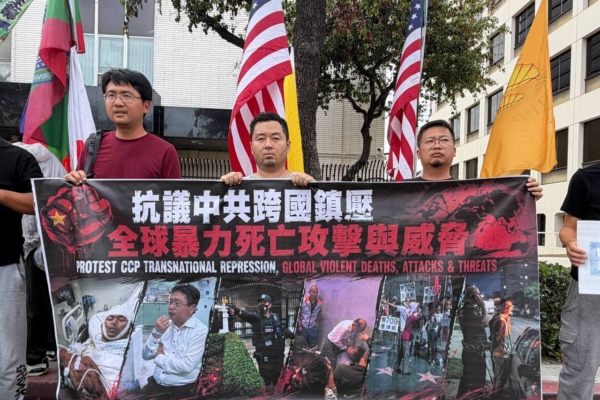
Following the introduction of the “Law on the Promotion of National Unity and Progress” by the Chinese Communist Party on July 1st, several countries have seen a series of incidents where Chinese dissidents or foreign citizens have been subjected to cross-border suppression. Analysts believe that these events are all orchestrated by the Chinese Communist Party.
On the afternoon of Sunday, the 26th, various Chinese community groups in Los Angeles held a protest rally in front of the Chinese consulate. Protesters held banners with slogans such as “Oppose cross-border suppression by the CCP”, “CCP is the largest criminal organization” and “Release Zhang Xinyan”, with banners displaying photos of recent victims like Mitsuo Yaito, the Executive Director of the Indo-Pacific Strategic Think Tank who was recently attacked violently, as well as Jie Libin, Chairman of the International Alliance of the China Democratic Party, and Hong Kong legislative councilor Zhang Xinyan.
During her speech, member of the China Democratic Party, Shi Shuping, stated that the frequent incidents of cross-border suppression are no longer isolated cases but rather human rights and rule of law issues worthy of international attention. She said, “When violence, intimidation, or harassment crosses borders and targets individuals who express their views peacefully, what is being challenged is the legal principles of safeguarding freedom of speech, assembly, and personal safety in various countries.”
Protester Fang Shuo denounced the authoritarian regime of the CCP for using violent means to suppress dissidents across borders, calling their actions despicable and no different from that of thugs.
Since the beginning of this month, numerous overseas dissidents have faced cross-border persecution, including incidents of violent attacks, death threats, illegal intrusions, vehicle thefts, airport detentions, and facing extradition to China, causing widespread shock. Protesters cited:
On the 15th, Jie Libin was suddenly attacked by three unknown Asian males near the New York Flushing Botanical Garden, sustaining serious head injuries and requiring ICU treatment. Prior to the attack, Jie Libin had noticed the suspicious behavior of the three men but did not see any weapons. He suspected the attackers were armed with easily concealable batons or expandable batons.
On the 12th, Zhang Boli, a former leader of the 1989 pro-democracy movement and a Chinese pastor in Los Angeles, experienced an illegal invasion of his home. Zhang Boli described the scene he found upon returning home as “like a nuclear explosion aftermath,” with the police asking him, “Who have you offended?” He posted on X platform, “Because I know the thieves are minions of Satan, what I did angered them, shaking their dark power.”
Having been in exile overseas for over three decades, Zhang Boli publicly commemorates the June Fourth Incident every year and criticizes the CCP’s persecution of Christians.
The attack on Mitsuo Yaito occurred in Taiwan. On the 6th, a man followed him and physically assaulted him. Subsequent investigations indicated the involvement of several Hong Kong gang members. Analysts suggest that this is the CCP’s attempt to create a “chilling effect” through cross-border suppression in Japan and Taiwan, silencing critics.
On the 8th, two incidents occurred consecutively in Thailand: Zhang Jinsong, a UN refugee and a dissident recently elected to the Chinese parliament, was arrested by Thai immigration authorities; and Zhang Xinyan, a member of the overseas Hong Kong Autonomous Council “Hong Kong Parliament,” was detained at the airport on her way to Canada. The Interim Organizing Committee of the Chinese Parliament is appealing and making efforts to rescue Zhang Jinsong.
One of the exile student leaders from the June Fourth Incident, Tang Baiqiao, who has been active on several social media platforms, also posted on X platform last week, stating that despite taking stringent security measures, his personal vehicle was still stolen. He warned overseas Chinese, “It seems that many recent events are neither isolated cases nor coincidences. Be careful!”
Six days before the attack, Jie Libin filed a lawsuit against the CCP regime and the Chinese consulate for cross-border suppression in the US Federal Court. He also provided relevant information about the CCP’s illegal agent, Tang Yuanjun, to the Southern District of New York Attorney’s Office.
Liu Min, one of the protesters in Los Angeles, mentioned that in January of this year, several democracy activists were violently attacked by security guards during a gathering in front of the Chinese consulate. The June Fourth Memorial Hall was also vandalized this year, and in connection with the experiences of Zhang Boli, Mitsuo Yaito, and others, he believes that “these are by no means isolated incidents but rather a reflection of the increasingly rampant cross-border suppression by the CCP.”
Liu Min pointed out that the CCP is “afraid of the truth, afraid of freedom, and even more afraid of anyone who dares to stand up and resist.”
A series of cross-border suppression incidents, especially since the implementation of the “Law on the Promotion of National Unity and Progress” by the CCP on July 1st, concerning the jurisdiction over foreign individuals, has caught the attention of US government officials, who are urging the government to take action to stop it.
On the 14th of this month, bipartisan federal senators in the US introduced the “Stop TNR Act of 2026” to criminalize threats and violent attacks by foreign governments on foreign individuals as cross-border suppression behavior; violators could face up to 10 years in prison and a $100,000 fine. One of the sponsors of the bill, Senator Adam Schiff of California, specifically noted in a press release that since 2014, there have been 319 recorded cases of cross-border violence suppression by the CCP.
Following Mitsuo Yaito’s attack, Japanese-Chinese senator Ishi Ping also stated on X platform, “Initially, I thought it was the isolated act of an individual madman. However, based on the information that has now emerged, things seem more complicated, possibly indicating organized crime planned by that rogue regime.” “If so, this becomes a challenge from a rogue regime to the entire civilized world. We must remain highly vigilant.”
Officials and civilians in Taiwan have also swiftly responded to cross-border suppression. According to Central News Agency, in response to Jie Libin’s attack in the US, Taiwan’s Foreign Minister Joseph Lin mentioned that the CCP’s cross-border suppression extends domestic law into democratic countries overseas; the Ministry of Foreign Affairs has established “Standard Operating Procedures” (SOP) to address CCP’s cross-border suppression.
Wu Xindai, currently running for Taipei City Council, posted on Facebook, “From Taiwan to mainland USA, they are trying to send a chilling message with blood and violence: if you dare oppose me, no matter where you are, I will beat you to death.” “This behavior of turning the state machine into a gangster’s henchman is not only infuriating but also deeply troubling.” She expressed, “The expansion of totalitarianism is no longer a distant political theory; it is a real threat happening around us, instilling fear in every free soul.”
The CCP officials have flatly denied any “cross-border suppression.” According to Reuters, Chinese Embassy spokesperson Liu Chang claimed that the concept of cross-border suppression is “completely fabricated.”
Jie Libin, on the other hand, stated that CCP leader Xi Jinping plans to visit the United States in September, and the East Coast, particularly New York, is the main base of CCP influence, suggesting that the attacks on him are likely intended to pressure peaceful protesters and discourage them from participating further; all these incidents are not isolated but rather systematically arranged.
Taiwanese officials and citizens are also taking swift actions against cross-border suppression. CNA reported that regarding Jie Libin’s attack in the US, Taiwanese Foreign Minister Lin Jialong mentioned that the CCP’s cross-border suppression extends domestic law into democratic countries overseas; the Ministry of Foreign Affairs has established “Standard Operating Procedures” (SOP) to counter CCP’s cross-border suppression.
Adam Schiff, a federal senator from California, one of the sponsors of the bill, specifically noted in a press release that since 2014, there have been 319 recorded cases of cross-border violence suppression by the CCP.