
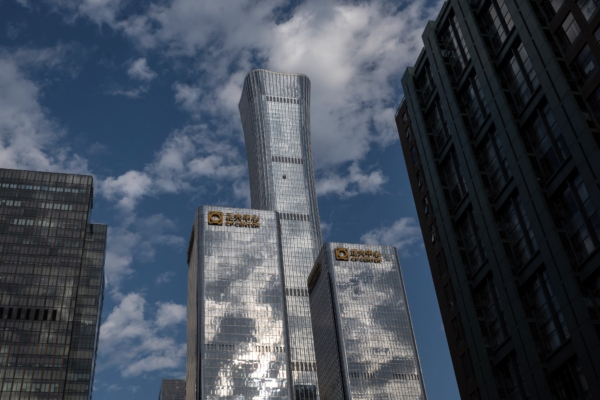
Last Friday (June 26), a small plane crashed into the iconic landmark building in Beijing, China, the CITIC Tower (also known as the “China Zun”), causing a stir among the top officials of the Chinese Communist Party. According to four sources familiar with the matter who spoke to our reporter, the authorities have preliminarily concluded that the pilot intentionally crashed the aircraft, and the incident has now been classified internally as a terrorist attack.
On June 26, a single-engine two-seater light sport aircraft took off from the Shifo Temple Airport in Ma Fang Town northeast of Beijing, deviated from its flight path minutes after takeoff, flew directly towards the city center of Beijing, and crashed into the 528-meter-high CITIC Tower. The next day, the “Beijing Chaoyang” WeChat account issued a notice stating that the incident resulted in the death of the pilot on board and 13 people injured. On July 2, the official announcement revealed that the pilot involved was a 66-year-old Beijing resident named Liu, who was a freelancer holding a pilot license and had expressed intentions to “end life” in his diary multiple times.
Multiple sources revealed to the reporter that on June 28, the investigative team within the authorities concluded during an internal briefing that the incident was not a regular flying accident but rather a case of “deliberate piloting the aircraft into the building,” leading to its classification as a “terrorist attack.” The sources also mentioned that the pilot passed away after being transported to the hospital by an ambulance.
An official within the Chinese Communist Party system, using the pseudonym Zheng Rentian, disclosed to the reporter that there has been an initial judgment within the authorities regarding the incident.
He said, “After the plane deviated from its flight path and approached the high-rise building in Beijing, it was still under control, and there were even signs of acceleration in the final stages. Residents nearby witnessed that the plane was flying smoothly in the air before the accident, without any significant swaying and maintaining a stable speed. The possibility of a mechanical failure was ruled out early on, leaving only the possibility of a suicide attack. Internally in mainland China, such incidents are categorized as terrorist attacks.”
Official reports issued a day after the incident did not disclose the name of the building that was hit nor provide details about the aircraft and its flight route.
Zheng Rentian remarked, “The official reports are intentionally vague, aiming to withhold detailed information from the public. They do not want to draw attention from the citizens or let foreigners know about this incident, fearing potential imitation of such acts. Some suspect that the pilot originally planned to fly the plane to Tiananmen Square, as it would have taken just three more minutes to reach the square, which would have had significant consequences.”
Mr. Li, an insider in the aviation industry in mainland China, explained to the reporter that the aircraft took off from the Shifo Temple Airport in Pinggu, Beijing, around 5:30 pm on June 26, intending to carry out general aviation training involving local takeoffs and landings. Local takeoff and landing are fundamental elements of sport pilot license training, where the aircraft takes off, completes a five-sided flight around the airport, and then returns for landing.
Minutes after ascending, the plane deviated from its expected flight path, and although air traffic control and military systems detected the abnormal trajectory, interception was not completed before the aircraft entered the core direction of Beijing, exposing a major flaw in the defense network of the Beijing airspace.
Li mentioned that the monitoring center of the Chinese Air Force observed that the aircraft circled the Shifo Temple Airport twice after taking off but did not return within the specified timeframe. He stated, “Around 15 minutes after taking off, the plane veered off course, began deviating at 5:40 pm, and collided at 5:55 pm, accelerating its speed to 110 knots just before impact. This indicates that the aircraft was still under the control of the pilot.”
The CITIC Tower is only a few kilometers away from the central government compounds. Mr. Zhang, responsible for security at the capital airport, informed the reporter, “Internally, it is rumored that if the small plane had flown a few more minutes forward, it would not have only hit the building but also declared war on the authorities. This matter is being privately discussed internally. With just a single small plane being able to penetrate the core direction of Beijing and collide with a tall building, the capital airspace would quickly be compromised in the event of a conflict.”
Another source familiar with the incident response, using the pseudonym Qin Nong, disclosed that the focus of the relevant agencies after the incident was not on conducting a public investigation but rather on controlling the dissemination of information and data cleansing.
He explained, “Currently, this matter is kept from public disclosure. Internally, it is considered a terrorist attack, but I am unsure if the internal briefings also refer to it as such. Those involved in handling the situation are not allowed to carry mobile phones.”
Qin Nong speculated that the aftermath of the incident may lead to internal accountability within the Chinese military. He mentioned, “The head of the relevant aviation brigade responsible for low-altitude defense in Beijing may face disciplinary action, and leaders of the central combat zone may also be held accountable.”
As of now, the Chinese official authorities have yet to disclose the identity of the pilot involved, the flight mission details, flight approval records, reasons for deviation, and the conclusions of the accident investigation.
The interviewed individuals indicated that the authorities may continue to downplay the nature of the incident under the guise of an “accident investigation” to gloss over the vulnerabilities in Beijing’s airspace defense and suppress external inquiries into related social risks.
Qin Nong revealed that after the incident, police cars equipped with warning radars have been deployed outside the Fourth Ring of Beijing to prevent similar incidents from recurring. He highlighted that unauthorized aircraft entering the airspace over Beijing exposed weaknesses in the capital’s airspace defense system.
He emphasized, “Beijing has one of the most tightly controlled airspaces in China, and the protocol dictates a response time of 5 to 7 minutes. The fact that it took 15 minutes from deviation to impact shows that the actual response certainly exceeded the expected time.”
According to the Financial Times, following the incident, various private light fixed-wing aircraft, gliding, parachuting, and some recreational aviation activities in multiple regions of China have been restricted. Numerous aviation clubs and flight training institutions have been instructed to suspend operations, although these restrictions have not been officially announced publicly, operators have received requests for temporary shutdowns.