
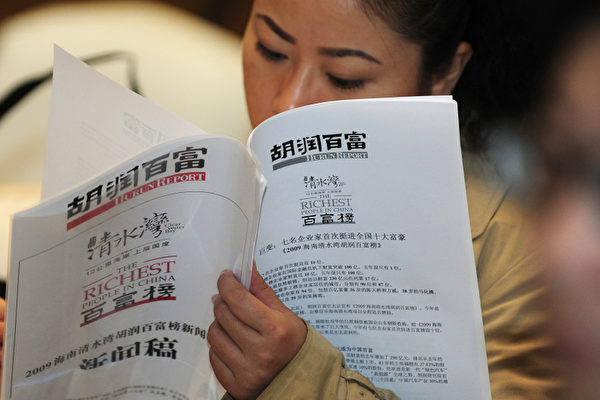
The Hurun Wealth Report has revealed changes in the number, scale, and distribution of affluent families in China, with a decrease in both the number and wealth of families meeting various wealth criteria. In the changing political and economic environment of China, the affluent class is actively seeking avenues, including transferring assets overseas.
On June 30, the Hurun Research Institute and BEA released the “BEA·Hurun Wealth Report 2025.” This marks the 17th consecutive year that the Hurun Research Institute has published this report, shedding light on the number, regional distribution, and demographic composition of affluent families in China. The report was based on data from 2024 for statistical and analytical purposes.
The report disclosed the number of households in China with total wealth exceeding 6 million, 10 million, 100 million RMB, and 30 million USD, along with the corresponding number of investable asset households. Covering 34 provincial-level administrative regions in China, including Hong Kong, Macau, and Taiwan, totaling 108 cities, the report aims to comprehensively illustrate the changes in the size and distribution of wealthy families in China.
According to the report, the number of affluent households in China with assets of 6 million RMB has decreased to 5.06 million households, a 1.3% decline year-on-year, representing a reduction of 68,000 households. The number of high net worth households with assets exceeding 10 million RMB was 2.005 million households, down 2.9% compared to the previous year, with a decrease of 60,000 households. The number of ultra-high net worth households with assets exceeding 100 million RMB was 126,000 households, a 3.1% decrease from the same period last year, amounting to a reduction of 4,000 households.
The total wealth of affluent households in China with assets exceeding 6 million RMB amounted to 145 trillion RMB, representing a 3.3% decline from the previous year. Among these households, the ultra-high net worth households with assets exceeding 100 million RMB held a total wealth of 84 trillion RMB, accounting for 58% of the total wealth.
On the report release page of the Hurun Group website, Chairman and Chief Research Officer Hurun mentioned that global private wealth distribution displays an imbalance. While North America has continued its recovery since 2023, benefiting from sustained growth in the stock market and the push for high-interest rate policies, “the resilience of private wealth in China is weaker than major developed economies, primarily due to the intensification of Sino-U.S. trade conflicts and constraints from weak domestic demand, in addition to the ongoing real estate market adjustments.”
Hurun stated, “From a national perspective, for every 250 households, there is one high net worth family with assets over 10 million RMB; for every 100 households, there is one affluent family with assets exceeding 6 million RMB.”
The total wealth in the report encompasses both fixed and liquid assets. Fixed assets include equities of listed or unlisted companies, residential properties, and investment properties; liquid assets comprise stocks, funds, bonds, deposits, insurance, among others. The report predicts that approximately 21 trillion RMB of wealth will be transferred to the next generation in the next 10 years.
Political observer Xia Yan pointed out that both affluent and ordinary families in China are experiencing a shrinkage of wealth due to policies implemented by the Chinese Communist Party. Ordinary families bear greater pressure, as the total amount of RMB deposits seems high, while the actual wealth of ordinary families is “averaged out.” Constant policy changes have undermined market confidence, failing to achieve the so-called “common prosperity,” instead damaging the economy and burdening the whole population with the consequences.
International media and research institutions have paid attention to the changes in the political and economic environment in China, prompting the wealthy class to seek avenues, including asset relocation overseas.
In the “Global Wealth Migration Report 2025” released by the UK consulting firm Henley & Partners, China once again topped the list as the country with the highest outflow of millionaires worldwide. In 2024, over 15,200 Chinese millionaires with assets exceeding $1 million USD moved abroad, making China the country with the most millionaire outflows globally for the third consecutive year.
According to the “China High Net Worth Individual Brand Inclination Report” released by the Hurun Research Institute, nearly 40% of surveyed high net worth families are considering moving abroad.
The Economist previously analyzed that the dim economic growth prospects in China, coupled with the need to address the capricious authoritarian leadership and uncertain relationships with major trading partners, have led to a worrying financial environment in China. Foreign investors, who once held boundless enthusiasm for China, are hurriedly withdrawing investments, as are many wealthy Chinese individuals.