
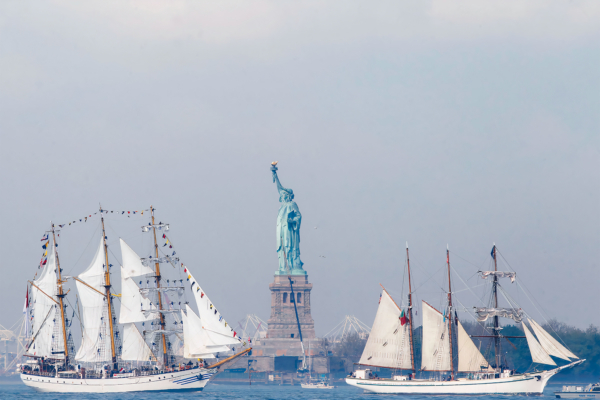
From the colonial era of “New Amsterdam” in the Netherlands to the American independence, the gateway of global immigration, and now the world’s tall ships gathering, “New York Harbor” has once again become the focus of the world. On July 4, 2026, New York Harbor transformed into the world’s largest maritime stage, welcoming nearly 40 tall ships from over 20 countries and more than 40 naval vessels.
At the same time, in the sky, the U.S. Navy Blue Angels flight demonstration team led a formation of 120 aircraft as they soared over New York Harbor, putting on a joint performance across the sea and sky to celebrate the 250th Independence Day of the United States.
On that morning, majestic tall ships with billowing white sails crossed the Verrazzano-Narrows Bridge, sailed past the Statue of Liberty, navigating in alphabetical order of their countries’ English names along the Hudson River northward to the George Washington Bridge before returning to New York Harbor to dock at various piers. Along the way, masts stood tall, sails fluttered, and hundreds of sailors lined up on deck, saluting the many onlookers ashore.
This magnificent maritime parade, known as “Sail4th 250,” marked the beginning of the largest tall ship gathering in American history. Each ship carries its own country’s seafaring traditions, symbolizing exploration, adventure, and friendship across borders.
Organizers estimate that the six-day event will attract around 6 million people to flock to the ports of New York and New Jersey, collectively witnessing this historic moment spanning land, sea, and air along the 15-mile coastline.
However, for many, what truly moves them about this event is not just the spectacular fleet of ships or the fighter jets soaring through the skies, but the location of the event itself – New York Harbor.
Few ports in the world can carry such a rich and diverse history as New York Harbor.
Around 1624, the Dutch established New Amsterdam on this land, developing it into an important commercial port with a natural deepwater harbor. After the British took over in 1664 and renamed it New York, the harbor gradually evolved into one of North America’s significant ports. During the American Revolutionary War, New York Harbor became a military and supply stronghold fought over by the British army and colonial forces, witnessing the most critical chapters in the birth of this fledgling nation.
By 1776, the United States declared its independence and New York Harbor witnessed the birth of a new nation, evolving into one of the world’s busiest ports and a significant gateway for America’s global outreach.
From the late 19th century to the early 20th century, over 12 million immigrants from various parts of Europe arrived at New York Harbor aboard ocean liners crossing the Atlantic. For many of these early immigrants, the sight that often captivated them upon the end of their long voyages was the Statue of Liberty towering over the harbor.
For countless immigrants at that time, seeing the Statue of Liberty symbolized a fresh start in their new lives.
Some arrived with a suitcase holding all their possessions, not speaking a word of English; they left behind famine, war, political persecution, and poverty, coming to this land with the belief that freedom and democracy could change their destinies. Stepping foot on American soil from Ellis Island, they, along with their descendants, collectively built the multicultural city of today, gradually turning New York Harbor into a symbol of “the harbor of liberty.”
Therefore, this year, all tall ships chose to sail past the Statue of Liberty once again, not just as a route for the event but as a deeply symbolic historical ritual.
250 years ago, the colonists fought for freedom in these waters, initiating a revolution that changed world history. 250 years later, tall ships from various countries raise their sails once again, sailing towards the same harbor. These ships no longer carry colonialism and conquest but instead, beliefs in peace, friendship, and the guardianship of shared values.
Tall ships were once the primary tools for humanity to explore the world, open sea routes, and cross oceans. They were also crucial vessels for America’s early commercial, maritime, and diplomatic endeavors. Each mast, each sail, carries seafaring technologies, national histories, and maritime cultures.
Therefore, in today’s era of satellite navigation, nuclear power, and aircraft carriers, for most people, tall ships always evoke a sense of nostalgic, romantic charm reminiscent of the age of great voyages. However, the ships docked in New York Harbor are mostly active training vessels of various countries’ navies.
The young naval officers and cadets onboard not only learn modern navigation technologies but also must master centuries-old seafaring techniques, including wind recognition, sail operation, reading sea currents, and relying on teamwork to complete each voyage in the unpredictable seas.
Chris O’Brien, the chairman of Sail4th 250, stated that each tall ship serves as an official representative of a nation, and when it docks at a port, it’s akin to an official state visit. He pointed out that crews from different countries will open their ships for public tours, inviting everyone to come aboard to learn about different cultures, fostering friendships through seafaring.
“They shoulder not only naval training but also a mission to promote international goodwill,” O’Brien expressed during a media interview.
Therefore, the tall ships sailing into New York Harbor today are not just historical artifacts but are cultural ambassadors still sailing in today’s world, engaging in maritime cultural diplomacy.
The history of Sail4th 250 traces back to 1961.
Then-U.S. President John F. Kennedy supported and promoted the “Operation Sail (OpSail)” program, aiming to gather active tall ships from around the world in the United States during significant commemorative years, fostering international friendship and peace exchange.
It was an era dominated by steam and diesel power. Many then believed that sailboats that once ruled the global seas for hundreds of years were fading from history’s stage.
O’Brien, the chairman of Sail4th 250, noted that the founders of the event had a very simple idea at the time, “to gather these majestic tall ships before they completely disappear.”
However, history did not unfold as people predicted.
Tall ships not only did not disappear but gradually transformed into vital platforms for naval training for various countries and became important symbols for countries worldwide promoting cultural diplomacy.
The OpSail held in New York for the first time in 1964 has been regarded by many maritime historians as a significant turning point in the global revival of tall ship culture. Subsequently, large sailing festivals emerged worldwide, including the renowned SAIL Amsterdam in the Netherlands, all influenced by OpSail.
Today, what was once a vision to preserve maritime culture has evolved into an international event involving dozens of countries.
In 1976, during America’s Bicentennial, Operation Sail became one of the most representative international events of the year. Now, half a century later, the Sail4th 250 for the 250th anniversary has set a new record for scale.
Official records indicate that this year will see 37 tall ships, 15,000 sailors collectively participating, including world-renowned training ships such as Italy’s “Amerigo Vespucci,” Portugal’s “Sagres,” Germany’s “Gorch Fock,” Romania’s “Mircea,” and the historic American ship “Elissa.”
This year’s event not only features tall ships. The U.S. Navy is concurrently hosting the International Naval Review, with over 40 U.S. and allied naval vessels moored in the Hudson River, accompanied by naval officers from 46 countries gathering in New York. This marks the largest multi-nation naval assembly in the United States since the Bicentennial in 1976.
From July 5th to 7th, the tall ships moored at the ports of New York and New Jersey will be open for free public boarding. Visitors can walk the decks, meet the crew, learn about different cultures, and experience firsthand how these vessels sailing around the world connect through the seas.
In accordance with international maritime conventions, boarding a foreign naval training vessel is equivalent to stepping onto that country’s territory, yet during the event, the public will be able to board for tours without passports, turning these once symbols of national sovereignty into bridges for promoting people-to-people exchanges, to experience different cultures and maritime traditions up close.
The 250th anniversary commemorates not only the signing of the Declaration of Independence but also the continuous pursuit of freedom by immigrants from various countries over the past 250 years.
For many immigrants, their pursuit is not just for political democracy but most importantly for religious freedom. From the 17th century when new immigrants crossed the Atlantic seeking religious autonomy, to the inclusion of religious freedom in the first amendment of the U.S. Bill of Rights, respecting different beliefs and cultural backgrounds, peaceful coexistence of people with varying faiths gradually became a significant component of America’s founding principles.
Therefore, when more than 40 countries’ naval vessels gather in New York Harbor, this maritime celebration’s symbolism goes beyond just celebrating Independence Day; it becomes a cross-border and cross-cultural festivity.