
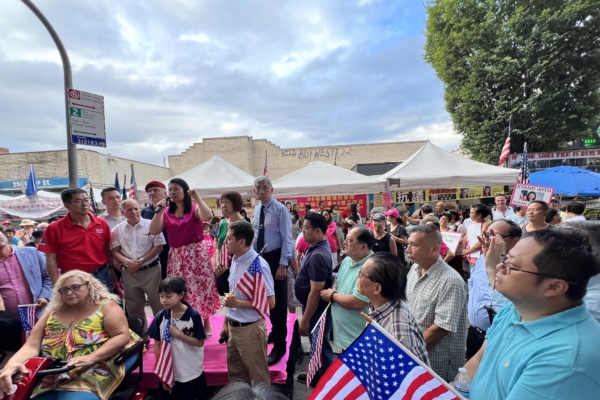
In a report published by Epoch Times on July 4, 2026, it was highlighted that the ongoing discussions surrounding the establishment of shelters for the homeless in New York City’s Chinatown area have taken a significant turn. The upcoming public hearings by the Board of Standards and Appeals (BSA) for the Bayard Street Homeless Shelter, simultaneous progress in administrative and judicial procedures for the Benson Hurst 86th Street shelter case, and the continued scrutiny of the East Broadway 91 Safe Haven have collectively transformed the community protest over the homeless shelters’ locations into a legal battle concerning city zoning laws, building district approvals, and administrative procedures.
After careful analysis, it was discovered that the three most prominent homeless shelter cases in the Chinese community fall under three different policies and legal frameworks: Supportive Housing, Traditional Shelters, and Safe Havens. While all three serve the homeless population, they differ in terms of regulatory positioning, funding sources, governing authorities, and land use procedures, leading to varying legal challenges raised by residents.
Under current regulations in New York City, Traditional Shelters typically bypass community voting and zoning changes by being constructed under city-approved procurement contracts with “By-Right” provisions. In times of homeless surges or refugee crises, the city can utilize emergency procurement mechanisms to rapidly sign operating contracts with non-profit organizations, exempting the standard public bidding and pre-community consultation processes to swiftly establish shelters.
As for Supportive Housing, being categorized primarily for residential purposes rather than traditional homeless shelters, these projects often follow general residential development procedures as long as they comply with existing zoning regulations. Some residents question whether projects approved under the guise of Supportive Housing end up functioning as Traditional Shelters, thus challenging the initial approved usage and relevant regulations, leading to several controversial cases in recent years.
Traditional Shelters mainly provide emergency shelter and are operated by non-profit organizations under short-term contracts commissioned by the New York City Department of Homeless Services (DHS). On the other hand, Supportive/Transitional Housing aims to combine housing with social services to assist residents in long-term stable housing, often involving federal and state long-term housing funds with contracts extending up to 20 to 30 years, subject to the requirements of agencies like the Department of Housing Preservation and Development (HPD).
Safe Havens fall between the two categories, catering to individuals who prefer not to stay in large homeless shelters. Residents can stay for longer periods with fewer entry restrictions before transitioning to Supportive Housing or other permanent residences when stability is achieved.
One of the most noticeable differences highlighted by residents is the mode of accommodation – Traditional Shelters typically offer emergency shelter with daytime evacuation requirements for most single adults, while Supportive Housing allows round-the-clock residency akin to regular housing, providing individual case management, medical, and employment support services. Safe Havens adopt a more flexible approach, allowing residents to stay on-site 24/7 with less stringent rules to accommodate long-term street dwellers.
Residents have raised concerns about mixed-use procedures seen in recent city projects where applications submitted to the Department of Buildings (DOB) as Supportive Housing or community facilities later operate as Traditional Shelters under agreements with DHS. Such practices have sparked debates on the consistency with approved usage and legal challenges.
The upcoming BSA public hearings for the Coyle Street Shelter at 2134 Coyle St on August 10 have attracted various written concerns from residents, questioning aspects including eligibility criteria for Supportive Housing, Mandatory Inclusionary Housing (MIH) regulations, land ownership, developer qualifications, and DOB’s building permit procedures.
Residents pointed out discrepancies in DHS’s initial project description to DOB, which once labeled the project as transitional housing capable of accommodating 175 family units but was later treated as a traditional homeless shelter service contract by the city in partnership with the operator. This move raised suspicions among residents regarding potential future adjustments by the city to manipulate demographics, such as replacing families with single individuals or maintaining a 95% occupancy rate, leaving legal loopholes. This issue also relates to the shift in federal funding allocations from traditional homeless shelters to supporting housing projects.
In the case of the Bensonhurst 86th Street Men’s Shelter with 150 beds, residents have pursued multiple avenues, including administrative appeals to the BSA and court hearings on neighbor access permits under RPAPL Article 881. Residents have continued to file administrative complaints with the DOB, questioning the legality of zoning applications, statutory notification procedures, and construction processes.
Concerning the East Broadway 91 Safe Haven case in Chinatown, the focus has shifted to the Building Use Permit (CO). Since Safe Havens operate as a service model rather than a legal building use classification, the primary legal issue lies in determining the building’s final approved use and any potential changes in building use categories.
Residents highlighted developers attempting to retain the hotel designation for partial exemption from reviews while seeking DOB approval for changing the building use category from J-1 (suitable for short-term daily/weekly lodgings) to R-1 (within 30 days), along with the addition of a medical clinic. Residents argued whether these alterations affect the original building use and application procedures, marking crucial legal points in the case possibly linked to the project’s pending CO approval.
Overall, these three cases reflect not just the establishment of homeless facilities in communities but also whether different types of shelter facilities are being developed in compliance with their respective legal frameworks within building laws, zoning regulations, and administrative procedures. This has shifted the community’s protest from political realms to battles concerning legal regulations and procedures.