
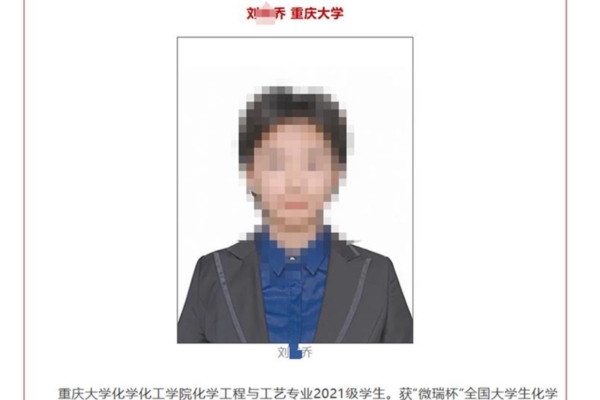
Recently, an article about Liu Qiao, a senior student at Chongqing University, has sparked attention online. According to the article, Liu Qiao has published 14 SCI journal papers and obtained multiple national invention patents. Students at the university suspect that Liu Qiao’s achievements may be linked to her father, who is a vice dean at the university.
On May 7th, a WeChat public account post titled “These 8 Students in Chongqing Receive National Scholarships” claimed that Liu Qiao, a fourth-year student from the School of Chemistry and Chemical Engineering at Chongqing University, has already published 14 SCI papers and received authorization for 3 national invention patents. Additionally, she has served as a teaching assistant for two semesters, accumulating 60 hours of work and volunteering in academic support activities for a total of 24 hours.
SCI (Science Citation Index) is one of the world’s three major indexing systems, mainly featuring influential journals in the fields of natural sciences and engineering. Liu Qiao’s impressive resume has led netizens to question, can undergraduates really publish multiple SCI papers and obtain multiple national invention patents?
Journalists from Cover News found through a search on the Chinese knowledge network that there are indeed 14 patents under the name “Liu Qiao”, with the earliest application dating back to 2016, indicating that at the time, Liu Qiao was likely still a middle school student.
However, none of these patents list Liu Qiao as the first inventor. For 12 of the patents, the first author is Liu Hua, while for the remaining 2 patents, the first author is Liu Long.
Chongqing University’s official website shows that Liu Hua is the vice dean and professor of the Graduate School, and Liu Long is a professor at the same school. According to multiple Chongqing University students who spoke to Cover News, Liu Hua and Liu Qiao are father and daughter. Students suspect that Liu Qiao’s academic achievements are related to her father.
In response, Chongqing University released a “Statement of Facts” on the evening of May 8th, stating that a special working group has been established to verify the situation, and if any improper behavior is found, it will be handled in accordance with relevant regulations.
The investigation results are pending. However, according to an educator from a higher education institution, it is unimaginable for an undergraduate to publish 14 SCI journal papers. “The extent of involvement is questionable. Undergraduates need to attend classes, conducting experiments to publish papers requires time.”
According to this educator, participating in paper publications can link to evaluations, recommendations for graduate studies, and other qualifications.
Another educator stated that the authorship order of papers is determined by the level of contribution, with the first author being the main executor of the experiment and writer of the paper. The corresponding author is usually the supervisor, providing guidance on the article and communicating externally. “Aside from the first and corresponding authors, the further down the list the author is, the smaller the contribution. If Liu Qiao has made contributions to experiments and writing, then it’s reasonable to be included in the author list. We look forward to Chongqing University’s investigation conclusion.”
Faced with inquiries, Liu Hua himself has chosen not to respond to media questioning.
According to netizens, such practices are seemingly common in China. “My senior sister published articles, and the supervisor would include his wife and daughter’s names. His daughter participated in various competitions, requiring experimental designs. The supervisor had us help with this, and a senior sister in the third year prepared the English presentations and reports.”
However, some netizens also mentioned, “I am also in the field of science and engineering. Many experiments are straightforward, even middle school students can do them. He just doesn’t understand the principles, does some basic work, puts his name on it.” “Conducting experiments is not difficult; research and development are the challenging parts.”