
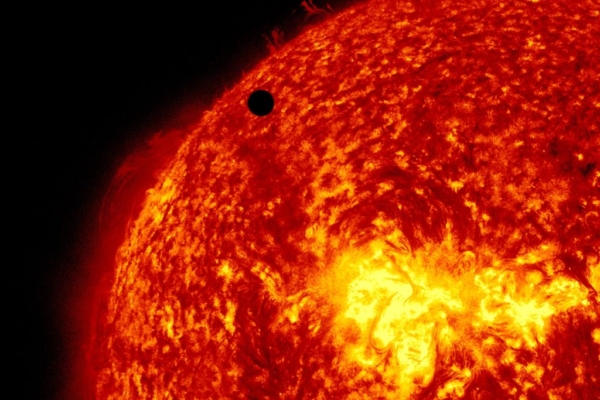
In recent years, the solar activity cycle, often metaphorically referred to as the “heart beat” of the sun, has been undergoing abnormal changes. Scientists have recently discovered through observations that the sun may be entering a different operational mode unlike anything seen in the past 40 years.
Bill Chaplin, an astrophysicist at the University of Birmingham in the UK, has been analyzing data from the Birmingham Solar Oscillations Network (BiSON) to study the internal activities of the sun. The BiSON, consisting of 6 remote solar observation stations worldwide, has been collecting solar oscillation data since 1976. By analyzing nearly 40 years of Doppler velocity data, Chaplin’s team confirmed unprecedented changes in the sun.
Researchers examined the “p-mode oscillations” within the sun, which are oscillations that propagate like sound waves inside the sun, causing the sun to resonate like a massive thermonuclear bell.
To assess the activity at different depths within the sun, the research team analyzed three oscillation frequency ranges: low, medium, and high. They then compared this data with two external indicators of solar activity – sunspot numbers and area, as well as solar radio flux strength – to determine if there was consistency between internal and external activities.
The study revealed an intriguing phenomenon: while the surface (outer layer) activity of the sun was weaker than expected, the high-frequency oscillations within the sun were stronger, exhibiting characteristics of early solar cycle patterns.
According to Chaplin, this discovery marks a significant milestone in the scientific community’s understanding of the sun.
The sun, likened to a bar magnet, has two poles.
Primarily composed of high-temperature charged plasma, the sun’s plasma continuously churns and generates a magnetic field. Due to the vigorous internal motion within the sun, coupled with the phenomenon known as “differential rotation” (where the equatorial rotation speed is faster than the poles), the magnetic field is constantly stretched, twisted, and becomes increasingly complex. Eventually, this leads to the reversal of the sun’s north and south magnetic poles. Typically, within each 11-year solar (sunspot) activity cycle known as the Schwabe cycle, the poles will flip once.
To complete a full magnetic field cycle (restoring the original polarity), it takes approximately 22 years. This magnetic cycle is known as the “Hale cycle.”
During the solar (sunspot) activity cycle’s minimum period, the sun is relatively calm, and its impact on Earth is milder.
However, as the sun enters the period of maximum activity, its surface becomes highly unstable, prone to releasing intense energy in the form of solar flares and coronal mass ejections (CMEs), which hurl large quantities of charged particles from the sun’s corona into space. These space weather events have the potential to disrupt satellites, GPS systems, communication networks, and power grids.
In recent cycles, both the overall intensity of solar activity and the evolution of the magnetic field have been undergoing changes. In the previous cycle (Cycle 24, lasting from December 2008 to December 2019), solar activity significantly weakened, with reductions observed in sunspot numbers and radiation activity at various wavelengths.
Sarbani Basu, an astronomer at Yale University, stated, “We have observed changes in the relationship between solar interior oscillations and surface activity over the past few cycles.” She noted, “This trend cannot be solely explained by a weakening magnetic field; in fact, it indicates a restructuring of the magnetic field distribution beneath the sun’s surface.”
This research has been published in the Monthly Notices of the Royal Astronomical Society (MNRAS) and draws references from the coverage by the technology news website ScienceAlert.