
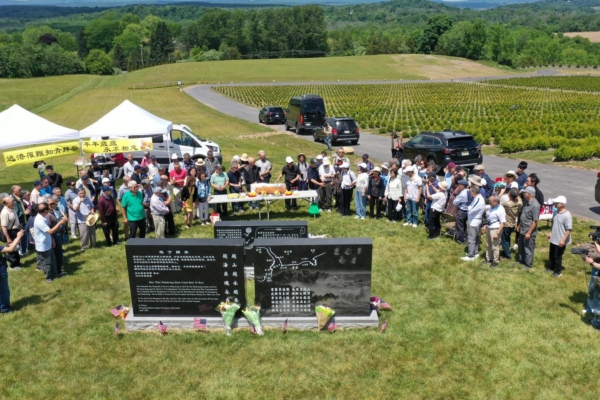
On June 7th, under clear skies, nearly two hundred individuals from the East Coast, West Coast, as well as Hong Kong and Australia, gathered in front of the “Fleeing Hong Kong Peril Memorial Monument” at the perpetual happiness cemetery in New Jersey to mourn their relatives or friends who tragically lost their lives during the process of fleeing Hong Kong from the late 1960s to the early 1980s.
This year marks the fifth year of the memorial ceremony, with the highest number of participants and the best weather. Following the principle of “not forgetting year after year”, these mourners have been holding this memorial event every year since the first monument was erected in 2022. Now, three monuments stand in the cemetery, each inscribed with the names of 430 victims.
Although most of the mourners are elderly, aged over seventy and gradually weakening, they persist in commemorating this segment of their own lived history. What is even more heartening is that among the mourners are descendants of the fleeing Hong Kong youths and several young scholars who are studying this history, all deeply moved and expressing that this unimaginable tragic history must never be repeated.
The head of the monument building group in the East Coast, who organized this event, stated: “The number of names of deceased Guangzhou youths who fled Hong Kong recorded on the monument is 430, far exceeding the death toll of the Berlin Wall. This harrowing fact of the last century is little known to the world, and investigating and compiling statistics is not easy. The Guangzhou Youth Fleeing Hong Kong Memorial Monument is the first monument dedicated to naming the victims of the Communist movement. We are now rescuing the history of our generation ourselves, and the lessons of history must never be forgotten.”
Renowned preacher Manny Perlman, who drove all the way from Maryland to participate in the memorial service, sang his song “Tide of Freedom” created in memory of the victims: “The sea is cold, the journey is long, but our hope is incredibly strong, breaking through the turbulent sea, in the tide of freedom, we will sing your name.”
The memorial ceremony included traditional ways of honoring the deceased such as burning incense, presenting flowers, and offering words of condolence. After the ceremony, participants gathered for a discussion near the monument. They fondly recalled the hardships of their smuggling journey and sincerely appreciated Hong Kong, the first piece of free land that sheltered them, and the United States, which enabled them to build a better life.