
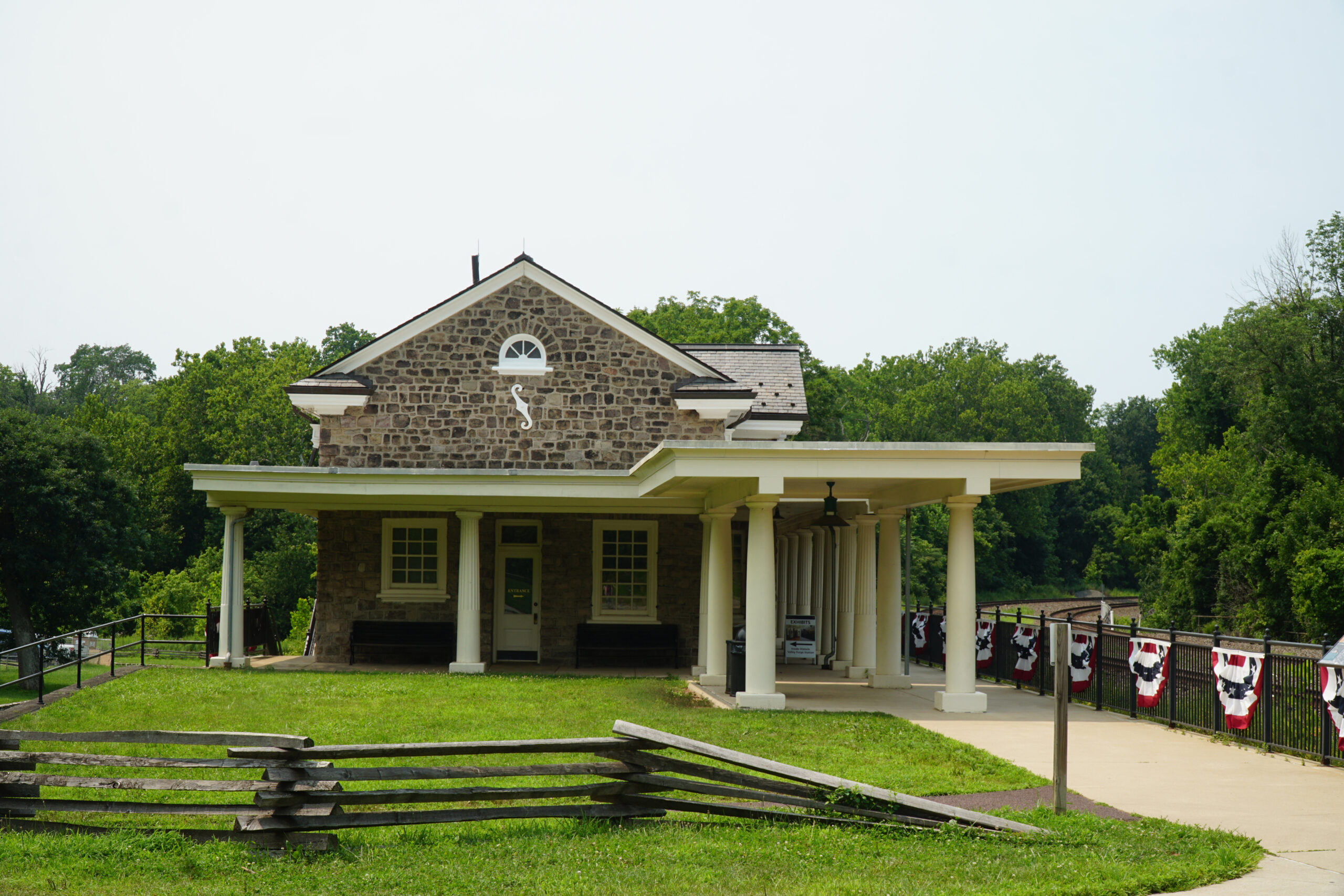
In the northwest of Philadelphia, Pennsylvania, about 40 kilometers away, lies the 3,500-acre Valley Forge National Historical Park. During the harsh winter of 1777 to 1778, George Washington led the Continental Army to camp here for six months. This place played a crucial role in American history, witnessing not only a turning point in the American Revolutionary War but also how General Washington built an army that changed the course of American destiny.
In the winter of 1777, after the British captured Philadelphia, General Washington led approximately 12,000 Continental Army soldiers to Valley Forge to camp for the winter. Six months later, this originally poorly equipped, loosely disciplined, and on the brink of disbandment militia emerged from Valley Forge with a new look, becoming a disciplined army capable of standing up to the then world’s most powerful British army, contributing significantly to America’s victory in the Revolutionary War.
Visitors are drawn to a simple stone house, Washington’s Headquarters, when entering Valley Forge. It was here, in this small cabin, that Washington commanded the Continental Army during the winter of 1777 to 1778. He and his staff dealt with a multitude of tasks daily, including issuing general orders, analyzing intelligence, maintaining relationships with civilians, translating documents from France and Spain, meeting with European officers, arranging personnel appointments in the Continental Army, listening to survivors’ reports, and managing prisoner exchanges. All these works were documented in letters, orders, and official documents, all handwritten by the staff themselves.
By the end of 1777, the American Revolutionary War hit a low point. New York fell, Philadelphia was captured, the Continental Army lacked supplies, diseases spread, and about two thousand soldiers perished in that harsh winter. Some senior officers in the army lost confidence in Washington due to consecutive defeats, even attempting to replace him as commander.
Faced with external threats, internal doubts, and the possibility of the revolution failing at any moment, Washington did not back down. Instead of choosing to engage the British army in a risky battle, he opted to preserve the strength of the Continental Army, wear down the British through a war of attrition, and wait for the opportunity for ultimate victory.
Washington’s greatness was not only evident on the battlefield. In Valley Forge, he not only formulated strategies but also began a comprehensive reform of the Continental Army. He implemented a series of reform measures, including strengthening training, establishing regular formations, ensuring supplies of food and materials, extending terms of service, implementing a merit-based system for officers’ appointments, and establishing retirement benefits for officers. These measures aimed to create a resilient force capable of enduring against the British in the long run, ultimately securing victory.
When Washington’s army arrived in Valley Forge camp on December 19, 1777, exhausted, cold, and lacking the necessary training for sustained victories on the battlefield. After six months of encampment, the army rallied and successfully repelled the British in the Battle of Monmouth in New Jersey on June 19, 1778, showcasing the transformative change in the Continental Army. Washington’s leadership in continuous victories played a crucial role in ultimately winning the Revolutionary War.
The exhibit at Washington’s Headquarters evaluates the founding father of the United States as follows: “George Washington led America for a quarter of a century, a term unmatched in American history.” “His initiative always accompanied by humanitarian spirit and honesty.”
From a plantation owner to a commander, and then to the President of the United States, Washington’s achievements in various positions fully demonstrate his wisdom, foresight, pragmatism, and iron-like discipline. Those who worked with him unanimously pointed out that his code of conduct was based on fairness and respect for others.
The exhibit also emphasized that Washington never shirked difficult responsibilities. “During the eight-year war, he placed responsibility and principles above personal interests, inspiring those around him to do the same. He took command of the Continental Army, challenged the world’s most powerful army at the time, putting everything at stake – once the British won, he would face persecution, and his family’s wealth would be confiscated.”
Not far from Washington’s Headquarters is the magnificent Gothic-style building – Washington Memorial Chapel.
Although the chapel is located within the Valley Forge National Historical Park, it is privately managed, not belonging to the National Park Service. Built between 1903 and 1917, it was constructed to commemorate the founding father of America, George Washington. Inspired by a deep admiration for Washington, Anglican pastor Rev. W. Herbert Burk initiated the construction of this temple, which not only worships God but also commemorates George Washington and the Continental Army, hoping that future generations will remember not only the victory of the American Revolutionary War but also those who took responsibility and were willing to sacrifice for freedom.
According to the chapel’s guide Deb Brinker, almost every design in the chapel carries symbolic significance. She said, “There are 13 large windows here, symbolizing the original 13 colonies. If you look closely, you will find that the main colors of the windows are red and blue, mainly to embody patriotism.”
The ceiling of the chapel displays American imagery, with the emblems of all 50 states arranged according to the order in which they joined the United States; bronze panels on the ground indicate the corresponding state emblem above.
The stained glass windows depict the development of America from Columbus discovering the New World, the colonial period, figures of American founding such as Franklin, Jefferson, Washington, to the arrival of the Bible and the scenes of Washington presenting the Bible to his children and stepchildren, showcasing the development of American history and faith.
The walls of the chapel are adorned with many flags, including Washington’s flag as the commander in chief and flags of the Philadelphia Light Horse unit, the first American flag made by Betsy Ross, and more.
A striking Washington statue on one side of the chapel is noteworthy. Brinker explained that unlike the typical Washington statues on horseback or standing tall, this statue portrays Washington during the Revolutionary War facing conflict, internal challenges, shouldering responsibility, and upholding beliefs.
Opposite the chapel is the training ground where Washington’s soldiers trained, also known as the Grand Parade. Brinker expressed, “Every time I walk out of the chapel and think about the history outside, it really feels special.”