
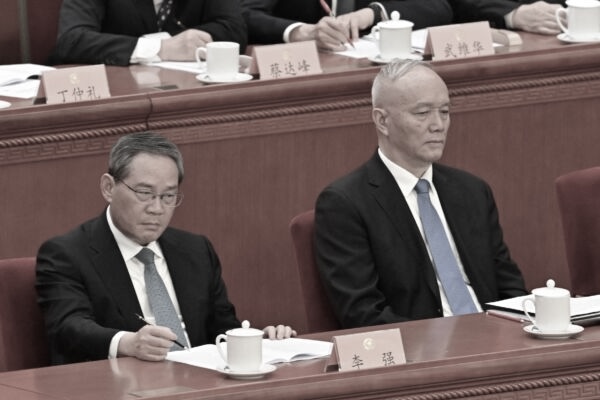
In a recent development, Cai Qi, who is now practically the second most important figure within the Chinese Communist Party, has added the title of President of the Central Party School to his credentials. The level of the Party School President is closely tied to the crisis awareness of the top echelons of the Chinese Communist Party. It is considered abnormal for Cai Qi to hold the position of the Director of the General Office of the Party, especially when the main focus within the Party is on power struggles, making the second most important figure the most vulnerable.
Cai Qi has replaced Chen Xi as the President of the Central Party School. This news was not officially announced by the CCP but was seen on CCTV on June 5th. On that day, Cai Qi appeared at a graduation ceremony in his capacity as the President of the Central Party School. This marked his first public appearance in this role, and the official website of the Central Party School has already been updated with Cai Qi’s name as the President.
It is generally believed that this move indicates the return of the Central Party School President position to the Politburo Standing Committee.
The Central Party School, formerly known as the Central Marxist-Leninist Institute, has had varying levels of significance at different times. It held high esteem before and after the establishment of the People’s Republic of China, when there was a crucial need for strategic shifts from war to peaceful governance. Mao Zedong himself served as the Director. During the period spanning the establishment of the PRC, the second most important figure in the CCP, Liu Shaoqi, served as the Director.
After 1953, the position of the Party School President was held by second- and third-tier figures, indicating that Mao Zedong believed his regime was consolidated, and the most challenging transitional period had passed. The training of senior officials within the Party was deemed a routine operation. Just as in 1954, the CCP adopted its own constitution and replaced the united front with the National People’s Congress, a reflection of internal adjustments within the party.
Similarly, after the end of the Cultural Revolution, the Central Party School was reinstated, with Hua Guofeng serving as both the General Secretary and President of the School. This highlighted the urgent need for internal education of senior party officials, requiring their loyalty to the new leadership and adaptation to the post-Cultural Revolution era.
The elevation of the Party School President’s level in 1989 was significant, coinciding with the Tiananmen Square crackdown. Qiao Shi, as a Politburo Standing Committee member, assumed the role of President. Although the appointment took place before the crackdown in April, the social tensions at the time had already alerted the top CCP leadership to the crisis. Since 1989, the President has always been a Standing Committee member, including two successors in Hu Jintao and Xi Jinping, until Xi Jinping’s second term when the role was downgraded to Committee member Chen Xi. This reflected Xi Jinping’s increased confidence, alongside considerations for Chen Xi.
It can be observed that the role of the Party School President is closely related to the loyalty of the major officials within the party and their influence on the leadership’s interests. The more unstable the situation and the more officials dissent, the higher the level of the President.
The primary function of the Central Party School is to systematically train senior party officials, ensuring their loyalty and understanding of major policies through regular reinforcement. Therefore, the reassignment of the President to Politburo Standing Committee member Cai Qi, as in the past, indicates Xi Jinping is sensing a crisis and needs to re-establish the loyalty of senior party members. This also signifies Xi Jinping’s trust in Cai Qi.
From another perspective, Cai Qi, ranking fifth in the Politburo Standing Committee, is perceived to hold more power compared to Li Qiang, Zhao Leji, and Wang Huning, making him the second most important figure after Xi Jinping. With titles such as Secretary of the Central Secretariat and Director of the General Office already under his belt, Cai Qi’s latest appointment as President of the CCP Central Party School adds to his growing influence.
Traditionally, serving as the President of the Party School while holding the position of Secretary of the Central Secretariat is not uncommon, but it is highly unusual for a Standing Committee member to serve as the Director of the General Office.
Prior to the Cultural Revolution, most Directors of the General Office were mere Central Committee members. After the Cultural Revolution, those who held the position were invariably either Politburo Committee members or Secretaries of the Central Secretariat, including Xi Jinping’s predecessors, Li Zhanshu, and Ding Xuexiang, both of whom were Committee members. Ding Xuexiang continued his tenure as Director for a few months after the 20th Party Congress, holding the transitional position.
Strictly speaking, Cai Qi is the first Standing Committee member of the CCP to serve as Director of the General Office since the establishment of the Party. This position is crucial not because of the status of the individual holding it, but because it serves as a hub of power.
In China, the exact definition of the CCP Central Committee can be ambiguous, ranging from being a member of the Central Committee to the Politburo or the Politburo Standing Committee. The office of a Party Central Committee is usually one level lower. The Director of the General Office functions as the Secretary-General or office of the entire Standing Committee, a position that should not typically be held by a Standing Committee member, similar to how the head of an institution cannot serve as their own secretary. By appointing Cai Qi, it may suggest that there is a lack of available or trusted candidates at the Committee member level.
The Director of the General Office holds all the secrets of the top CCP leadership, including the power to mobilize the Central Guard Bureau. There have been at least two coup attempts since the establishment of the PRC. The first was the arrest of the Gang of Four, which was orchestrated through the mobilization of the Central Guard Bureau under the direction of the Director of the General Office, Wang Dongxing, before the formal dismissal through proper channels.
The second instance was the arrest of Zhang Yuexia and Liu Zhenli. This scenario, much like the former, involved the personal direction of General Secretary Xi Jinping and did not go through any legal procedures, highlighting the potential use of the Central Guard Bureau by the Director of the General Office.
In mainland China, control over the Director of the General Office or at least part of the Central Guard Bureau is essential for any potential coup. Without it, even a highly respected veteran like Zhang Yuexia, with a significant reputation within the military, could only surrender. Nonetheless, the Director of the General Office serves as an executor, not a policy maker like a Committee member.
Therefore, for Cai Qi, being appointed as the Director of the General Office as a Standing Committee member does not imply an increase in his power. For the CCP, the necessity of having a Committee member assume a lower-level position reflects operational obstructions within the system.
Cai Qi, ranked fifth among the Politburo Standing Committee members, has emerged as the second most important figure within the Party.
Throughout CCP history, the period of economic reform and opening up presents an exception, where high-level power struggles and ideological disputes take precedence, making the second most important figure at the top of the power hierarchy the most vulnerable. Securing the position of the second most important figure requires considerable effort to consolidate the power of the paramount leader. During the Yan’an Rectification Movement, Liu Shaoqi laid the theoretical foundation for the movement, aiding Mao Zedong in reshaping party history and solidifying Mao’s leadership position. He advocated for establishing the party’s absolute authority early on, actively promoting personal worship of Mao Zedong.
As a result, Liu Shaoqi became the second most important figure in the CCP after Mao Zedong’s establishment of the PRC but also planted the seeds of becoming Mao’s top enemy in the future, ultimately meeting a disastrous end.
During the Cultural Revolution, Lin Biao also occupied the role of the second most important figure. In 1964, at a time when the conflicts between Mao Zedong and Liu Shaoqi were evident, Lin Biao, like Liu during the Yan’an Rectification Movement, promoted political delineation and the supremacy of Mao, fostering personal worship of Mao Zedong. As the successor, his status was even enshrined in the Party Constitution. However, he couldn’t avoid a confrontation with Mao Zedong, likely unintentional, and eventually fell into the trap laid out by Mao. Hua Guofeng managed to escape unscathed because he was never perceived as the second most important figure by Mao and also because Mao did not live long enough to initiate another ideological struggle.
Xi Jinping’s suspicions are no less than Mao Zedong’s, having purged all potential successors. However, this doesn’t imply he won’t create new targets. Opposition or lack thereof does not safeguard individuals, as seen in the cases of Liu Shaoqi and Lin Biao, both of whom did not oppose Mao Zedong yet suffered consequences.
The second most important figure indeed wields some power, making decisions and resolving issues that may not align with the supreme leader’s intentions, potentially becoming grounds for their removal.