
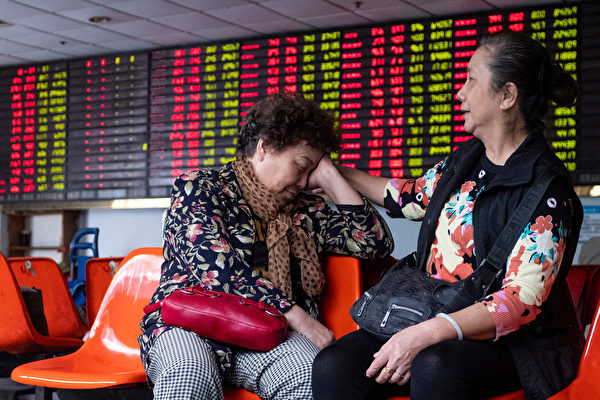
On June 3, China’s state television channel CCTV’s “News Broadcast” aired a rare 110-second report, stating that international funds are continuing to show optimism towards the Chinese economy and are increasing their investments in A-shares. However, on the following day, June 4, all three major A-share indices experienced a simultaneous decline, with over 4,100 individual stocks falling. The Hang Seng Index in Hong Kong also dropped by nearly 1.5% on the same day, showcasing a stark contrast between the market trend and the official media narrative.
The CCTV “News Broadcast” on June 3 featured a report titled “Long-term Foreign Investors Bullish on China, Continuously Increasing Investments in High-tech Industries,” with a duration of approximately 1 minute and 49 seconds.
The report mentioned that in recent times, several international financial institutions have released positive outlooks on the Chinese economy, increasing their investments in Chinese technology companies and expediting their investment layouts in China.
This marks the first appearance of A-shares on the “News Broadcast” this year, with more than a year having passed since their last coverage. Previously, A-shares were mentioned on the “News Broadcast” during market rallies on January 14, 2025, and September 30, 2024.
However, less than 24 hours after CCTV aired the positive news, the A-share market experienced a day of continual adjustment on June 4, with all three major indices collectively dropping, presenting a noticeable disparity from the previous day’s official narrative.
At the close of trading, the Shanghai Composite Index fell by 0.64% to 4,057.78 points, the Shenzhen Component Index fell by 0.27% to 15,561.57 points, and the ChiNext Index fell by 0.83% to 4,088.88 points.
Statistical data from Wind shows that a total of 4,120 stocks across both the Shanghai and Shenzhen stock exchanges, as well as the Beijing Stock Exchange, experienced declines.
The total trading volume in the Shanghai and Shenzhen markets amounted to 2.75 trillion yuan, a decrease of 372.6 billion yuan compared to the previous trading day. The Shanghai market recorded a trading volume of 1.2747 trillion yuan, down by 155.1 billion yuan compared to the prior trading day.
In terms of sector performance, the sectors of non-ferrous metals, retail, electrical power networks, culture and media, liquor, biotechnology, and oil and gas experienced significant declines, with lithium batteries, consumer goods, and AI applications showing notable downturns.
Within the retail and trade sector, companies such as Central Mart, China Resources Group, Step High, and Ningbo Central Mart all fell by over 5-7%.
The negative trend in the A-share market spilled over to Hong Kong’s Hang Seng Index on June 4, which dropped significantly on the same day, continuing the overall subdued market sentiment.
The Hang Seng Index in Hong Kong fell by 379.81 points, a decline of 1.48%, closing at 25,253.4 points. The total trading volume on the main board for the day was 270.23 billion Hong Kong dollars.
The Hong Kong-listed state-owned enterprises index fell by 94.68 points to close at 8,501.91 points, a decrease of 1.1%. The Hang Seng Technology Index dropped by 81.61 points to 4,975.36 points, a decline of 1.61%.
Among the blue-chip stocks, Tencent Holdings fell by 1.59%, Hong Kong Exchanges dropped by 2.1%, China Mobile fell by 0.94%, and HSBC Holdings declined by 0.34%.
Regarding mainland Chinese financial stocks, Bank of China fell by 0.38%, Construction Bank fell by 0.23%, Industrial and Commercial Bank showed no significant change, and China Ping An dropped by 1.3%.
In the petroleum and petrochemical sector, China Petroleum & Chemical Corporation fell by 0.46%, PetroChina fell by 1.31%, and CNOOC Ltd. dropped by 0.88%.
On June 3, the Hang Seng Index in Hong Kong witnessed a decline of 405.11 points, a decrease of 1.56%, closing at 25,633.21 points. The total trading volume on the main board for that day was 322.921 billion Hong Kong dollars.