
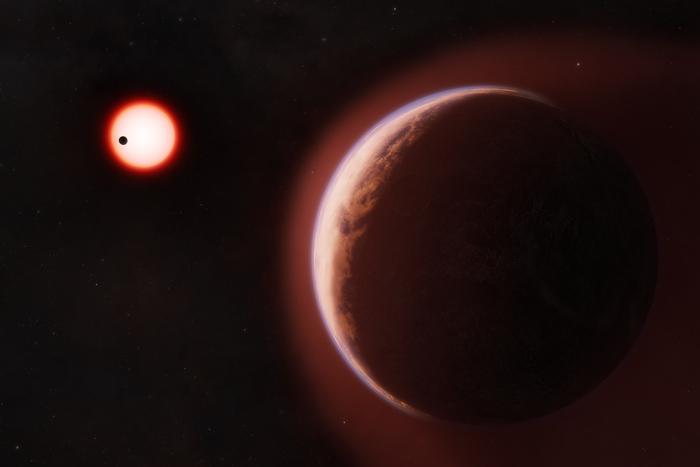
Astronomers have, for the first time, detected an atmosphere on a rocky, Earth-like exoplanet outside our solar system, which is located in the habitable zone of its parent star, potentially suitable for life. This discovery marks a significant milestone in the search for alien life.
According to a press release issued by the Center for Astrophysics at Harvard & Smithsonian (CfA) on July 16, this finding provides the strongest evidence yet that planets with similar composition and temperatures to Earth, capable of sustaining life, may exist beyond our solar system.
Collin Cherubim, the lead author of the study and a recent Ph.D. graduate in Earth and Planetary Sciences from Harvard University, explained, “As we know, the presence of an atmosphere is crucial for a planet to support life.”
He added, “This is the first time that an atmosphere has been found on a rocky exoplanet located in the habitable zone of another star.”
Named LHS 1140 b, this Earth-like planet is located approximately 48 light years away from Earth. It orbits a red dwarf star within the star’s habitable zone, where temperature and environmental conditions are suitable for the existence of liquid water on the planet’s surface.
Astronomers have discovered thousands of exoplanets to date, including a few rocky planets within their parent stars’ habitable zones. However, confirming whether these planets have atmospheres remains a significant challenge.
Robin Wordsworth, one of Cherubim’s Ph.D. thesis advisors and a professor in Earth and Planetary Sciences at Harvard University, stated that two decades ago, astronomers were unsure about the existence of other Earth-like planets. Since then, they have found such planets to be quite common and have identified some in habitable zones.
He said, “The next question is whether any of these planets can retain their atmospheres. Now we know that at least one does.”
While previous studies have identified rocky planets within the habitable zones of stars, this research is the first to definitively confirm the presence of an atmosphere on LHS 1140 b, which has been stable for billions of years.
Cherubim and his colleagues developed a theoretical model predicting that LHS 1140 b possesses a high-altitude atmosphere rich in helium, with this helium gradually escaping into space.
To verify this prediction, the research team conducted observations using a spectrograph at the Magellan Observatory in Chile. They observed LHS 1140 b and another planet passing in front of their parent star on the same night, a phenomenon known as a transit.
While one planet did not show signs of an atmosphere, LHS 1140 b exhibited evidence of helium escaping its surroundings, confirming the presence of its atmosphere.
The research results suggest that ground-based observatories equipped to detect escaping gases may become essential tools for studying the atmospheres of rocky exoplanets.
Researchers suggest that the atmosphere of LHS 1140 b has likely been in existence for over 3 billion years, making it a valuable target for future observations.
The findings of this study were published in the journal “Science” on July 16.