
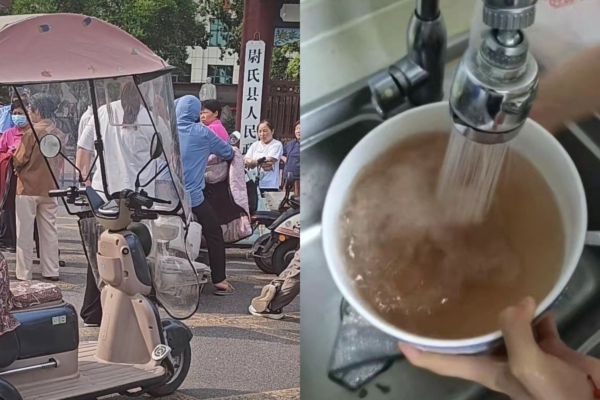
Water is the source of life, and water pollution directly affects human safety. Recently, there have been continuous reports of “poisoning” incidents in drinking water in Weishi County, Kaifeng, Henan Province, China. A large number of people have experienced symptoms such as nausea, diarrhea, and itchy skin, with nearby hospitals and clinics being overcrowded for several days. On May 22nd and 23rd, some residents protested in front of the Weishi County government, expressing dissatisfaction with the government’s handling of the situation.
According to a journalist from the mainland’s “Tide News” mobile app, when they contacted the mayor’s hotline in Kaifeng on May 23rd, the staff indicated that Weishi County has not yet achieved completely safe and normal water supply. After the water supply was partially restored in some areas, tap water appeared light blue, claiming it was due to residual disinfectants after the pipe network was disinfected. Currently, residents are advised not to use the water until an official notice for safe consumption is issued.
A resident of Hongyu International City in Weishi County, who goes by the pseudonym Yang Lan, told a reporter that the official information stated that tap water had been tested, and they were advised to let the water run for 30 minutes before using it for washing purposes, but not for drinking. Yang Lan mentioned that people experienced diarrhea after brushing their teeth or washing their face, some had stomach issues after showering, and others had skin problems, always sensing a foul odor in the water. The government did not disclose the bacterial content of the water, nor provide transparency on the water quality test results.
The entire county is facing water quality issues, with the government distributing bottled water only once. Yang Lan mentioned that she received only 24 bottles of water. Bottled water is in short supply and prices have surged to 20 yuan per bottle in some places.
The biggest dissatisfaction among residents is that the government’s compensation is merely providing each household with 20 tons of free tap water. Yang Lan said, “The key point is that they subsided tap water, but no one dares to drink it. It’s meaningless. This problem has been ongoing since April. The government tried to hide it, and once it became widespread, this situation emerged.”
Yang Lan criticized the government for its inaction, mentioning that some people protested while most were too unwell to participate, and even if they did, the issue was not resolved. There is a blame game going on between the property management and the government because they monopolize the water supply.
Expressing anger, Yang Lan stated that when problems arise, the government does not have effective measures in place, making it difficult for people to seek medical help. “Whether it’s a small clinic or a large hospital, the lines are always long. At a small clinic, you may have to wait until midnight, with over 200 people waiting in a day.”
Although the water supply has been restored, as of May 24th, the authorities have not released the recent water quality test data nor made a statement on the safety of tap water in response to public doubts.
Mr. Qi, a mainland Chinese citizen, pointed out that deep well water is fine, but the processed and filtered tap water is causing problems. This is not the first time such an issue has occurred; similar incidents have been reported in Hangzhou before. The government’s response to problems is lacking, as they merely subsidize a small amount of tap water, which Mr. Qi views as disrespectful and ludicrous. This situation reflects the lack of regard the Communist Party has for the Chinese people, where such incidents are considered minor, and people have become desensitized, depicting the prevailing situation in China.