
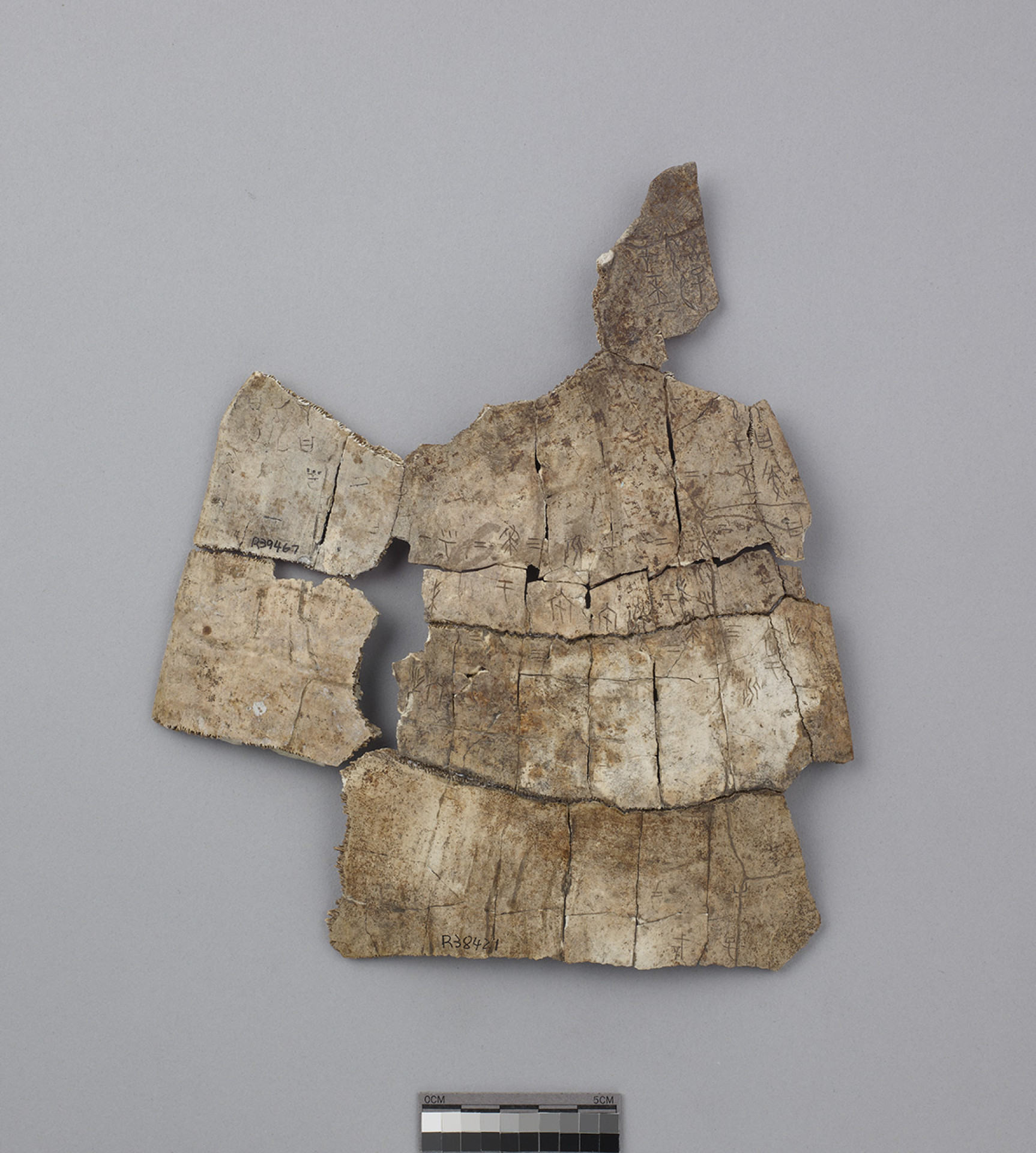
The Taiwan Academia Sinica (Institute of History and Philology) is currently hosting a special exhibition titled “Divine Back, Sacred Turtle: Late Shang Turtle Shells,” which runs until December 27th. This exhibition aims to provide insights into the material aspects of the turtle shell divination practice, with a focus on the often overlooked back shells, attempting to reveal the forms and variations preserved in the divinatory shells.
The exhibition “Divine Back, Sacred Turtle: Late Shang Turtle Shells” at the Institute of History and Philology is divided into three sections, showcasing common divination materials of the Late Shang period, the treatment of turtle shells, and the inscriptions carved on them. The Academia Sinica stated that under the hegemony of the Great Yi-Shang, there had been significant progress in social, cultural, political, and economic aspects. Yet, in the face of the unknown, merchants continued to rely on divination to communicate with spirits and foresee the future.
According to the Academia Sinica, turtle shells and scapulas, as spiritual objects, were transformed from living organisms into mediums for divination. The process involved a series of grinding, treatment, as well as circular drilling and prolonged carving to enable the casting of divinatory omens and queries.
Among the mediums used for divination by merchants, the most common were ox scapulas and turtle shells. Turtle shells, particularly plastrons, were most commonly used, possibly due to their flatness compared to back shells, making them easier for drilling and carving.
The treatment of ox scapulas for divination involved scraping off the upright spines on the reverse side, sawing to create a terraced back on the original oval bone socket, cutting out the notches, and polishing the bone surface.
In contrast, the treatment of plastrons mainly involved sawing near the edges close to the turtle’s back, leaving the bridge between the plastrons on the left and right sides. After sawing was completed, the surface was scraped of gluey scales and polished to transform any originally thick and uneven areas into smooth and thin ones. The junction between the bridge and the plastron was often ground, resulting in obtuse or nearly right-angled corners.
By comparing with the original turtle shell forms, the current divinatory shells can be classified into three categories based on their treatment: “Untreated” (complete back shells), “Semicircle” (split back shells), and “Altered” (sawn and carved) shells.
1. Untreated Turtle Shells: Divinatory back shells that remain uncut are relatively rare among surviving examples, indirectly suggesting that untreated back shells were not commonly used for divination.
2. Semicircle Turtle Shells: Sawn into two halves from the back ridge, this is the most common treatment method for turtle shells. Some protruding edge shells were sawn, and based on inscriptions, the split shells were offered in pairs during rituals, indicating the use of pairs rather than live turtles for offerings. The left and right sides of the semicircle shells can be determined based on the shape of the turtle shell or the direction of divination.
3. Altered Turtle Shells: Altered shells refer to those sawed into oval shapes and drilled with round holes, resembling shoe soles, hence also known as “shoe sole-shaped back shells.” While altered shells are relatively scarce among visible bone remnants, the YH127 pit excavated by the Institute of History and Philology yielded 14 examples, indicating a significant presence of altered back shells in this bone pit.
The presence of round holes on altered back shells has led to two mainstream theories regarding their purpose: (1) the “Turtle Register” theory, where multiple pieces were strung together; and (2) the “Storage” theory, suggesting the holes were drilled to store or hang the shells. Additionally, avoiding round holes in carvings indicates that the holes were made earlier than the carvings.
The content of oracle bone inscriptions mainly consists of divinatory processes and results known as “Oracle Inscriptions,” with a minority related to records or carved inscriptions. The inscriptions engraved on the bones by carvers required extensive practice to produce smooth and elegant characters, with practice scripts known as “Carved Inscriptions.” In rare instances, these carved inscriptions were removed before formal divination was performed.