
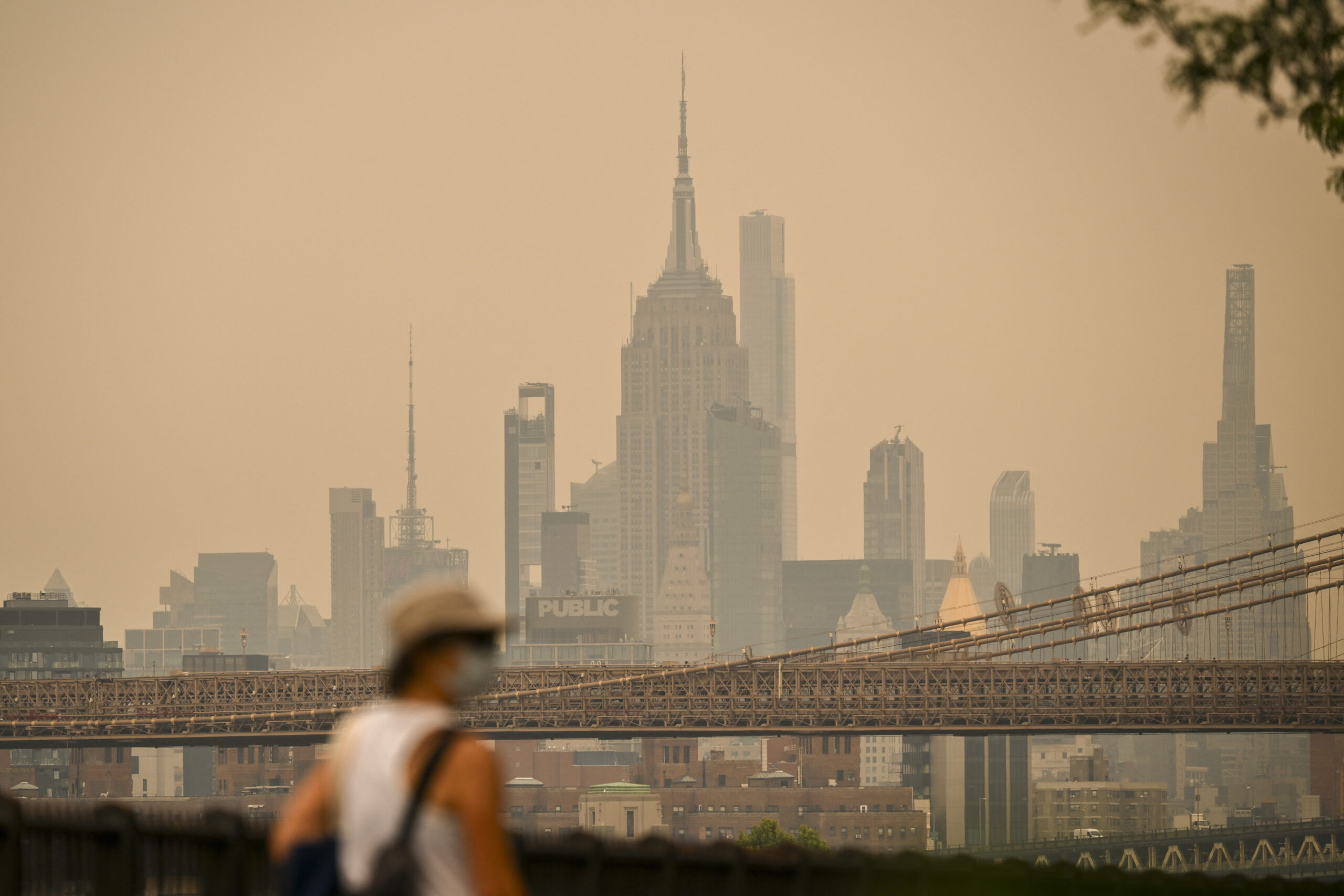
From Canada, wildfire smoke continues to spread southwards, with an estimated 109 million people in the Midwestern and Mid-Atlantic regions of the United States as well as the Northeast expected to face “unhealthy” or worse air quality by early Sunday morning (July 19).
According to The Washington Post, as of 6 a.m. on Friday (July 17), the Air Quality Index (AQI) in Detroit and Chicago surged to 447 and 404 respectively, reaching the “Hazardous” level, making them the two major cities with the most severe air pollution globally at that time.
Based on data from the air quality monitoring organization IQAir as of 6 a.m. on Friday, the AQI in Washington D.C. was 247, Toronto 225, New York City 176, all higher than Kinshasa, Democratic Republic of the Congo at 160, and Nairobi, Kenya at 142.
On Friday, a “Code Red” air quality alert was issued for most areas of Washington D.C. and Maryland, with western Maryland entering a “Code Purple” alert.
The Maryland Department of the Environment warned in a statement that a “Code Purple” air quality alert indicates that the air pollution concentration in the area is very unhealthy for the general public.
The statement pointed out that people should avoid engaging in vigorous outdoor activities or exercise to minimize the impact of air pollution.
Currently, there are over 800 wildfires burning in Canada, including 194 large fires or uncontrolled fires. So far this year, nearly 6 million acres of land have been consumed by wildfires.
The largest uncontrolled wildfire in Canada is located near Wabakimi Provincial Park in remote Ontario, covering an area of 787,802 acres.
Meanwhile, thunderstorms in Oregon, Washington, and Idaho on Thursday seemed to have sparked multiple wildfires.
Meteorologist Colin McCarthy stated, “The wildfire situation in North America has just worsened. Tens of thousands of lightning strikes hit the Pacific Northwest, sparking dozens of new wildfires in Oregon and Washington.”
The smoke from these new fires is expected to affect eastern Oregon and Washington, as well as western and northern Idaho this weekend.
On Friday morning, wildfire smoke continued to move south, covering northern Virginia, and is expected to reach Charlotte, North Carolina by Friday afternoon at the furthest.
The northeastern U.S. and New England regions temporarily escaped the smoke on Friday due to stronger winds from Quebec pushing the smoke southward.
However, by early Saturday morning, the Mid-Atlantic region is expected to still be shrouded in dense smoke, which may gradually diminish before potentially being blown back towards the Northeastern U.S. and New England regions.
A storm system moving from west to east is expected to bring rain to the affected areas on Saturday, possibly leading to severe thunderstorms.
It is reported that initially the rain may bring smoke particles from higher levels of the atmosphere down to the ground, temporarily intensifying the smell of wildfire smoke. However, as the rain continues, the droplets are likely to gradually remove the smoke particles from the air.
After the storm exits on Saturday night, the air quality in most of the eastern U.S. is expected to significantly improve.
In the Midwest, smoke in the Minneapolis area briefly eased on Friday and extended to Chicago and Detroit from Friday evening to Saturday morning. However, this period of relief may be short-lived as a new wave of smoke is expected to arrive later on Saturday.
This new smoke plume is likely to continue moving eastward on Saturday night and into Sunday, reintroducing smoke into the Mid-Atlantic and northeastern regions of the U.S.
The World Cup final is scheduled for Sunday afternoon at 3 p.m. in East Rutherford, New Jersey, with local air quality still under observation.
Western Ontario is forecasted to receive rain on Friday, Monday, and Tuesday, which may reduce the concentration of smoke in the wildfire source areas. As a result, the intensity of smoke entering the U.S. in the following days may be lower than the earlier waves this week.
Authorities recommend closing windows, reducing door openings, and using HVAC systems equipped with MERV-13 or higher-rated filters due to the poor air quality.
Official alerts state, “If you must spend time outdoors, it is recommended to wear N95 or P100 respirators marked with NIOSH.”