
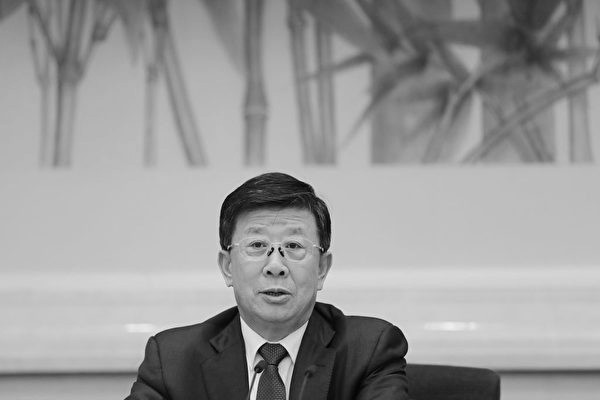
In the power struggle within the Chinese Communist Party, many former national or deputy national-level high-ranking officials have shown signs of their old allies being targeted for removal before they themselves encounter trouble. Recently, Huang Ruixue, the Vice Governor of Sichuan Province and Director of the Public Security Department, was reported to have suddenly passed away due to illness, with rumors circulating online suggesting it was a suicide. Huang Ruixue was once the “chief steward” of former Minister of Public Security, Zhao Kezhi. Additionally, Xu Liuwei, a secretary promoted by Zhao Kezhi in Guizhou, fell from grace recently.
According to a report by the official media outlet in Sichuan, “Chuanguan News,” on the afternoon of the 16th, it was announced that Huang Ruixue, the Secretary of the Party Committee and Director of the Public Security Department of Sichuan Province, passed away at the age of 54 on July 15 at 8:30 p.m. due to an unexpected illness.
A post by user “Vincent” claimed that Huang Ruixue was found dead by hanging in his office on the night of July 15, after attending a national public security bureau chief symposium and returning to Chengdu.
According to public reports, the national public security bureau chief symposium of the Chinese Communist Party was held in Nanjing from July 14th to 15th, with Wang Xiaohong, Secretary of the Secretariat of the Central Committee of the Communist Party of China and Minister of Public Security, in attendance and delivering a speech.
Hong Kong’s “Ming Pao” newspaper noted that the official obituary from the Chinese Communist Party used the expression “passed away unexpectedly,” which typically signifies a “non-natural death.”
Online commentators remarked, “If it is true, the protected bigwigs need to take care of their families.”
Public records show that Huang Ruixue, born in February 1972 in Xinyu, Jiangxi Province, previously served in the Ministry of Public Security’s Domestic Security Protection Bureau and later held various positions before his untimely death.
Wang Xiaohong assumed the position of Minister of Public Security on June 24, 2022, with Huang Ruixue subsequently being transferred to Gansu that same month.
Independent commentator Cai Shenkun suggested on a media platform that Huang Ruixue’s downfall was part of the ongoing purge of Zhao Kezhi’s former associates. He believed that after Wang Xiaohong took over the leadership of the Ministry of Public Security early, Huang Ruixue was marginalized, leading to his transfer to be the Director of Public Security in Gansu in June 2022.
Cai Shenkun also mentioned that the authorities have continuously targeted Zhao Kezhi’s old associates, with several individuals linked to Zhao facing repercussions, such as the former secretary general of Hebei Provincial Party Committee, Shang Liguang, who was arrested in September 2023 and eventually sentenced to life imprisonment for bribery in December 2024.
Cai Shenkun previously analyzed on his media program in 2024 that during Zhao Kezhi’s tenure as Minister of Public Security, his close ties with Sun Lijun could potentially lead to repercussions sanctioned by Xi Jinping through Wang Xiaohong. There were rumors circulating that Zhao Kezhi was involved in hoarding classified documents.
Furthermore, on July 16th, Xu Liuwei, a young government official who once served as the youngest county magistrate in Guizhou, was placed under investigation.
Xu Liuwei, born in June 1982 in Hong’an, Hubei Province, began his career after earning a master’s degree from Renmin University of China in 2005. He moved up the ranks holding various positions before facing scrutiny earlier this month.
When Xu Liuwei was serving as the county magistrate in Danzhai, he clashed with Wang Jianlin, the founder of Wanda Group, over profits generated by Wanda’s business in the county. Their disagreement resulted in Wang Jianlin stating that all profits generated in Danzhai should remain within the county, to which Xu Liuwei boldly responded, “If you only want to distribute profits, I can give you 500 million yuan annually without getting involved. Wouldn’t that be easier for everyone?”
Rumors suggest that Xu Liuwei’s bold stance stemmed from his connection to Zhao Kezhi during his tenure as the provincial governor of Guizhou and his familiarity with Li Zhanshu, who was the Party Secretary of Guizhou at that time.
Zhao Kezhi served as the Deputy Party Secretary and Acting Governor of Guizhou Province in August 2010 before becoming the Governor in September of the same year. He later assumed the position of Party Secretary of Guizhou Province in July 2012.
Current affairs commentator Li Linyi emphasized that while Xu Liuwei may not have been Zhao Kezhi’s personal secretary, he was at least a member supported by Zhao’s inner circle. Li pointed out that during Zhao Kezhi’s governorship, Xu Liuwei rose through the ranks from a regular secretary in the provincial government office to a deputy director, indicating he was a trusted ally left by Zhao during his time in Guizhou.
Li Linyi further highlighted that in the recent power struggles within the CCP, there have been signs of Zhao Kezhi and his former allies, including several former national or deputy national-level high-ranking officials, being targeted for removal.