
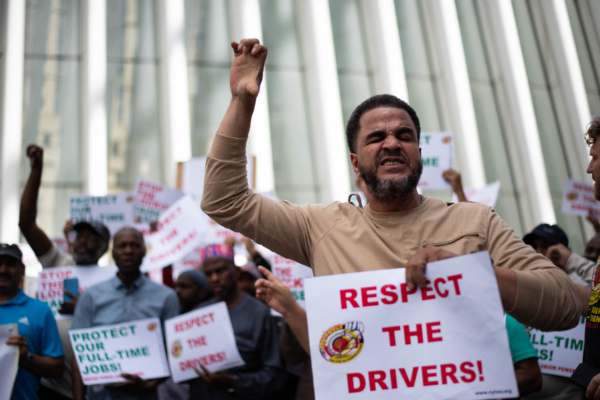
Uber and Lyft have filed a lawsuit to block the enactment of the “Just Cause Employment Law” (Local Law 52), which was heard in the Manhattan Federal Court on July 16. This law is considered a significant legislation in the United States as it formally introduces the “Just Cause” principle into the suspension system of large ride-hailing platforms, and it is currently one of the most controversial cases in the gig economy labor protection arena, directly impacting the rights of nearly 100,000 Uber and Lyft drivers in New York City.
The presiding judge, Gregory H. Woods, heard oral arguments from both sides during the trial but did not make an immediate ruling. The decision on whether the law will go into effect as scheduled on July 28 will be determined by the court in the coming days.
The focus of this trial is not to determine the legality of the 52nd Local Law but to review Uber and Lyft’s request for a Preliminary Injunction to decide whether the new law should be temporarily suspended before a final judgment is reached. If the court approves the injunction, the implementation of the law will be delayed; if the application is rejected, the new law will go into effect on the scheduled date.
During the trial, Uber reiterated that the new law would weaken the platform’s ability to swiftly suspend risky drivers and potential fraudsters, thus increasing safety risks for passengers. They also demanded that the platform provide suspension reasons, notification compliance, and an appeal process, while bearing additional burden of proof, leading to increased operational costs and management obligations. Uber argued that the city’s regulations have interfered with platform operations and contractual relationships with drivers, some of which fall within the scope of federal legal protections, hence requesting the court to suspend the law.
In response, the New York City government stated that the 52nd Local Law does not prohibit platform suspension of drivers but rather requires that any suspension must have a “just cause” or legitimate economic reason, while establishing notification and appeal procedures to prevent arbitrary suspensions without full explanation. The city government emphasized that in cases involving serious violations such as violence, harassment, fraud, or identity theft, platforms can still suspend drivers immediately, and the new law does not compromise passenger safety measures.
With the rapid growth of the gig economy, platform companies are increasingly relying on algorithms to manage drivers, including dispatching, rating, and suspension decisions. Supporters of the law believe that when suspension decisions are primarily made based on algorithms and systemic determinations, drivers often struggle to know the specific reasons and lack effective avenues for appeal, hence the need for more transparent explanation of reasons and appeal procedures; while platforms argue that increasing procedural requirements will impact management efficiency and safety risk control.
The crux of this lawsuit is not about whether platforms have the authority to suspend drivers but about whether suspensions must be based on “just cause,” and whether drivers should have basic procedural safeguards such as notification and appeal rights. This is why the 52nd Local Law has garnered national attention and is seen as a significant milestone in labor protection for platform workers in the United States, with its ruling potentially serving as an important reference for other states and cities in formulating gig economy labor protection policies.
The New York Taxi Workers Alliance (NYTWA), which supports the law, has stated that platforms have controlled drivers’ livelihoods for years, yet they have been able to suspend accounts without providing sufficient explanation or effective appeal procedures. The 52nd Local Law only seeks to establish basic procedural safeguards and does not strip platforms of their authority to maintain passenger safety. The union criticized Uber and Lyft for distorting the content of the law and emphasized that the law still allows platforms to immediately suspend drivers involved in serious misconduct.
The court is expected to rule on the injunction application before the law takes effect, and the outcome will determine whether this highly anticipated new law can be implemented as scheduled on July 28.