
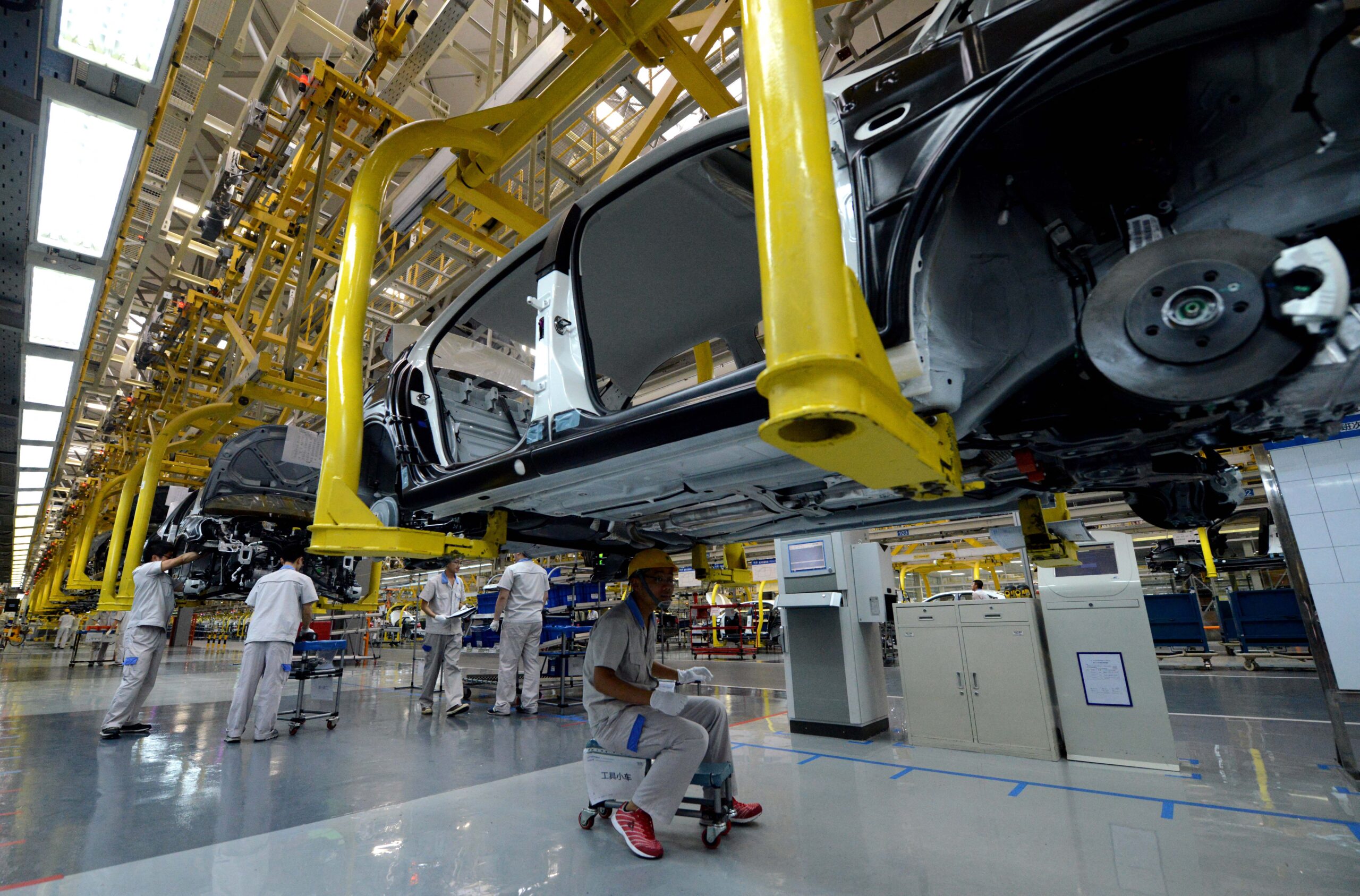
Recently, a notice issued by Changchun City specifically mentioned the prominent economic pillar “FAW-Volkswagen” experiencing a continuous decline in production and sales, putting it under restructuring pressure. Subsequently, local residents of Changchun disclosed that the frontline workshops of FAW-Volkswagen have started implementing “half-month rotational leave, with a corresponding reduction in monthly salary.” The official acknowledgment by the Chinese Communist Party (CCP) of the extreme internal competition has led to car manufacturers’ profit margins shrinking to a mere 1.5%. FAW-Volkswagen is now facing the triple pressure of internal competition, administrative challenges, and transformation.
The “Commercial Times” on June 12 revealed a document titled “Changchun City Automobile Industry Development ’15th Five-Year Plan,'” which mentioned that the automobile market has entered a stage of stock competition, with the industry’s profit margin dropping to 4.1% in 2025, below the industrial average. Under the pressure of internal competition, it is predicted that by 2030, the number of domestic car companies will decrease from 71 to around 15.
Furthermore, the report cited the views of BYD Chairman Wang Chuanfu and Huawei Terminal BG Chairman Yu Chengdong, who stated that within the next three to five years, the vast majority of marginal Chinese car companies may face bankruptcy or acquisition, possibly leaving only three to five Chinese complete vehicle enterprises that can truly survive and expand globally.
Moreover, Changchun’s official plan also uncommonly singled out the local key enterprise, FAW-Volkswagen, for its declining production and sales, which may lead to facing restructuring pressure in the future.
It is reported that in 2020, FAW-Volkswagen’s total vehicle production was 3.727 million units. By 2025, the total production plummeted to 3.307 million units, showing a decrease of 420,000 units over a five-year period, with the downward trend continuing for several years without any signs of reversal.
Furthermore, its most critical weakness has been identified as lagging behind in the transition to new energy vehicles. In 2025, the total production of new energy vehicles was 446,000 units, accounting for only 13.5% of the group’s total production.
Recently, a video circulated on Sina Weibo revealed the current situation of FAW-Volkswagen as disclosed by Changchun residents. The video mentioned that the frontline workshops have already begun implementing “half-month rotational leave with corresponding reduction in monthly salary.” Currently, the Changchun base and several subsidiary plants in Qingdao, and Chengdu have initiated rotational leave and reduced production. Due to the sharp drop in income, many employees are facing increased economic pressures related to supporting their families and paying mortgages.
Additionally, in a video segment, a staff member of a second-hand car dealership in Changchun revealed that many people have been inquiring about renting cars or buying cheaper used cars recently, with the intention of engaging in ride-hailing services. These inquiries are all related to FAW-Volkswagen’s planned implementation of “half-month rotational leave,” with many employees starting to seek alternative opportunities.
The staff member lamented, “I can’t imagine what would happen if FAW-Volkswagen in Changchun, Jilin, actually goes bankrupt. What will all these employees do?”
According to official data from Changchun City, FAW-Volkswagen has approximately 12,000 formal employees in the area. In 2025, the automotive industry in the city achieved a total output value of 443.37 billion yuan, accounting for 57.7% of the city’s total industrial output value, playing a significant role in the local economy.
On July 13th, at the China Automobile Industry High-Quality Development Summit Forum, Chen Shihua, Deputy Secretary-General of the CCP Automobile Industry Association, stated that the profit margin for complete vehicle manufacturing is only 1.5%, reaching a historical low point.
Chen Shihua admitted that the phenomena of internal competition are difficult to halt in the short term. He mentioned, “The automotive industry is in the initial stage of price restoration and has not fully emerged from the price wars. The soft demand side continues to restrain the stability of price recovery.” He also emphasized that combating internal competition is a long-term task.
Chen Shihua further stated that the prices of batteries and automotive storage chips are continuously rising, which is increasing the proportion of costs related to smart electric vehicles in the overall vehicle costs, further squeezing the profit margins of complete vehicle enterprises.
He also pointed out that the market for fuel vehicles will continue to rapidly shrink, and joint venture brands will need to make sacrifices to survive. He noted, “The penetration rate of new energy passenger vehicles exceeded 55% in June, and the market share of fuel vehicles is rapidly declining. Car companies are facing intensified competition and inventory pressure.”
In the trend of industrial transformation, FAW-Volkswagen, which still produces more than 80% of its total output as fuel vehicles, is now facing the triple pressure of internal competition, administrative challenges, and transformation.