
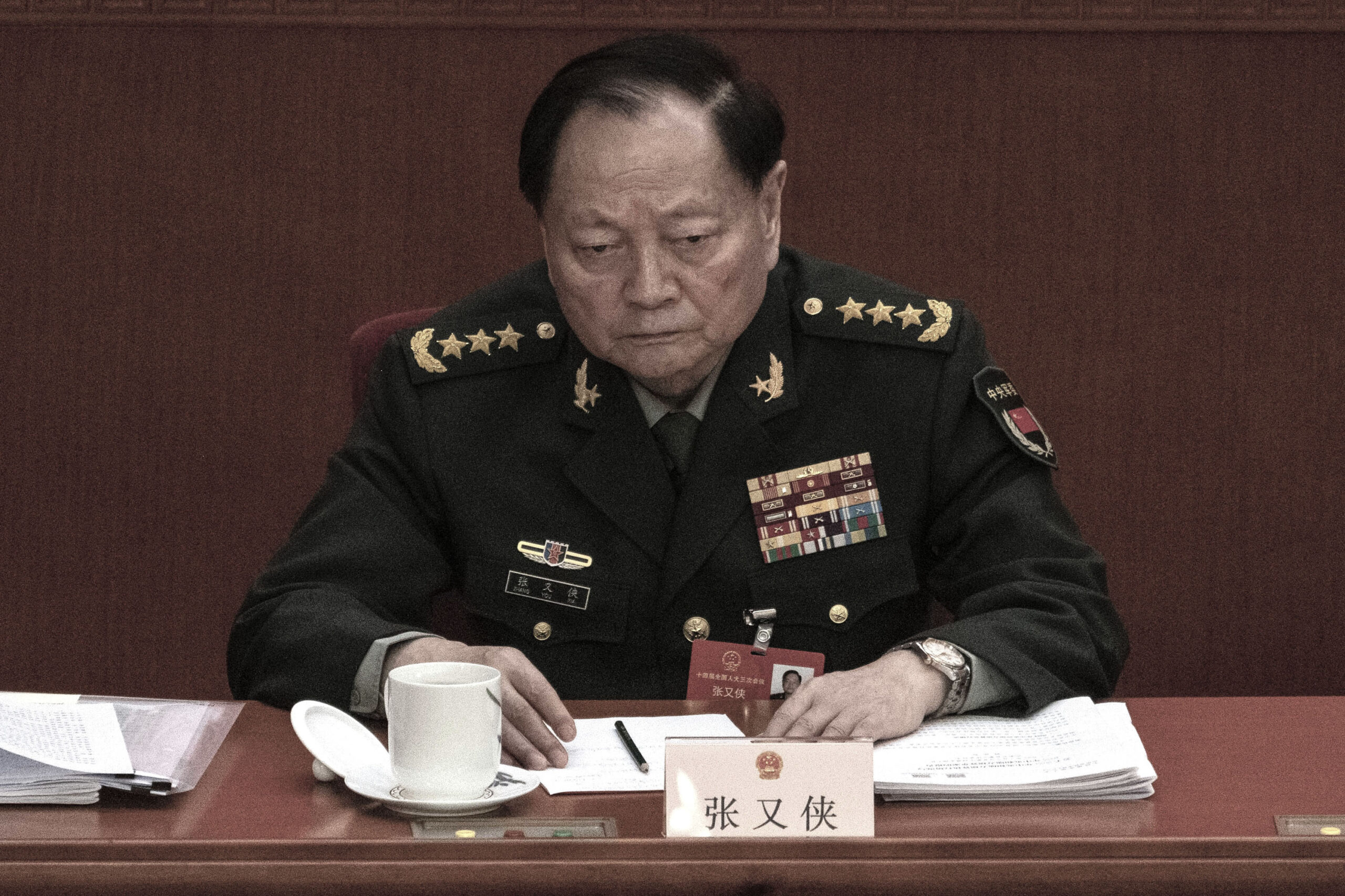
Recently, independent commentator Cai Shengkun revealed a bombshell claim that Zhang Yuxia had admitted to attempting to force Xi Jinping to relinquish power, bluntly stating that “rewriting history is just one step away.” He also cited sources saying that Zhang Yuxia had received support from Wang Qishan, Zeng Qinghong, and some party elders. At the same time, he believes that the political situation before the 21st National Congress of the Communist Party of China is still full of variables, with various factions waiting for the right moment. If a crucial event occurs, the power dynamics at the top level could change in an instant.
On July 16, independent commentator Cai Shengkun revealed during a live broadcast on his “Cai Shengkun Says” YouTube channel that he had recently received information that Zhang Yuxia had initially refused to admit to the official accusations against him, saying he “would not plead guilty or confess.”
It is reported that on January 24 of this year, the Ministry of National Defense of the Communist Party of China announced that Zhang Yuxia, a member of the Politburo of the CPC Central Committee and Vice Chairman of the Central Military Commission, and Liu Zhenli, a member of the Central Military Commission and Chief of the General Staff of the Joint Staff, were under investigation for suspected “serious violations of discipline and law.”
On January 25, the official military newspaper of the Communist Party pointed out that Zhang Yuxia and Liu Zhenli committed “seven sins.” Among them, the most crucial accusation, widely believed by outsiders, was “seriously trampling and undermining the system of the Military Commission chairman’s responsibility.” The commentary cited by Liberty Times stated that “to trample and undermine” is equivalent to declaring that Zhang’s actions were seen as “undermining Xi Jinping” and weakening the political issue of centralized unified command.
In response to these accusations, Cai Shengkun stated that the latest information revealed in the later stages of the investigation of the Zhang Yuxia case used his son as a breakthrough to coerce his cooperation. Ultimately, Zhang Yuxia changed his attitude.
According to Cai Shengkun, it was said that Zhang Yuxia has confessed to attempting to launch a coup and pressure Xi Jinping to relinquish power in a series of issues.
Regarding this, Cai Shengkun said he was “shocked,” overturning his previous belief that “Zhang Yuxia lacked the courage to oppose Xi, nor the ambition to do so.”
He believed that Zhang Yuxia not only supported Xi Jinping’s constitutional amendments but also assisted the military in fully supporting Xi Jinping’s “core status” during the 19th National Congress. After the 20th Congress, he served as the First Vice Chairman of the Central Military Commission, so he has always been considered an important ally of Xi Jinping.
The sources cited by Cai Shengkun stated that “Zhang Yuxia has clearly admitted to having a plan to press Xi Jinping,” and has received support from high-ranking CCP officials, “including Wang Qishan, Zeng Qinghong, and some party elders.” Based on this, it is believed that recent events, such as the downfall of Wang Qishan’s old associates like Zhou Liang, and rumors of Wang Qishan being under house arrest, could be related to this. As for Zeng Qinghong’s camp not undergoing a large-scale purge, Cai Shengkun cited sources saying that it was because “afterward, Zeng Qinghong timely distanced himself, and it would no longer be meaningful for Wang Qishan to do the same.”
However, Cai Shengkun stated that he cannot verify the authenticity of the above information, he was merely relaying the disclosed information.
In fact, Epoch Times published a series of reports between 2024 and 2025, analyzing that Zhang Yuxia represented an important force in the military against Xi Jinping’s excessive centralization of power. It was also argued that the successive purges of the Rocket Force, senior generals, and the Xi family army indicated growing discontent within the military. In this context, Zhang Yuxia, together with some CCP elders and military forces, attempted to hinder Xi Jinping’s re-election or weaken his military authority, even considering the possibility of a “toppling Xi” strategy.
However, in recent years, figures like Zhang Yuxia, Wang Qishan, and retired CCP elders have been closely monitored, making it nearly impossible for them to communicate. In response to this, Cai Shengkun mentioned that although retired and current senior officials are under strict surveillance, their children and others who may seem less important still have the potential to pass on messages to each other.
Cai Shengkun stated that recently, Cai Fuchao, the former Deputy Minister of the Central Propaganda Department and former Director of the National Press and Publication Administration, was arrested. His son was also taken away at the same time. Cai Fuchao was once an important associate of Wang Qishan during his leadership in Beijing, and “his son is said to be a go-between for Zhang Yuxia and Wang Qishan.”
Further analyzing the situation, Cai Shengkun pointed out that initially, Xi Jinping did not completely purge Wang Qishan, leaving behind Zhou Liang and his other associates, probably as part of a “tacit agreement” between Xi Jinping and Wang Qishan. However, if Zhang Yuxia admits to the coup attempt being true, it indicates that Wang Qishan has not completely conceded defeat and still intends to bring down Xi Jinping.
Cai Shengkun believes that even if the revelations are true, he does not think that Zhang Yuxia was initially anti-Xi, and the evolution of the current situation may have been due to a conflict of interests between Xi and Zhang in terms of military personnel authority, which led to the situation.
Cai Shengkun analyzed that before the 20th Congress, the party elders wanted Zhang Yuxia to remain as the Vice Chairman of the Central Military Commission, not to confront Xi Jinping but to ensure a smooth transition of power in the future. He believes that at that time, the consensus between the elders and Xi Jinping included:
1. Agreeing on Xi Jinping’s re-election for a second term at the 20th Congress;
2. Transferring power to Hu Chunhua at the 21st Congress;
3. Keeping Zhang Yuxia in the military to ensure the smooth completion of the future power handover.
He pointed out that Zhang Yuxia initially accepted a “protective transition” mission, rather than aiming to overthrow Xi Jinping.
Cai Shengkun argued that the real turning point came after the 20th Congress. He stated that Xi Jinping originally planned for Miao Hua to become the First Vice Chairman of the Military Commission and He Weidong to be the Second Vice Chairman. Zhang Yuxia’s continued presence was not what Xi Jinping wanted. Therefore, after the 20th Congress, Xi Jinping began a series of anti-corruption measures targeting senior military figures like Li Shangfu, the Rocket Force, and the equipment systems. Xi Jinping’s real purpose of all these purges was to gradually weaken Zhang Yuxia and ultimately force him to surrender military control.
Cai Shengkun mentioned that as Zhang Yuxia gradually realized that Xi Jinping’s true target was himself, he stopped passively waiting and began to fight back. He seized evidence implicating Xi Jinping’s military confidants like Miao Hua and He Weidong in corruption and “disrespecting Xi Jinping,” and presented the evidence to Xi Jinping, forcing him to deal with a group of his most trusted military confidants.
He believed that in the later stages, the irreconcilable struggle between Xi and Zhang for military power meant that “Zhang Yuxia not only felt in danger but was convinced that Xi Jinping was preparing to move against him.” Thus, he sought support from party elders to try to change the power structure at the time.
Cai Shengkun said that “Zhang Yuxia’s action was a passive counterattack,” as he planned to work with the “old comrades” to push for a major action that could change the political situation in China, but ultimately failed, and it’s unclear where things went wrong.
Cai Shengkun believed that from the downfall of Wang Qishan, Zhang Yuxia, to Chen Xi, it showed that even core confidants who had worked tirelessly for Xi Jinping for many years and had a close relationship may not guarantee political security. This situation would undoubtedly impact the psychology of current core staff like Cai Qi, Wang Xiaohong, Li Qiang, and Ding Xuexiang. They are both worried that loyalty may not necessarily lead to a good ending, and understanding that anyone deemed to have potential for succession could be prematurely suppressed.
Cai Shengkun acknowledged that the current situation is far from peaceful behind the scenes. Various factions are still waiting for the right moment, and there are still many variables before the 21st Congress. If a crucial event capable of igniting the situation occurs, it could trigger a chain reaction, reshuffling the top-level power of the CCP, and at that time, the political direction might not be entirely controlled by Xi Jinping alone.