
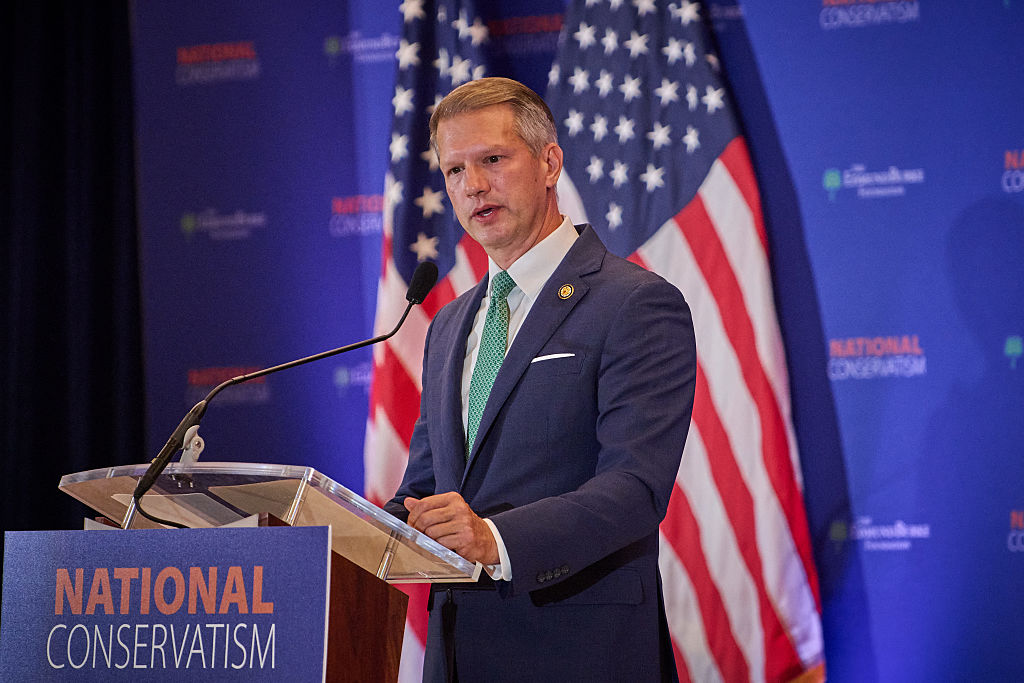
In recent days, Congressman Riley Moore (Republican) from West Virginia has voiced growing concerns about the H-1B visa program, calling it a “scam” that results in the replacement of American workers and leads to unemployment among young Americans.
In an interview with Fox News Digital, Moore expressed his frustration with the H-1B visa program, stating that many Republican colleagues also support the idea of abolishing this foreign labor program.
“I believe that the H-1B visa program is a scam that has been ongoing for far too long, harming Americans,” Moore said. “We have essentially moved all manufacturing jobs overseas, encouraging workers to learn programming. Yet, now even programming jobs are being taken over by foreign workers on H-1B visas. When will American workers truly have a chance at success?”
He lamented, “We send all our children to college, trade schools, or elsewhere to acquire advanced knowledge or prepare for employment. However, low-skilled, low-income H-1B visa holders are replacing them, leaving many young people either unemployed, working as baristas at Starbucks, or in other jobs while burdened with $200,000 in debt.”
The original intent of the H-1B visa program was to help U.S. employers recruit “highly skilled professionals with advanced degrees” from around the world, providing them with temporary work permits to fill the severe shortage of high-end labor in fields such as science, mathematics, engineering, and computer science in the U.S.
However, in practice, employers using the H-1B visa program do not have to prove to the Department of Labor (DOL) that they cannot find qualified American workers for the same job.
For most regular businesses, federal law does not mandate that they submit complete local recruitment advertisements and proof of “unavailable qualified American workers” before recruiting H-1B employees.
Last week, Microsoft’s Xbox gaming division announced the layoff of 1,600 employees, sparking controversy. Yet, this year alone, Microsoft’s parent company obtained 2,273 H-1B visas.
Moore asserted that the notion that H-1B workers are more skilled than American workers is “extremely absurd,” stating that they are brought to the U.S. solely because their wages are lower than those of ordinary Americans.
“This is a market manipulation that is unfair to American workers. It is not true free-market capitalism because the government not only issues these visas but also sets the number of H-1B visas issued. It’s clear that large corporate lobbying groups are pushing for more H-1B visas to be issued, not allowing the market to operate freely,” Moore said.
He spoke out for American workers, saying, “American workers are the only ones on earth who need to compete with labor from all over the world within their own borders. We are the only country like this, and it makes no sense. This puts all young people at a disadvantage.”
The annual regular quota for H-1B visas is 85,000, including a general quota of 65,000 open to all eligible bachelor’s degree and higher degree applicants, and a high-degree quota of 20,000 (Master’s Cap) reserved for graduates with master’s or higher degrees from U.S. universities.
Currently, the companies using H-1B visas the most include Amazon, IT consulting companies like Cognizant, Infosys, IBM, and Microsoft.
According to official U.S. and related immigration data reports, India has long been the largest beneficiary country of H-1B professional and technical work visas. Indians holding H-1B visas make up approximately 70% to 75% of the total number of visa holders. This is mainly because India has a large population of Information Technology (IT) and STEM field graduates, with many major tech companies and outsourcing consulting firms applying for and securing such visas for a significant number of Indian employees annually.
Typically, an H-1B visa is valid for three years and can be extended, for a maximum total of six years. Before the end of the six years, if the employer is willing to provide sponsorship, the H-1B visa holder can apply for an employment-based green card. According to data from the U.S. Citizenship and Immigration Services (USCIS), 80% of H-1B visa holders have successfully applied for employment-based green cards, gaining permanent resident status.
(Reference: FOX NEWS report)