
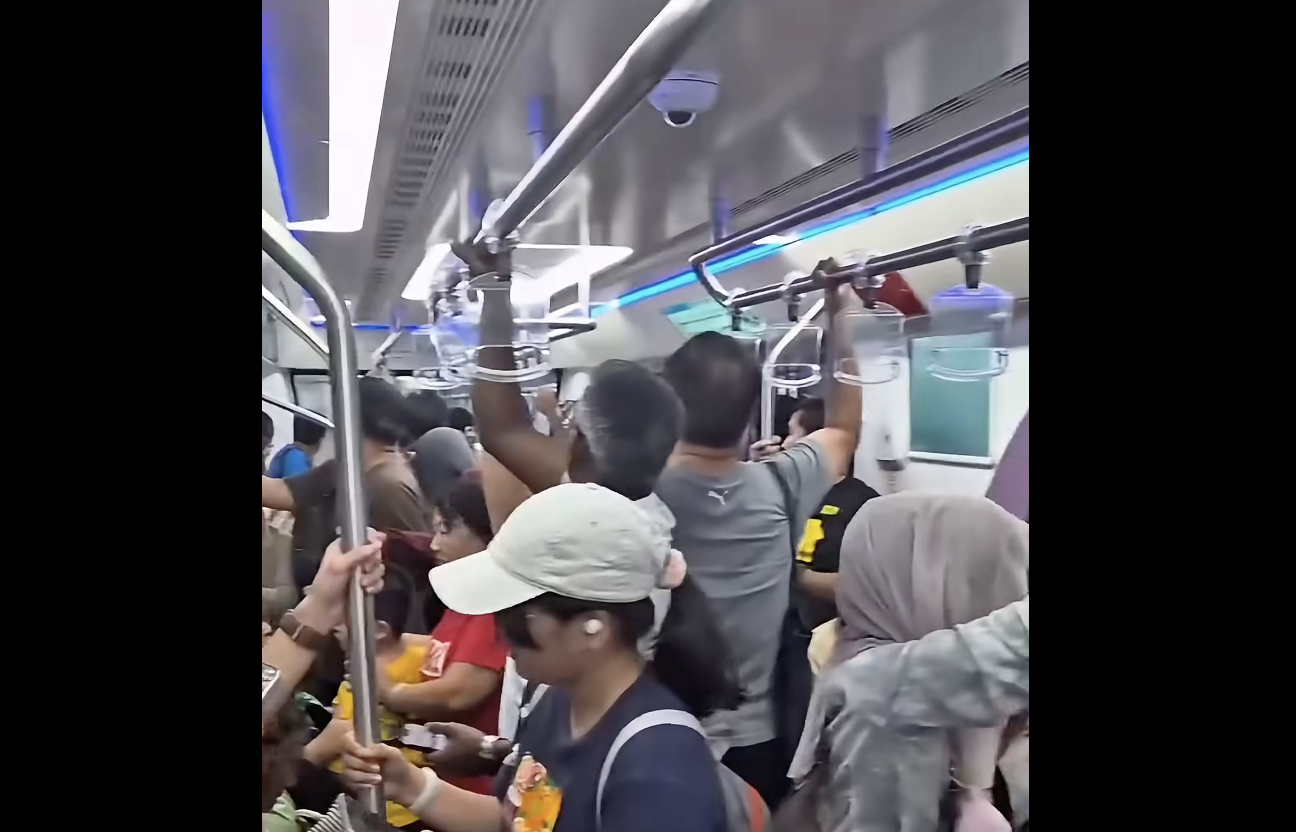
On July 5th, the third line of the Sa Anan Light Rapid Transit (LRT3) operated by Rapid KL in Kuala Lumpur, Malaysia, experienced a train incident during its inaugural week. The train suddenly stopped, accompanied by bursting sounds and sparking, leading passengers to evacuate and switch to another train to continue their journey. These trains were manufactured by the Chinese state-owned enterprise CRRC.
It wasn’t until July 14th that the operator Rapid KL confirmed the train incident on the LRT3 during its first week of operation, attributing it to contact between train parts and power conductors causing minor bursting sounds and sparks.
According to official statements, the affected train was immediately taken out of service after the incident, causing no injuries to anyone.
Prior to the incident, a Malaysian netizen shared their first experience on the LRT3 on Facebook. They boarded the train at the Sa Anan Sports Complex station heading to Bandar Utama station on July 5th at 7 p.m. The train was full of passengers.
In a video, the train abruptly stopped on its way to Kerjaya station, then resumed after 2 minutes. However, after passing the Bai Sha Luo Yi Da Man station, another explosion-like sound was heard, accompanied by visible smoke outside the windows, causing panic among passengers.
Upon arriving at the next station, all passengers were instructed to disembark and board another train to continue their journey. The video captured the rear of the train emitting sparks as it departed the station.
Public records show that the Sa Anan Light Rapid Transit Line (LRT3) spans 37.8 kilometers, connecting Johan Setia and Bandar Utama, with a total project cost of approximately 16.3 billion Malaysian Ringgit.
The LRT3 officially commenced operation on June 29th, and on July 1st, Malaysian Chinese media widely publicized that all 22 trains on the LRT3 were “Made in China.” Reports highlighted the strong presence of Chinese elements in the LRT3, celebrating it as a successful collaborative effort in rail transport between Malaysia and China.
It was reported that all 22 three-car light rail trains put into operation were manufactured by China CNR Corporation Ltd. (CRRC ZELC). The LRT3 project marked the sixth train order in Malaysia for CRRC ZELC and became the first overseas driverless light rail line led by a Chinese company.
In addition to train manufacturing, multiple Chinese companies, including China Energy Construction Group, were also involved in the project’s construction.
In recent years, as part of its “Belt and Road” initiative, China has faced negative cases of exporting substandard projects through state-owned enterprises. Chinese train manufacturers, including CRRC, have received criticism in Malaysia before.
On August 4, 2025, technical issues were reported with the Aerotrain shuttle at Kuala Lumpur International Airport (KLIA), as the train doors failed to close properly, triggering an automatic safety mechanism that caused a 15-minute disruption on the shuttle line, forcing passengers to temporarily switch to buses.
The new generation Aerotrain at KLIA was also manufactured by CRRC.
CRRC has been aggressively expanding into the Southeast Asian market in recent years, with the Bukit Panjang Light Rail Transit in Singapore also adopting new train models produced by CRRC. However, issues arose shortly after the trains’ delivery in 2024, requiring them to be sent back to China for modifications.
Chinese companies often secure projects in international bidding due to subsidies from the Chinese government, enabling them to offer lower prices. However, quality assurance may be compromised after winning contracts with low bids.
On April 21, the European Commission stated that CRRC, selected for the construction of Lisbon’s new metro line, received “substantial support and subsidies” from the Chinese government, which disadvantaged other bidders. As a result, CRRC had to withdraw from the Lisbon metro contract under pressure and was replaced by a Polish company.
Back in 2024, CRRC reportedly offered an extremely low bid of 115 million Euros, 14% lower than the Swiss company Stadler Rail, for another metro project in Lisbon, but Stadler Rail eventually won the contract.
Following an investigation by the European Commission in March 2024 into alleged Chinese government subsidies to CRRC, the company withdrew from a 665 million USD train procurement tender in Bulgaria. This was later confirmed by the European Commission.
It is believed that CRRC Qingdao Sifang Co., a subsidiary of CRRC, submitted a bid with unfair advantages by relying on government subsidies, attempting to win the electric train procurement tender in Bulgaria.
The Bangkok Pink Line Light Rail System, also produced by CRRC Puzhen Alstom Transportation Systems Limited, experienced rare incidents towards the end of 2023 and the beginning of 2024. These incidents included steel tracks falling from an elevated bridge, damaging parked cars below, and a train wheel detaching from a Thai Pink Line monorail train, hitting a taxi.
The monorail in Bangkok is manufactured and provided by CRRC Puzhen Alstom Transportation Systems Limited.